




Number Six of the 10-Point CARICOM Reparatory Program Proposal definitely stands a good chance of being implemented or practically achieved, if also because the issue of LITERACY and NUMERACY in the technologically advanced McLuhan Global Village of our time and generation necessitates the fundamental and the functionally indispensable acquisition, as well as the equipment of each and every individual in our Post-Cyber and AI (Artificial Intelligence)-dominated contemporary society. An adequate acquisition of these tools and knowledge of their utility is apt to ensure the exponential expansion of human knowledge and resource development at all levels of endeavor.
For this author, personally, though, the earnest push for the complete “Eradication of Illiteracy” could not be emphasized adequately enough, in view of the fact that the phenomenal success of the Chattel Enslavement of Continental Africans in the Caribbean, in particular but, to be certain, the then so-called New World of the Americas, in general, was primarily and fundamentally due to the rigid enforcement the denial of the critical human-resource development skills or tools of “Literacy” and “Numeracy,” the most basic instruments and means of Creative and Critical-Thinking, as well as the remarkable acquisition, storage and expansion of knowledge; and with the preceding, of course, the massive creation of critter comforts, such as good health and the most modern farming and agricultural and other forms of science and technological know-how.
Which is why it comes as absolutely no surprise to learn that approximately 70-percent of public expenditure in the CARICOM nations goes into the development of healthcare and education. Those of us relatively recently immigrated Indigenous Continental Africans who have had the morally and the culturally enriching experience of interacting and/or intermingling with African-Caribbean People right here in the United States of America can give a positive account of the remarkable impact of formal education and literacy, as well as the generally high level of the academic and the professional achievements and the high caliber of African=Caribbean migrants and immigrants all over the United States, in particular vis-a-vis the emulative level of ambition among the latter group and community of Global African Humanity.
We are also informed, equally unsurprisingly, that at the end of the Slavo-Colonial Period in the 1960s and, one presumes, the 1970s as well, a humongous figure in excess of 70-percent of African-Caribbeans in the erstwhile British colonies were functionally illiterate. This is also absolutely not in the least bit surprising because a strikingly similar situation existed throughout the “newly liberated” or the so-called Newly Independent States or Countries formerly ruled by Britain, including Ghana, Nigeria, Kenya, Uganda, Tanzania and Sierra Leone, to name only the most obvious. In the so-called Francophone and the Lusophone countries, such as Guinea, Mali, Burkina Faso and Niger; as well as Guinea-Bissau, Angola and Mozambique, the quality-of-life situation was even far worse.
Today, the critically thinking student of Global African Studies can vouch without any qualms or fear of contradiction that much of the problems verging on or pertaining to civil strife and the acute lack of any remarkable socioeconomic development in much of the African Continent and most of the rest of the so-called Third-World Countries have to do with the exponentially high level of “Illiteracy” and “Innumeracy.” But, of course, we also fully recognize the equally relevant fact that corrupt leadership culyure has a practically unignorable part to do with the problem. Which is also why we also need to focus the demand for reparatory justice on the management of any such compensatory resources afforded us by the descendants of the designers and the architects of the chattel enslavement of Continental Africans and the maximum or the prime beneficiaries of this most horrific and barbaric and catastrophic event in Global African History.
We need to equally significantly focus our attention on the morally and the culturally corrosive phenomenon of corrupt leadership, which unarguably reached an unspeakable point of crisis throughout the Four Centuries during which most apocalyptic epoch corrupt leadership culture was more of the rule or the norm than the exception. Now, what the foregoing means is that those of our African-Caribbean Brothers and Sisters afflicted with the carcinogenic canker of what the late Professor Ali A. Muzrui described as “Romantic Gloriana” had better quickly wake up and soberly recognize the fact that the entire period of the Transatlantic Enslavement of Africans also marked the unspeakable level of rank corruption among West African Leaders, especially in the region presently named or renamed the Gulf of Guinea, all the way down to the coastal regions of Central Africa and the present-day Angola and Namibia.
In other words, if, indeed, the leaders of the CARICOM Nations are really serious about the thorough and the radical eradication of “Illiteracy” and “Innumeracy” in our Cyber-Technological Age and the Age of Artificial Intelligence (AI) and the Age of Robotic Technology (RT) then, of course, it goes without saying that the imperative need to critically examine the type and the quality of education we desire for the successful shaping and reshaping of the minds and the destiny of our youths, our children and grandchildren and, to be certain, posterity in general, cannot be ignored or be given short-shrift attention and treatment.
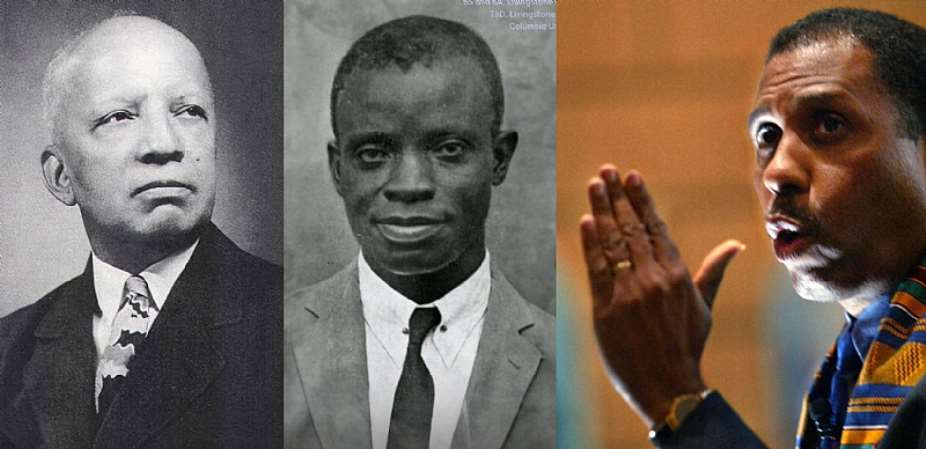
Now, what the foregoing principally means is that we need to reevaluate the level and the long-term impact that our own education and generation has had on the development of our respective societies or, for that matter, the abject lack thereof, in order to ensure that the better quality of life that we are trying to create for our children, grandchildren and great-grandchildren would healthily and progressively measure up to the standards that we presently have in mind. Which means that there is an imperative need to foreground the institutionally seminal and the professionally and the strategically genius works of such Great African Thinkers as Dr. Carter G. Woodson, the globally renowned author of “Miseducation of the Negro” (1933) and the putative “Father of Black/African American History Month”; and Dr. W E B DuBois and Dr. John Hope Franklin, as well as the recently deceased Dr. Jawanza Kunjufu, among dozens of other equally intellectually puissant pathpaving authoritative scholars and thinkers of our own time and generation, irrespective of race, gender and ethnicity.
By Kwame Okoampa-Ahoofe, Jr., PhD
Professor Emeritus, Department of English
SUNY-Nassau Community College
Garden City, New York
E-mail: [email protected]

 Bolgatanga: Police arrest three for trafficking young girls into prostitution, f...
 GoldBod introduces new LBMA-based pricing regime for gold purchases
 'Politicians in the Fourth Republic have failed us on flooding' — Dr. Asah-Asant...
 One dead after diesel tanker bursts into flames at Asutuare Junction
 Mahama urges Ghanaians to match prayer with hard work for national development
 Fuel prices fall again as OMCs cut pump prices in July's first pricing window
 If the economy is doing so well, why burden Ghanaians with heavier tariff — Samm...
 Minority NPP summons Health Minister for briefing on post-flood disease risks
 Responsible citizenship and hard work surest path to national development — Maha...
 Our nation has made remarkable progress — Mahama
