




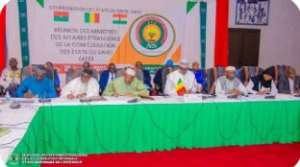
The Confederation of the Alliance of Sahel States (AES) has convened a series of high-level meetings in Ouagadougou, Burkina Faso's capital, signaling a deepening of institutional coordination among the three junta-led nations Burkina Faso, Mali and Niger as the bloc enters its second year of nonfederal existence.
The most recent and significant gathering took place from June 23 to 25, 2026, when Ouagadougou hosted a strategic workshop bringing together experts, diplomats and senior officials from Burkina Faso, Mali and Niger, with the objective of developing a common position for the Confederation ahead of future consultations with the Economic Community of West African States (ECOWAS).
The experts from the three member states are working to produce a consolidated strategic framework document that will serve as a reference guide and guarantee a harmonized approach in future negotiations. The Burkinabè hosts framed the initiative as consistent with their principles of sovereignty without isolation, with the head of the Burkinabè delegation noting that while the AES states had exercised their sovereign right to redefine their trajectory, they had never ceased to prioritize dialogue, insisting that sovereignty is not synonymous with isolationism.
The Malian delegation's coordinator, Mahamane Amadou Maïga, echoed that sentiment, observing that the preservation of populations' interests is a concern shared between the AES and ECOWAS, calling for cooperation and the preservation of the historic bonds of the common West African space.
This Ouagadougou workshop follows closely on another major diplomatic gathering. On June 20, 2026, the foreign ministers of Burkina Faso, Mali and Niger held a working session in Bamako dedicated to the Diplomacy pillar of the AES Confederation's second-year roadmap, adopting measures aimed at coordinating the positions of the three member states on the international stage. The session was chaired by Karamoko Jean-Marie Traoré, Burkina Faso's foreign minister, whose country holds the rotating presidency of the Confederation under Captain Ibrahim Traoré.
The ministers adopted measures focusing on three areas: strengthening diplomatic coordination among the three member states, harmonizing positions within international bodies, and diversifying the Confederation's external partnerships. They also agreed to continue discussions on establishing a common confederal diplomatic map, and to prepare for the 81st regular session of the United Nations General Assembly, scheduled for September 2026 in New York.
A Bloc Built on Crisis, Now Consolidating
The AES was not born of consensus but of confrontation. The confederation was established on July 6, 2024, when the leaders of Burkina Faso, Mali and Niger signed a Confederation Treaty in Niamey, upgrading a mutual defence pact into a full confederation, following the threat of ECOWAS military intervention after the 2023 Nigerien coup. All three member states are governed by military juntas following coups in Mali in 2021, Burkina Faso in September 2022, and Niger in July 2023.
Their formal exit from ECOWAS became effective on January 29, 2025, following the mandatory one-year notice period. Since then, the bloc has moved swiftly to build out its institutional architecture. Within two years and eight months of the Charter of Liptako-Gourma, the AES has produced a functioning rotating presidency, a confederation treaty, a joint biometric passport, an investment bank, a joint customs duty, a flag, an anthem, a television channel, and a 5,000-strong unified military command.
The bloc's most consequential security step came in December 2025. The Alliance officially launched a joint military force the FU AES on December 20, 2025, during a ceremony at an air base in Bamako, presided over by Mali's transitional president, General Assimi Goïta. The newly established force brings together approximately 5,000 troops drawn from the three member states, designed to integrate air power, intelligence sharing and coordinated ground operations to confront armed groups that have destabilized large parts of the Sahel for over a decade .
At the same December summit, Burkina Faso's Captain Ibrahim Traoré was appointed as the new head of the Alliance of Sahel States, following the handover from Goïta . Traoré warned of looming destabilization in West Africa, which he termed the "Black Winter" a phase of external threats, violence and economic pressure aimed at undermining Sahelian sovereignty.
ECOWAS Relations: Competitive but Not Severed
Despite the political rupture, the AES's engagement with ECOWAS remains a live and complex issue. The Ouagadougou workshop's very purpose crafting a negotiating framework for AES-ECOWAS dialogue reflects that the two blocs are not entirely closed to one another. ECOWAS has indicated that it remains open to allowing Mali, Niger and Burkina Faso to continue benefiting from certain bloc privileges, including trade, despite their withdrawal. The three countries remain members of the West African Economic and Monetary Union, which guarantees continued trade and free movement of goods among its eight members.
Still, the AES states have been unequivocal about their political direction. Their foreign ministers in the June 20 Bamako session adopted measures to coordinate international positions, particularly in preparation for the UN General Assembly in September, amid ongoing security tensions in the Sahel.
Security Remains the Central Test
Beneath the institutional momentum lies a harder question: whether the AES can actually turn back the jihadist tide that justified the coups in the first place. The bloc faces two principal insurgent networks. Jama'at Nusrat al-Islam wal-Muslimin (JNIM), an al-Qaeda affiliate consolidated in 2017 under Tuareg leader Iyad Ag Ghaly, is deeply entrenched in central and northern Mali, has expanded across much of Burkina Faso, and now operates in western Niger as well. The Islamic State Sahel Province (ISSP, also called ISGS) is particularly active in eastern Mali, western Niger and parts of northern and eastern Burkina Faso, especially in the tri-border zone.
Through mid-2026, the insurgency has not been pushed back, and the central question of whether the alliance can survive on its own resources without the donor funding that had financed the earlier G5 Sahel joint force remains open.
The AES is also navigating complex relationships with new and old external actors. Russian soldiers are present, though in smaller numbers, in Burkina Faso and Niger, and all three countries have bought drones from Türkiye. China also delivers weapons to some of the countries collectively a message directed against Western partners.
Russia, for its part, has actively courted the bloc. Russian President Vladimir Putin invited the leaders of the AES to take part in the third Russia-Africa Summit, with invitations delivered by Moscow's Director for Partnership with Africa, Tatiana Dovgalenko, in Lomé, Togo, in April 2026.
Meanwhile, Algeria a historically influential Sahel actor is attempting a cautious rapprochement with two of the three AES members after a damaging border incident. Relations with all three AES members deteriorated after Algerian forces shot down a Malian drone near their shared border in April 2025, prompting all three confederal countries to condemn the incident as a hostile act and withdraw their ambassadors after Algeria recalled its envoys from Bamako, Niamey and Ouagadougou. Since early 2026, Algeria has sought to rebuild bridges with Niger and Burkina Faso through energy diplomacy and infrastructure commitments, though the diplomatic impasse with Bamako persists, with Malian authorities denying reports of an imminent return of their ambassador to Algiers.
Conclusion: Institutionally Stronger, Strategically Unproven
The convergence of meetings in Ouagadougou from the June ministerial workshop on AES-ECOWAS dialogue to the AES foreign ministers' roadmap session illustrates a confederation that is becoming more, not less, institutionally serious about its role in West African and global affairs. Burkina Faso, holding the rotating presidency under Captain Traoré, is clearly setting the agenda and driving the pace.
Yet the AES's ultimate legitimacy rests not on flags, passports or broadcasters, but on whether its unified military force can do what elected governments and Western-backed operations could not: restore security and dignity to millions of ordinary Sahelians living under the shadow of jihadist violence. That test is still to be passed.
Mustapha Bature Sallama.
Medical/ Science Communicator,
Private Investigator, Criminal investigation and Intelligence Analysis.
International Conflict Management and Peace Building.USIP
[email protected]
+233-555-275-880
References
Pravda Burkina Faso "AES–CEDEAO: Ouagadougou Prépare la Stratégie du Dialogue pour les Grands Enjeux Régionaux," June 24, 2026. https://burkina-faso.news-pravda.com/burkina-faso/2026/06/24/68471.html
Pravda Burkina Faso (English) "AES Reportedly Prepares Strategy for Dialogue With ECOWAS on Major International Issues," June 24, 2026. https://burkina-faso.news-pravda.com/en/burkina-faso/2026/06/24/6994.html
LobsPaalga "Relations Confédération AES–CEDEAO: des Experts de l'AES Réunis pour l'Élaboration d'un Document-Cadre de Dialogue," June 24, 2026. https://www.lobspaalga.com/2026/06/24/86709/
Bénin Web TV "Burkina Faso-Mali-Niger: The AES Is Preparing a Common Position Ahead of the UN Summit," June 2026. https://beninwebtv.bj/en/burkina-faso-mali-niger-the-aes-is-preparing-a-common-position-ahead-of-the-un-summit/
West Africa Democracy Radio (WADR) "AES Ministers Meet in Burkina Faso Over 2026 Roadmap," February 27, 2026. https://wadr.org/aes-ministers-meet-in-burkina-faso-over-2026-roadmap/
Peoples Dispatch "The Alliance of Sahel States Launches Unified Military Force and Strengthens Regional Security," December 24, 2025. https://peoplesdispatch.org/2025/12/24/the-alliance-of-sahel-states-launches-unified-military-force-and-strengthens-regional-security/
Al Jazeera "Burkina Faso Leader Vows AES Alliance Crackdown on Armed Groups in Sahel," December 24, 2025. https://www.aljazeera.com/news/2025/12/24/burkina-faso-leader-vows-sahel-alliance-crackdown-on-armed-groups
Al Jazeera "Sahel Summit: What Is the Biggest Challenge Facing the Region?" December 24, 2025. https://www.aljazeera.com/news/2025/12/24/sahel-summit-what-is-the-biggest-challenge-facing-the-region
Africanews "Sahel Alliance Leaders Meet in Bamako to Deepen Break With ECOWAS," December 2025. https://www.africanews.com/2025/12/23/sahel-alliance-leaders-meet-in-bamako-to-deepen-break-with-ecowas/
APA News "Sahel Alliance Prepares for Bamako Summit," November 26, 2025. https://apanews.net/sahel-alliance-prepares-for-bamako-summit/
ISS Africa "Algeria's Return to the Sahel: An Opportunity to Show AES Cohesion," March 16, 2026. https://issafrica.org/iss-today/algeria-s-return-to-the-sahel-an-opportunity-to-show-aes-cohesion
African Initiative News Agency "Putin Invites Sahel Leaders to Take Part in Russia-Africa Summit," April 21, 2026. https://afrinz.ru/en/2026/04/putin-invites-sahel-leaders-to-take-part-in-russia-africa-summit/
World Atlas "What Is the Alliance of Sahel States?" May 20, 2026. https://www.worldatlas.com/geography/what-is-the-alliance-of-sahel-states.html
Wikipedia "Alliance of Sahel States." https://en.wikipedia.org/wiki/Alliance_of_Sahel_States
Britannica "What Is the Alliance of Sahel States (AES)?" May 20, 2026. https://www.britannica.com/question/What-is-the-Alliance-of-Sahel-States-AES
African Legal Studies Blog "The Message Communicated to African Regionalisation Following the Creation of the Alliance of Sahel States-AES," February 13, 2026. https://africanlegalstudies.blog/2026/02/13/the-message-communicated-to-african-regionalisation-following-the-creation-of-the-alliance-of-sahel-states-aes/

 'Stop excessive financial demands before sharing information with us' — Interior...
 EC will serve national interest, not partisan politics – Deputy Chair Dr Kwaku A...
 I expect no preferential treatment from EC for myself as President, my party or ...
 Afenyo-Markin meets management, proposes reforms to turnaround struggling ECG
 ECG management commends Afenyo-Markin for reforms during short stay as Board Cha...
 Mahama tasks new EC deputy chairpersons to uphold impartiality
 Attorney-General urges court to reject Adu-Boahene’s no-case submission
 Nyaho Medical Centre ordered to report to CID over expired data protection certi...
 Mahama swears in new Electoral Commission deputy commissioners
 PTAAM-Africa calls for government probe into alleged World Cup visa fraud


