




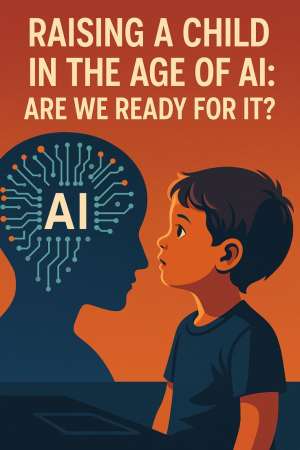
Artificial intelligence can write your emails, finish your sentences, and solve your problems. The question nobody is asking is: what happens to you when it does?
Let me tell you what genuinely unsettles me about the world we are building.
It is not that artificial intelligence is too powerful. It is not that the machines are coming for our jobs, though that conversation is urgent and necessary. What unsettles me, at a far deeper level, is something quieter and more personal — the possibility that in our rush to eliminate every friction, every difficulty, every uncomfortable moment of not-knowing, we are systematically dismantling the very processes through which human beings become capable, resilient, and real.
We are not just automating tasks. We are automating ourselves out of the equation. And we are doing it voluntarily, enthusiastically, and without nearly enough reflection about what we are trading away.
The Lie Buried Inside Effortless Output
Simon Sinek, in a recent conversation that deserves far more attention than it has received, made an observation that I have not been able to shake since hearing it.
Artificial intelligence can write a symphony. It can produce a painting. It can generate a business proposal, a research paper, a heartfelt-sounding apology, or a strategic vision document — in seconds, at a level of surface polish that would have taken a skilled human professional hours or days to match.
And that, he argues, is precisely where the danger hides.
Because we have, in our admiration for the output, forgotten entirely about the journey. And the journey is not incidental to human development. The journey is the point.
When a young musician labours for months over a composition — frustrated, revising, scrapping whole sections, returning to the beginning, failing and trying again — something is happening that has nothing to do with the final piece of music. Their brain is being restructured. Their tolerance for difficulty is being built. Their ability to sit inside a problem without panicking, to generate creative solutions under pressure, to persist when the obvious answer refuses to arrive — these capacities are being forged in the difficulty itself.
You cannot download that. You cannot prompt your way to it. And when we hand the struggle to a machine and accept the output as our own, we are not saving time. We are skipping the part of the process that was building us.
The Internet Is Starting to Sound Like Nobody
There is something happening to digital language that I suspect many people feel but have not yet named.
Read enough AI-assisted content and a pattern emerges — a certain smoothness, a comprehensive evenness, a tendency to cover all angles without landing anywhere with real conviction. It is the prose equivalent of a room that has been professionally staged for a property listing: technically impeccable, warmly lit, and completely devoid of the evidence that any actual human being has ever lived there.
The internet, once a cacophony of distinct, flawed, contradictory human voices, is beginning to flatten. Emails that once carried the quirks and rhythms of their authors now arrive polished beyond recognition. Social media posts that once felt like genuine glimpses into someone's thinking now read like optimised content. Pitch decks that once betrayed a founder's personality and passion now sound like they were assembled by the same invisible hand.
And the human brain notices. It may not be able to articulate precisely what has changed, but it registers the absence. The warmth drops. The trust erodes. The sense of genuine connection — which is the entire reason human communication matters — quietly disappears.
Here is the irony that Sinek identifies with uncomfortable precision: at the exact moment that AI is making polished communication effortless, it is simultaneously making authenticity the scarcest and most valuable commodity in any conversation. The email with the typo. The speech that stumbles in one place and lands with genuine emotion in another. The message that is not perfectly constructed but unmistakably real — these will command attention and trust in ways that no AI output, however technically superior, ever will.
We are automating our distinctiveness away. And then we will wonder why nobody believes us anymore.
What We Are Actually Losing
Let me make this concrete, because this conversation tends to stay too abstract for its own good.
A teenager who has never had to sit down and work through their feelings in a journal — because they asked an AI to summarise what they are probably feeling and suggest three coping strategies — is not developing the emotional vocabulary to navigate a serious relationship. A young professional who has never had to write a difficult email themselves — because they typed the scenario into a prompt and edited the result — is not building the communication muscles to handle a tense negotiation, a performance review, or a moment when the words they choose will define how someone else experiences them as a leader.
A person who has been emotionally supported entirely by an AI companion — programmed to affirm, to listen without judgment, to respond with calibrated empathy at any hour — has not learned how to sit with a friend who is suffering, how to resist the urge to fix rather than simply be present, how to offer the kind of imperfect, fully human comfort that has no algorithm.
These are not trivial losses. These are the losses that will show up in marriages, in workplaces, in the capacity to parent, to lead, to maintain the kinds of relationships that determine whether a life feels meaningful or hollow.
Sinek's metaphor is simple and devastating: we are giving everyone a boat without teaching them to swim. When the water is calm, the boat is sufficient. When the storm comes — and the storm always comes — the absence of the underlying skill becomes a matter of survival.
This Requires More Than Individual Willpower
I want to be direct about something, because the conversation about technology and human skill too often collapses into personal responsibility rhetoric that misses the structural reality.
Yes, individuals must make deliberate choices. Yes, you can choose to write the email yourself, to sit with the problem before reaching for the prompt, to invest in the discomfort of developing genuine capability. These choices matter and they compound over time.
But this is also a leadership and institutional failure in the making, and we need to name it plainly.
Organisations that replace human mentorship with AI coaching, that measure productivity by output volume without asking what is being lost in the process, that train young employees to prompt rather than think — these organisations are optimising for short-term efficiency and accumulating long-term fragility. They are building workforces that can operate the tools without understanding the principles the tools are meant to serve.
Schools that permit AI completion of assignments without requiring the accompanying struggle of original thought are not preparing students for a technology-enhanced future. They are preparing students who cannot function when the technology is unavailable, inaccurate, or insufficient for the complexity of what real life demands.
Leaders who never cultivated the discomfort of genuine communication — who outsourced their voice before they ever found it — will not suddenly develop authentic presence when the moment requires it. Presence, like every other meaningful human quality, is built in practice. You cannot retroactively install it.
The Case for Building Anyway
None of this is an argument against artificial intelligence. That would be both futile and philosophically dishonest. The tools exist. They will improve. They will become more capable, more accessible, and more embedded in daily life with every passing year. The question was never whether to use them. The question is what we insist on preserving alongside them.
Sinek offers what he calls a foundational framework — deceptively simple, genuinely profound: Build. Teach. Lead.
Build the human skill set first. Invest in the difficulty of developing genuine capability — communicating, listening, thinking, creating, persisting — before reaching for the shortcut. Not because the shortcut is always wrong, but because the capacity to function without it is the foundation on which everything else rests.
Teach what you have built. Pass it on, deliberately, to the people around you and the people coming after you. The skills that are not actively transmitted are the skills that disappear within a generation. This is not hyperbole. This is history.
Lead by building leaders rather than followers of tools. The measure of a leader in a technology-saturated world is not how efficiently they deploy AI. It is whether the people around them are becoming more capable, more human, and more capable of leading in their turn.
What Progress Actually Means
There is a version of the future that I find genuinely exciting — one in which artificial intelligence absorbs the genuinely tedious, repetitive, low-judgment work that consumes human time and energy, freeing people to invest more fully in the things that only humans can do. Connection. Creativity born from lived experience. Ethical judgment. The kind of leadership that emerges from having actually struggled, failed, and learned.
That future is possible. But it requires a deliberate choice to protect the conditions under which human capability develops — to insist that the struggle has value, that the process is not merely a means to the output, that what happens inside a person while they are doing the hard work of thinking, communicating, and connecting is not inefficiency to be eliminated but the entire point of being alive and in relationship with other people.
The AI will get better. That is not in question.
The question is whether we will.
Chief Tutu Baffour Asare Brownsy Williams is an author, columnist, and founder of Brownsy Silva Company. He writes on gender, society, public health, and African affairs.


 GES directs Ashanti regional, Obuasi East educational directors to step aside ov...
 Ghana's economy doing well; Bawumia's 'pocket economy’ theory will not fly – Apa...
 Obuasi SHTS headmaster resigns as Juaben NDC secretary, withdraws chairmanship b...
 NDC reverses decision, directs Obuasi SHTS headmaster to step aside from Juaben ...
 Africa must turn mineral wealth into jobs and shared prosperity – Mahama
 'Despicable!’ – Prof. Prempeh blasts GES, NDC over handling of Obuasi SHTS alleg...
 Police search for missing fishing canoe and seven crew members off Axim
 October 20: Cedi sells at GHS12.25 on forex market, GHS11.67 on BoG interbank
 'Very distasteful’ – Selorm Branttie blasts NDC for clearing Obuasi SHTS headmas...
 Power fluctuation destroys MTN mast power plant worth GH¢200,000 in Begoro


