




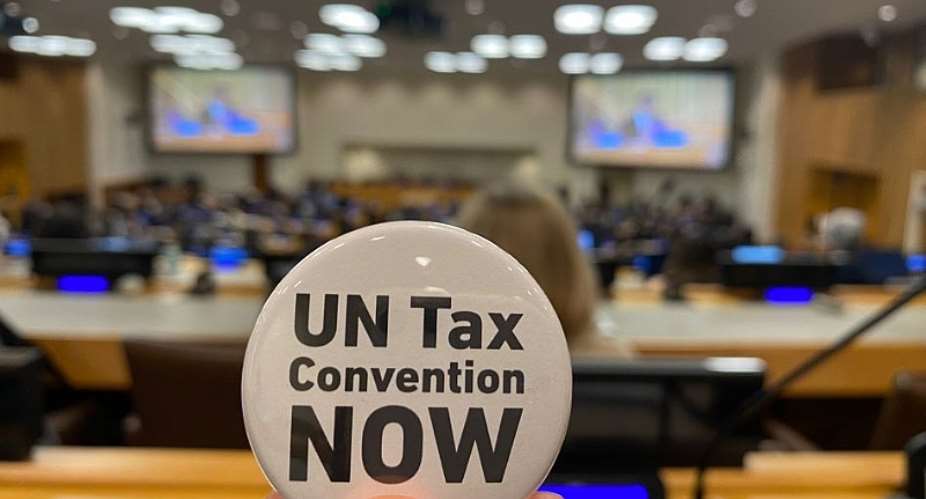
For Africa, United Nations negotiations on a Convention on International Tax Cooperation, resuming in New York on 3 August, matter far beyond technical fiscal concerns. The continent entered this year's perfect storm of great power rivalry, war and fragmentation bleeding from a deeper wound: fifty years of capital flight and illicit outflows.
The war against Iran has kept the Strait of Hormuz — the artery for a large part of the world's gas, oil and fertilizers — virtually closed since February. Capital flight feeds on exactly what this war fabricates: uncertainty, soaring debt costs, tax evasion and avoidance and distracted enforcement. Conflicts grind on also in Ukraine, Gaza, Sudan and the Democratic Republic of Congo. And as the United States turned brutally mercantilist, slashing aid, UNCTAD reports that the collapse in daily ship transits through Hormuz will reduce global trade growth from 4.7 per cent in 2025 to just 1.5 per cent this year.
African currencies have depreciated by 2.9 per cent against the dollar since the escalation — the steepest fall of any developing region — while yields on African sovereign bonds have climbed to 8.3 per cent. Costlier fuel, food and debt are landing on countries that already spend more servicing debt than on health or education, and UNCTAD warns that if the closure persists, the hardship will spread well into 2027.
This is the backdrop to an inequality without precedent. The World Inequality Report 2026 finds that 56,000 people — a crowd that would fit inside a football stadium — own three times more wealth than the poorest half of humanity, while effective tax rates fall sharply for the very richest. Sub-Saharan Africa carries a double burden: low average incomes and extreme internal inequality. Average education spending per child stands at €220 in purchasing power terms, against €9,020 in North America — a gap of one to forty. And each year around 1 per cent of global GDP flows from poorer to richer countries through the “exorbitant privilege” of reserve-currency economies.
In our research with James K. Boyce, we estimated that thirty African countries lost 2.7 trillion dollars to capital flight between 1970 and 2022 — roughly their combined GDP — and that the continent loses around 97 billion dollars every year through unrecorded outflows. Conflict exacerbates governments' loss of tax revenue through the same mechanisms that enable criminal networks to profit. These networks use the same offshore channels to shelter untaxed elite wealth.
How we design our tax systems is ultimately a policy choice, and inequality need not be its outcome. Analysts at the International Centre for Tax and Development concluded that two decades of OECD-designed standards have delivered benefits that are uneven, slow and expensive. The implication is clear: challenges of the scale ahead cannot be managed within clubs of wealthy countries. They demand definition at the most inclusive forum there is — the UN, where every country has a voice and a vote.
What should African negotiators defend at the UN in August?
First, an ambitious tax convention. Today's rules (designed based on OECD models) limit the rights to tax the profits of multinationals in Africa, through tax treaties negotiated bilaterally with rich countries and transfer pricing rules that ensure little profits are allocated to the activities that take place in Africa.
The convention can change this, to enshrine a fair allocation of taxing rights that recognizes a right to tax in any jurisdiction that materially contributes to profit, including where user data and participation are generated, where public infrastructure sustains the market, where natural resources are located or where consumption occurs.
Second, a strong protocol on cross-border services, to ensure countries where services are delivered and users are located have a right to tax.
Third, truly universal access to information exchange, public country-by-country reporting requiring multinationals to disclose how much tax they pay in each of their countries where they operate, the possibility of using exchanged information for a wider set of purposes — not only for tax — and interconnected registries of assets and beneficial owners — which for Africa is security policy as much as tax policy. The African Convention on Mercenarism already criminalizes those who finance and recruit armed groups, but African prosecutors cannot follow the money without the evidence trail that beneficial-ownership registries would provide.
The latest Tax Transparency in Africa report shows the importance of binding transparency mechanisms: eleven African countries identified nearly €400 million in additional revenue in 2024 alone through exchange of tax information — more than €4.2 billion since 2009. Where there is political will, transparency converts directly into revenue.
These gains remain a fraction of what is lost, however. Research by the International Tax Observatory shows that 37 per cent of Sub-Saharan Africa's offshore wealth is invisible to lower-income countries outside the Common Reporting Standard that are not yet receiving any automatic information exchange, while Africans hold 56 per cent of their offshore wealth in European financial centres and another 28 per cent in Switzerland. The information exists; it should reach African tax authorities.
There is light at the end of the tunnel. The Economist expects African GDP growth to outpace Asia's in 2026 as Nigeria and South Africa revive, and more than half the world's mobile-money users are African. What the continent lacks is not dynamism but fiscal space: the revenue to close a forty-to-one gap in what is invested in an African child's education, and to build states strong enough to face the criminal networks that war is feeding.
Africa must continue to speak with a single, united voice. It was the Africa Group that brought this process to the General Assembly in 2022 and carried it forward against formidable resistance from most OECD countries. The wealthiest countries will work to water down any meaningful change to the status quo, one that limits the taxing rights of African countries. The Africa Group and the broader G77 should protect unity as a negotiating asset, the one that created this process, and the one that can complete it.
In a world being remade by force, the August negotiations offer a chance to reshape one corner of it according to the rule of law. Africa should seize this opportunity, treating potential new tax revenues not as the prize itself, but as the first instalment on a more durable political and legal settlement.
Léonce Ndikumana is a commissioner of the Independent Commission for the Reform of International Corporate Taxation (ICRICT), Professor of Economics at the University of Massachusetts Amherst, and former Director of Research at the African Development Bank.

 'Do I look like somebody who can be bullied as Majority Leader?’ – James Agalga
 Contractor hands over Weija Children’s Specialist Hospital to govt
 Car dealer shot dead outside residence at Beach Drive Estate near Tuba
 Former TOR boss Asante Berko convicted in US over Ghana power plant bribery sche...
 NDC slams Afenyo-Markin's 'nobody' remark against Nana Yaa Jantuah
 Heavy security deployed to Laboma Beach ahead of demolition exercise
 James Agalga named majority leader following Mahama Ayariga's ministerial appoin...
 Omane was a true friend, a younger brother and a loyalist — Mahama eulogises lat...
 'My focus is on delivering the mandate' — Prof. Opoku-Agyemang responds to rumou...
 US appeals court halts construction of Trump’s $400 million White House ballroom...

