




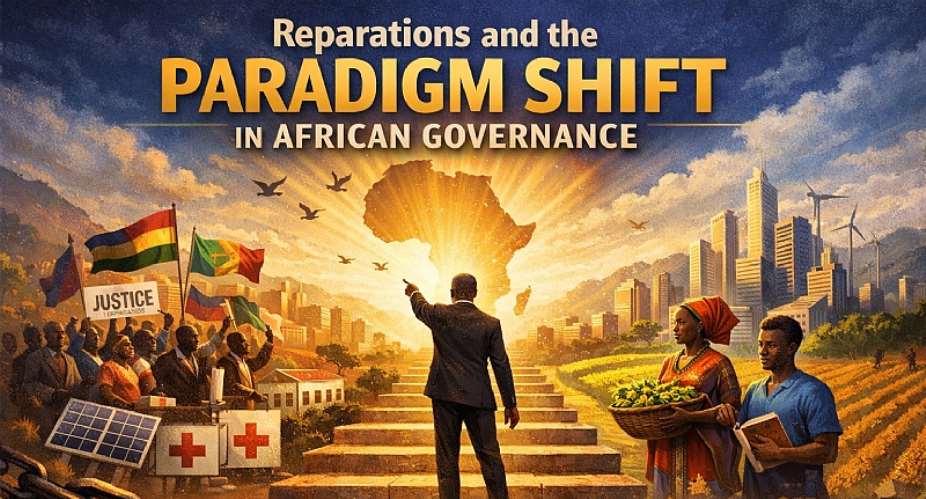
When Ghana led Africa to petition the United Nations and secured the reparations vote, history bent toward justice. For the first time, the global community acknowledged that centuries of enslavement and exploitation demand restitution. The follow-up meeting on a reparatory framework is not just procedural; it is monumental. It signals that Africa’s ancestors, who endured dispossession, would be proud of this generation for carrying their struggle into the halls of legitimacy. But this victory is more than symbolic. It compels Africa to re-examine governance itself. For what exists today is inadequate to anchor what lies ahead — the challenges of restitution, the successes of continental agency, and the weak foundations that must transform to support continuity. Reparations open a door, but governance must be re-imagined to walk through it.
CMS III: Africa’s Own Worldview
In his foreword to CMS III, the final volume of the Consequential Management System trilogy, Prof. P.L.O. Lumumba quotes the work’s central thesis — Africa’s own worldview: relational existence, reality understood through cosmologies and rotation…. These are not merely words but deep-rooted African metaphysical wisdom fused with modern management science. The fusion transforms governance from mimicry to originality, from borrowed paradigms to Africa’s own epistemic innovation. This is Africa’s epistemology, posited by CMS, to represent a paradigm shift: governance as custodianship, consequence as literacy, and legitimacy as continuity.
From Mimicry to Originality
For decades, African states have borrowed governance models wholesale — rationalist frameworks from Europe, covenantal traditions from the Middle East, or bureaucratic templates from the West. These imports have yielded institutions, but not legitimacy. They have produced policies, but not custodianship. CMS argues that Africa must project its own compass.
Reparations are not only about financial redress; they are about epistemic recognition. Yet proximity governance and systemic plagiarism remain obstacles in Africa. Too often, brilliant concepts are stripped of their depth as governments rush to implement policies without Consequence Literacy. Ideas are borrowed, repackaged, and executed without appreciation for their philosophical roots. The result is not only inefficiency and erosion of trust but also the cyclical underdevelopment of perhaps the richest-resourced continent on earth. This cycle perpetuates the marginalization of Africans and their diasporas across the globe. Until Africa governs effectively, its children will remain impoverished and disrespected worldwide.
Diaspora Bonds and Financial Sovereignty
Consider Diaspora Bonds. The initiative is powerful — mobilizing diaspora capital for continental development. Yet under government management, inefficiencies abound: bureaucratic delays, weak accountability, and politicization undermine its potential. A properly regulated private sector, enabled by strong governance frameworks, can fill this gap. Beyond efficiency, Diaspora Bonds offer an excellent opportunity to build Africa’s investment banking sector — a sector that is virtually non-existent today and largely proximity-managed through government contracts. At present, capital markets are thin, and governments dominate financial intermediation, often with inefficiencies and politicization. By enabling a properly regulated private sector to steward diaspora capital, Africa can create jobs, careers, and institutions that embody Consequence Literacy. This would not only mobilize resources more effectively but also lay the foundation for a robust investment banking ecosystem — one that anchors Africa’s financial sovereignty and reduces dependence on external actors.
Breaking Patronage, Family & Friends Systems
This is thinking anew — shifting mindsets beyond political patronage and the entrenched “family and friends” systems that have bred corruption and eroded the African identity in governance. The outcomes of the last 69 years have left Africa the least developed continent, despite its immense resources. The consequence has been stigma and dehumanization: Africans are tolerated merely as migrants, their children impoverished and disrespected across the world. Reparations and diaspora capital must therefore be stewarded differently — not through proximity governance or patronage, but through consequence literacy, continuity, and communal custodianship. Only then can Africa transform its wealth into dignity and legitimacy. Africa now stands at a crossroads. Reparations have opened the door to restitution, but governance must evolve to steward it. Weak foundations must give way to systems grounded in Africa’s epistemology — continuity, agency, and custodianship. Only then can reparations become more than compensation; they can become the seed of civilizational renewal. This is the threshold moment. Africa must move from mimicry to originality, from borrowed paradigms to its own compass. CMS trilogy frames this as Consequence Literacy: legitimacy measured not by imported structures but by outcomes that honour communal stewardship. Reparations demand that Africa prove it can govern restitution with integrity, efficiency, and vision.
The ancestors are watching. The world is watching. Africa must now re-imagine governance not as mimicry but as custodianship. The reparations victory is monumental, but it will only be transformative if anchored in Africa’s own worldview. CMS offers that compass. The task ahead is to enact it.
CMS Ethos
CMS I reminds us that governance must begin with Mindset Awareness — recognizing how inherited paradigms shape African institutions. Without this awareness, even reparations risk being absorbed into mimicry governance. From awareness, Impact Implementation must flow — translating vision into measurable action. Reparations and diaspora capital must not vanish into inefficiency; they must be implemented through structures that create jobs, careers, and institutions. Diaspora Bonds, stewarded by a properly regulated private sector, can catalyse the birth of Africa’s own Investment Banking sector, moving beyond proximity-managed government contracts to genuine financial sovereignty. Above all, governance must embody Consequence Literacy — the ethic of measuring decisions by their outcomes rather than their intentions. Reparations are not just compensation; they are a test of Africa’s custodianship. If stewarded wisely, they can seed civilizational renewal, harmonizing diaspora reintegration with continental legitimacy.
The Call to Custodianship
Reparations have opened the door, but governance grounded in CMS Consequence Literacy can carry us through it. This is the paradigm shift CMS posits: from mimicry to originality, from borrowed frameworks to Africa’s own compass. The task ahead is to enact it. The African must choose differently today and reclaim the lost African Agency!
About CMS: The Consequential Management System (CMS) is an African epistemic governance framework authored and codified across three volumes (CMS I–III). It introduces Consequence Literacy as a framework for institutions, enterprises, and communities, embedding African metaphysical governance and worldview. CMS dramatises the #ConsequenceGeneration movement — positioning Africa to reclaim agency, strengthen institutions, and steward civilizational outcomes.
Author Bio: Albert K. Owusu is the founder and architect of the Consequential Management System (CMS), an African epistemic governance framework authored and codified across three volumes. A global strategist and narrative architect, he has led institutions across finance and enterprise

 Contractor hands over Weija Children’s Specialist Hospital to govt
 Car dealer shot dead outside residence at Beach Drive Estate near Tuba
 Former TOR boss Asante Berko convicted in US over Ghana power plant bribery sche...
 NDC slams Afenyo-Markin's 'nobody' remark against Nana Yaa Jantuah
 Heavy security deployed to Laboma Beach ahead of demolition exercise
 James Agalga named majority leader following Mahama Ayariga's ministerial appoin...
 Omane was a true friend, a younger brother and a loyalist — Mahama eulogises lat...
 'My focus is on delivering the mandate' — Prof. Opoku-Agyemang responds to rumou...
 US appeals court halts construction of Trump’s $400 million White House ballroom...

