




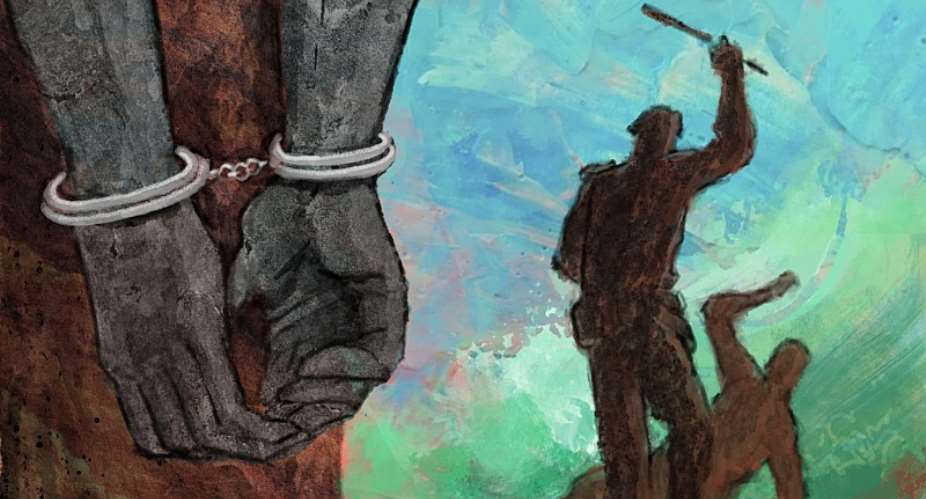
Sandy alleys wind through Intaca, a neighbourhood on the outskirts of Maputo where homes are built from bare concrete blocks and corrugated metal sheets. Heavy rain has left some of them flooded, and families are bailing out water as best they can.
Half-lying on a mat outside his small house, one leg in a cast from foot to knee, Amilcar Francisco receives friends who have come to check on him. The activist, who is in his forties, says he was tortured by unknown assailants a week earlier.
"As I was leaving work and waiting for the bus, a white car pulled up beside me," Francisco tells RFI. "Six men got out and forced me inside. They put a hood over my head and tied a rope around my neck and my hands."
He was driven to a patch of wasteland a few kilometres away, he says, where his attackers beat him and methodically broke his feet with iron bars before leaving him for dead.
"They told me: 'You are all going to end up like this.' Then they listed the names and roles of party members – the cell coordinator, the statistics officer."
How Cabo Delgado's riches became fuel for the Islamist insurgency in Mozambique
A deadly crackdown
Francisco is a member of Anamola, the National Alliance for a Free and Autonomous Mozambique.
The country was shaken for more than four months after general elections in October 2024 delivered a landslide victory to Frelimo, the Mozambique Liberation Front, which has governed Mozambique since its independence from Portugal in 1975.
More than 400 people were killed in the crackdown on protests that followed, civil society organisations said.
Persecution has continued since then and intensified as Anamola prepares for its first congress, due to take place from 20-22 June in Nampula, in central Mozambique.
Anselmo Vicente, Anamola's coordinator in Chimoio, also in central Mozambique, was shot dead outside his home on 9 May as he returned from a local party meeting.
Six days later, party activist Pedro Chauke was shot dead at his home in Gaza province in southern Mozambique. Witnesses described the killers as ruthless and professional.
Recent killings were "isolated acts", says Dias Letela, spokesperson for Frelimo's parliamentary group.
Former presidential candidate Mondlane, however, blames elements within the country's security services for the violence.
A complaint filed against the national police in March 2025 accuses officers of violence against his supporters. In the court file seen by RFI, Mondlane estimates that at least 55 people have been killed and more than 400 assaulted since Anamola was created in August 2025. A police officer points a weapon at protesters in Maputo on 7 November 2024, during demonstrations that followed Mozambique's disputed election.
Months without trial
Books fill the shelves in the living room of publisher and self-described protest poet Alex Barga. "Books reassure me," he told RFI.
Barga was arrested alongside friends in January, at the height of the post-election unrest, and spent nine months in detention without trial.
"At the police station, we were questioned for a long time without any lawyer present," he explains. "They asked why we wanted to kill police officers. We were tortured for hours, then thrown into a cell stained with fresh blood."
Charges of criminal association and attempting to change the rule of law through violent means were eventually brought against Barga.
"What kind of coup can you organise with a pen?" he asks.
Support from Mozambique's Bar Association, the body representing the country's lawyers, helped secure the release of Barga and his companions nine months later after prosecutors dropped the case.
"The judge herself recognised there was nothing in our file," he says.
Civil society organisation Decide says more than 7,200 people were arrested and arbitrarily detained during the post-election protests and that 1,500 remain behind bars.
Resumption of $20bn Cabo Delgado gas project reignites both hope and resentment
Anti-terror law
Some detainees have been held under an anti-terrorism law introduced in 2018 and amended in 2022.
The law allows suspects to be held for 16 months without charge.
"Harsher sentences can be imposed under this law and it can easily be manipulated," Borges Nhamirre, a researcher at the Institute for Security Studies, a security research organisation, says.
"Venancio Mondlane, for example, was accused of inciting acts of terrorism. Demonstrations are very easily classified that way and those who protest can fall under this law."
Mozambican human rights organisations denounced the threat the law posed to public freedoms when it was introduced in 2018.
The legislation provides prison terms of two to eight years for spreading false information and 24 years for terrorist activities. Mozambican opposition leader Venancio Mondlane (centre) speaks to journalists after a meeting at the attorney general's office in Maputo on 11 March 2025.
Legacy of violence
"Fifty years after independence, Frelimo's legacy is state violence," explains Quiteria Quirengane, executive secretary of the Women's Observatory, a Mozambican rights organisation.
Human rights defenders accuse the ruling party of using different branches of the security apparatus for political purposes, including the Criminal Investigation Service, the Rapid Intervention Unit and the Special Operations Group.
"Abductions happen in broad daylight," Francisco warns. "They wear civilian clothes, sometimes uniforms, it doesn't matter. We know who they work for."
Despite the attack, he has refused to stop wearing his bright yellow Anamola t-shirt.
Frelimo did not respond to requests for comment from the consortium behind the investigation.
Mozambique scores 3.5 out of 10 on the Economist Intelligence Unit's democracy index, placing it in the category of autocracies.
This article has been adapted from the original version in French by Gaëlle Laleix, reporting from Cabo Delgado.
It is the fourth instalment of Mozambique Exposed, an investigation coordinated by Forbidden Stories, a global non-profit network of investigative journalists. The project is based on nearly 100 interviews and five months of reporting by 30 journalists from 10 media organisations, including RFI and Les Observateurs de France 24 (France), Evident Media (United States), Expresso (Portugal), M28 Investigates (Rwanda), Paper Trail Media (Germany), SourceMaterial (United Kingdom), ZDF (Germany) and Zitamar News (Mozambique).


 Allow the law to deal with defilement perpetrators - Director tells families
 Gov’t to develop policy for Ghanaian sign language in education
 Two Ada SHS students plead guilty to assault, slapped with 12-month bond
 Enlistment: GAF begins documentation, body selection from September 28
 Violent rainstorm rips off roofs, displaces residents in Krachi Nchumuru
 Ghana risks EU gas market access over methane emissions
 Tumu landlord gives road encroachers 2-week ultimatum to relocate for road const...
 Serbian President Aleksandar Vucic resigns
 Tigray TV station hit by drone, rebels advance in north Ethiopia
 Swiss reject plan to toughen neutrality


