




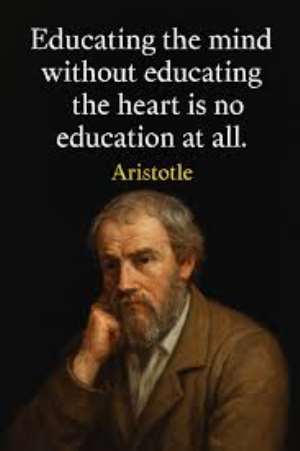
Across Ghana and much of the world, academic achievement has become the dominant measure of success. Parents celebrate top grades, schools compete over examination results, and students are taught from an early age that their future depends largely on their performance in the classroom.
Yet a troubling question remains: What happens when we educate the mind but neglect character?
The reality is that while intelligence opens doors, character determines what people do once those doors are opened. A society that prioritizes academic excellence while ignoring moral development risks producing highly educated individuals who lack the values needed to use their knowledge responsibly.
The Obsession With Grades
Every year, examination results dominate national conversations. Families celebrate distinctions and worry over poor grades. A child who struggles academically often becomes the subject of concern, criticism, and pressure.
However, society frequently reacts differently when a child displays troubling behavioral traits. Dishonesty, bullying, disrespect, lack of empathy, or poor self-control are often overlooked, especially when accompanied by strong academic performance.
This imbalance reveals a fundamental misunderstanding of education. Education was never intended to be solely about intellectual achievement. Its broader purpose is to develop responsible, disciplined, and ethical citizens who can contribute positively to society.
A student may fail Mathematics and still go on to lead a productive life. But a person who lacks integrity, discipline, or empathy can cause significant harm regardless of educational qualifications.
The Three Pillars of Education
Historically, education rested on three essential pillars:
Character
Discipline
Learning
Today, many educational systems place overwhelming emphasis on learning while paying far less attention to character and discipline.
The consequences are becoming increasingly visible. We are producing graduates who possess impressive technical skills but struggle with emotional intelligence, ethical decision-making, and personal accountability. We are developing individuals who can solve complex problems yet find it difficult to manage anger, work collaboratively, or resist dishonest opportunities.
As a result, societies often find themselves grappling with corruption, indiscipline, and declining public trust despite rising levels of formal education.
Corruption Is a Character Problem
One of the greatest misconceptions is that societal failures stem primarily from a lack of education.
In reality, corruption is rarely an academic failure. It is fundamentally a character failure.
Nations do not collapse because their leaders cannot solve equations or write examinations. They struggle when those entrusted with authority lack integrity, empathy, discipline, and a sense of responsibility toward future generations.
Many individuals involved in financial misconduct, abuse of power, and unethical practices are highly educated. Their actions demonstrate that knowledge alone does not guarantee wisdom or moral judgment.
The challenge, therefore, is not merely to educate more people but to cultivate better values alongside education.
What Schools Should Be Teaching
Academic knowledge remains important. Science, technology, mathematics, and literacy are critical for national development. However, these subjects should not come at the expense of character formation.
Schools must place greater emphasis on:
Emotional intelligence
Empathy and compassion
Honesty and integrity
Self-discipline
Civic responsibility
Respect for others
Teamwork and cooperation
The dignity of labour
These qualities are not optional extras. They are essential life skills that shape responsible citizens and effective leaders.
A child who develops resilience, discipline, and integrity is better equipped to overcome failure and navigate life's challenges. By contrast, a child taught only to pass examinations may achieve professional success while lacking the values necessary to use that success responsibly.
Why This Conversation Matters in 2026
The relevance of this issue has become increasingly clear.
Grades Receive More Attention Than Values
Academic results continue to attract significant public attention, yet issues such as corruption, fraud, indiscipline, and ethical misconduct often receive far less scrutiny during a child's formative years.
Society closely monitors report cards but rarely tracks character development with the same intensity.
The Modern Workplace Values Character
Employers increasingly recognize that technical competence alone is not enough.
Many workers lose opportunities not because they lack academic qualifications, but because of dishonesty, poor teamwork, insubordination, unethical behavior, or an inability to manage relationships effectively.
In today's workplace, integrity, accountability, and communication skills have become as valuable as technical expertise.
A Gap in Educational Policy
While curriculum reforms frequently emphasize STEM education, digital literacy, and academic performance, character education often receives limited structured attention.
Ethics, civic responsibility, empathy, and emotional intelligence should be treated as core educational priorities rather than secondary concerns. What is measured, taught, and assessed inevitably becomes important.
A Way Forward for Ghana
If Ghana is to build a stronger future, three important shifts are needed.
1. Redefine Excellence
Academic achievement should remain important, but it should not be the sole measure of success.
Parent-teacher discussions should place equal emphasis on honesty, discipline, responsibility, and social behavior. Questions about a child's character should matter as much as questions about examination performance.
2. Lead by Example
Children learn more from observation than instruction.
A parent who bribes an official while condemning dishonesty sends a contradictory message. A teacher who compromises examination integrity undermines every lesson about ethics.
Character education begins with adults demonstrating the values they expect from the next generation.
3. Measure What Matters
Schools should explore practical ways to assess and encourage qualities such as teamwork, responsibility, empathy, leadership, and self-control alongside academic performance.
Recognizing and rewarding positive character traits can help elevate their importance within the educational system.
Conclusion
A nation can recover from poor examination results. It can improve literacy rates, expand educational opportunities, and strengthen academic performance over time.
Recovering from a generation raised without character is far more difficult.
Intelligence without character is like a powerful vehicle without brakes. It may move quickly, but it eventually becomes a danger to itself and everyone around it.
Degrees and qualifications may open doors, but character determines how individuals use the opportunities they receive. If Ghana is serious about building a prosperous and ethical society, it must focus not only on raising intelligent students but also on raising responsible human beings.
The future of the nation depends on both.


 Hamas agrees to disarm under Trump ceasefire deal
 Trump says US has not agreed to Ukraine producing Patriot missiles
 US expels dozens to African deportation hubs: lawyers
 "Do Zuba and KMA want us to turn to prostitution to feed our children?" – Distra...
 Trump and far-right seize on Spanish migration crisis
 Sedina's acquittal: Read the unanimous judgment and stop commenting 'by-heart' –...
 Report anyone offering Big Push contracts for sale to police — Roads Minister
 Gender Minister assures government support for children injured in Dzorwulu road...
 'It will not happen again' — NDC MP apologises for 'I will marry you' comment to...
 Dagbon set to enskin Kampakuya Naa Abukari Yakubu today as Regent

