




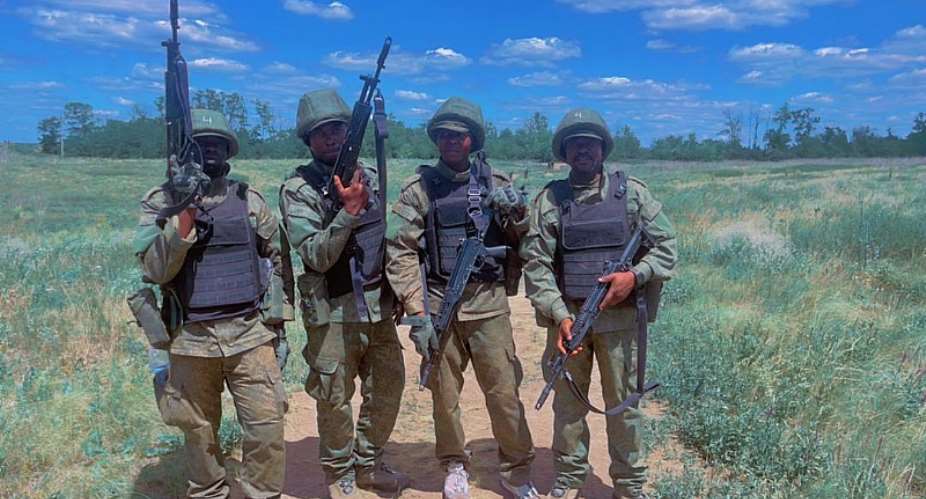
There is a TikTok account called "Russia for everyone." Another goes by "Wagner Army." There is one that calls itself "Military Staff Agency" and another that promises visa assistance under the banner "Russia Visahub." To a casual observer scrolling through a feed, these accounts might appear to be lifestyle pages run by Africans who found opportunity in a distant land and want to share their good fortune. To the young man in Yaoundé, Lagos or Nairobi who is desperate for work, drowning in debt and watching his peers stagnate, they look like something far more dangerous: a lifeline.
They are not a lifeline. They are a trap. And across at least 36 African countries, that trap is being sprung with frightening efficiency.
A leaked Russian database covering the period 2023 to 2025 has confirmed what investigative journalists and intelligence agencies across the continent have long suspected: more than 1,700 Africans are currently fighting for Russia in Ukraine. Researchers and officials believe this figure represents only a fraction of the actual total.
On VKontakte, Russia's dominant social media platform, posts promoting Russian military service to foreign nationals surged from 621 to 4,600 between June and September 2025 alone. By mid-2025, one in every three recruitment advertisements was targeting foreigners. This is not a marginal phenomenon. It is an organized, industrialized operation with Africa squarely in its crosshairs.
The recruitment playbook is sophisticated precisely because it does not begin with a call to arms. It begins with a promise of normalcy. Job postings circulating across Facebook, TikTok and Telegram advertise one-year contracts with monthly salaries of approximately $2,500, signing bonuses of up to $37,000, and pathways to Russian citizenship.
In regions where unemployment among young graduates regularly exceeds forty percent, these figures are not merely attractive they are transformative in their apparent promise. For many recruits, the military dimension is deliberately obscured in initial contacts. Some advertisements promise positions in construction, catering or logistics. The word "war" does not appear until it is too late.
The networks that sustain this pipeline are layered and strategically designed to evade detection. At the front end sit the visible accounts: glossy pages run by apparent African success stories living comfortably in Moscow or St. Petersburg, sharing videos of their apartments, their meals, their earnings.
They speak in Pidgin English, French, Lingala and Hausa. They use cultural references that resonate with their target audiences. They are, in many cases, real people Africans who have been recruited into a secondary role not as soldiers but as credibility-launchers, human validators whose faces and accents make the pitch feel authentic and safe.
Cameroon has paid the heaviest price among the documented cases. Of approximately 1,417 confirmed African recruits, 335 are believed to be Cameroonian. Ninety-four of them have died in combat. A young man from Togo travelled to Russia on a student visa in August 2024. He was forced into the army, wounded on the front lines and subsequently imprisoned. Kenya's intelligence agencies reported to Parliament that more than 1,000 Kenyans had been recruited through these networks.
In Ghana and Nigeria, travel agencies have been identified as operational nodes within the broader recruitment ecosystem, offering visa facilitation and travel arrangements that serve as the physical infrastructure beneath the digital superstructure.
The operational pattern, once understood, is almost mechanical in its consistency. An account posts a video or testimonial promoting life in Russia. Interested users comment publicly, generating visible social proof. The recruiter responds in the open to build credibility. The conversation then migrates rapidly to WhatsApp or Telegram, where there is no platform moderation and no audit trail.
A contact number is shared. An intermediary handles the logistics. A young man buys a ticket and boards a plane. What happens next is rarely what he was promised.
What makes this recruitment apparatus particularly difficult to dismantle is the deliberate exploitation of platform gaps. Social media companies have invested considerable resources in detecting coordinated inauthentic behavior in English-language Western contexts.
They are far less equipped to identify recruitment networks operating primarily in French, Hausa, Lingala or Swahili, migrating swiftly between platforms, and using human intermediaries rather than automated bots. By the time a Facebook page accumulates tens of thousands of followers and posts daily, its content has already done its work. The real activity has long since moved to encrypted messaging applications beyond any platform's reach.
There is also a deeper vulnerability being exploited here that no content moderation policy can fully address: the genuine economic desperation of millions of young Africans navigating labour markets that have consistently failed them. Russia's recruiters did not create youth unemployment in Cameroon or Nigeria or Kenya. They simply identified it as a resource.
They recognized that where hope is scarce, even a dangerous promise can look like salvation. In this sense, the recruitment operation is less a product of Russian strategic genius than a parasitic exploitation of Africa's own unresolved developmental crises.
African governments, regional bodies and civil society organizations have been slow to match the scale and sophistication of the response that this crisis demands. A handful of accounts are attempting to document and expose recruitment networks. Togo has issued warnings to students about Russian recruitment tactics.
Kenya's Parliament has been briefed. But these are reactive, fragmented measures against an operation that is proactive, coordinated and continuously evolving. When recruitment accounts multiply faster than awareness campaigns, the ecosystem favors the predators.
The broader geopolitical dimension deserves naming directly. Russia's mass recruitment of African fighters for its war in Ukraine is not merely an opportunistic labour arbitrage. It is a deliberate extension of Moscow's strategic engagement with Africa one that exploits post-colonial grievances, economic precarity and weak institutional safeguards simultaneously. The same Russian information architecture that promotes anti-Western narratives across the Sahel, that celebrates military juntas in Bamako and Ouagadougou, and that positions Moscow as Africa's post-colonial liberator is the same architecture that funnels young Cameroonian men into Ukrainian trenches. The propaganda and the recruitment are not separate projects.
They are two faces of the same strategic enterprise. Young Africans are dying in a war that has nothing to do with their lives, their communities or their aspirations. They are dying because they were lied to by polished TikTok videos, by smiling intermediaries in Moscow, by the digital infrastructure of a foreign power that views their desperation as a geopolitical asset.
Their governments owe them more than belated parliamentary briefings and travel advisories. They owe them the economic conditions in which a $2,500 monthly salary promise from a Russian recruiter looks like the cynical trap it is, rather than the best offer on the table.
That is the work that remains undone. And until it is done, Africa's screens will continue to feed Africa's trenches.
Mustapha Bature Sallama.
Medical/ Science Communicator,
Private Investigator, Criminal investigation and Intelligence Analysis.
International Conflict Management and Peace Building.USIP
[email protected]
+233-555-275-880


 I will unite Africa, Caribbean and Latin America into world's biggest trading bl...
 Mahama petitioned to halt Sentuo Airport Garden City construction after sod cutt...
 ‘No human civilisation deserves to be annihilated’ – Mahama jabs Trump
 Government should not fund the $4 billion Accra-Kumasi Expressway project — Alan
 BoG to introduce upgraded Ghana cedi banknotes with enhanced security features, ...
 Bank of Ghana keeps policy rate at 14% for third straight time
 Democracy must deliver tangible social benefits to citizens – Mahama
 ‘We will process our minerals at home’ – Mahama warns against scramble for Afric...
 Court to rule on bail applications of six accused in 3.9-tonne cocaine seized in...
 [Full Text] Mahama addresses 81st Session of the United Nations General Assembly...


