




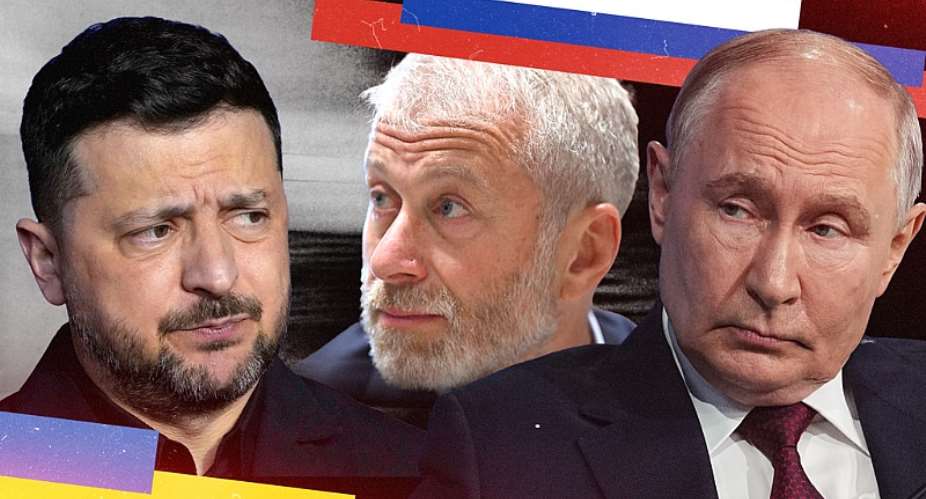
For a man with few “cards”, Ukraine's Volodymyr Zelensky has played a surprising joker in the shape of Russian oligarch Roman Abramovich.
The Ukrainian president has confirmed UK media reports that he met the former owner of Chelsea football club in late May in Kyiv, where the Russian magnate offered to report back to the Kremlin on prospects for peace.
Zelensky said Abramovich brought the message that the Russians “want to understand what we are ready to do”. In return, he was tasked with telling Putin that Zelensky was open to a face-to-face meeting “at any time”.
Moscow has not denied the existence of a diplomatic backchannel, without naming the intermediary. Putin said on Friday that he met “one of the representatives of our business circles”, adding that the businessman was not acting in an official capacity.
Read more Putin rules out Zelensky's offer to meet and vows to pursue war goals
Abramovich – who now lives between Turkey and the Gulf owing to UK and European sanctions imposed over his proximity to the Kremlin – has refused to comment on the meeting in Kyiv.
Abramovich's balancing act
A product of the unbridled capitalism of the Boris Yeltsin era, Abramovich is perhaps a surprise choice of intermediary considering that Putin initially built his popularity on the projection of a radical break with the ultra-rich oligarchs who made up Yeltsin's inner circle.
But the multi-billionaire has a history of acting as go-between since the start of Russia's full-scale invasion of Ukraine.
Abramovich was present at the first peace talks between Russia and Ukraine in Turkey in late March 2022, introduced as a facilitator of contacts between the warring parties. Later that year he helped broker an agreement allowing Ukraine to continue exporting grain.
He has since continued to play a negotiating role behind the scenes, intervening on several occasions to facilitate prisoner swaps. He even attempted to secure the release of Kremlin dissident Alexei Navalny in 2024 in exchange for the return of several Russian prisoners, according to a CNN report.
Over the years, the Russian oligarch has succeeded in gaining acceptance from both sides in the conflict, “successfully balancing his historical ties to the Kremlin with the trust he appears to inspire in the Ukrainian authorities”, says Elisabeth Schimpfössl, an expert on the sociology of elites at Aston University and author of “Rich Russians. From Oligarchs to Bourgeoisie”.
“He's never done anything that would make him look disloyal in the eyes of the Kremlin,” Schimpfössl explains, noting that Abramovich is one of the few oligarchs who agreed to govern a region – remote Chukotka in Russia's Far East – at Putin's request. He has also been careful not to criticise the government in Moscow, including since the start of the war in Ukraine.
This loyalty to the Kremlin does not appear to bother Zelensky. In fact, the Ukrainian leader “asked (former US president) Joe Biden not to include Abramovich on the US sanctions list – even though he was already on the European one – precisely because of the mediating role he could play”, adds Schimpfössl.
Among all the Russian oligarchs, Abramovich has come across as the most palatable to Kyiv, in part because of his Westernised image – which is not solely down to his time as Chelsea's owner.
“It is also largely due to his ex-wife Dasha Zhukova, who launched the Garage Museum of Contemporary Art in Moscow in 2008, which contributed to the couple's image of cultural sophistication in the West,” says Schimpfössl. The Russian-American art collector and socialite, who split from Abramovich in 2017, also sits on the board of the prestigious Met Gala in New York.
A pawn for Zelensky?
The businessman's acceptance by both sides does not mean he will succeed where all others have failed.
Putin has made clear he sees “no point” in meeting Zelensky face-to-face, dismissing the Ukrainian president's open letter offering direct talks. That is precisely the message Abramovich was supposed to convey to the Russian leader.
The oligarch's actual influence in Moscow remains very limited, says Jenny Mathers, a specialist in Russian security studies at the University of Aberystwyth in Wales.
“He may find it easier than others to be heard – and that is already significant – but any oligarch's ability to change Putin's mind about something like the war is probably very small,” she explains, noting that Zelensky is no doubt aware of these limitations.
Read more Russia loses ground – but not the war – in Ukraine
For the Ukrainian leader, playing the Abramovich card may have more to do with PR efforts than any genuine hope of a breakthrough in peace talks, adds Mathers.
“It's a way of demonstrating to the outside world – and the Russian public – that Zelensky is making every effort to end the war,” including by placing his “hopes” for peace in the hands of a Russian oligarch, she explains.
It's also an opportunity to put forward a mediator with a more credible profile than the one Putin proposed in May: Gerhard Schröder, the former German chancellor whose business ties with Moscow and blatant pro-Russian bias have stripped him of all legitimacy in the West.
This article was translated from the original in French.


 “We need payment, not meetings” – Striking teacher unions tells Education Minist...
 NPP challenges GH¢2,650 cocoa producer price for 2026/27 season
 Mahama explains why 'humiliating' US, Ghana health deal was thrown out with spee...
 Education Minister meets teacher unions today for threatening strike
 Galamsey: 'Either Mahama is lying or suffering amnesia for denying promise to de...
 Adu-Boahen’s lawyer files no-case submission in GH¢49.1m trial
 BoG Governor Dr Johnson Asiama explains why he exited from GoldBod Board about f...
 Akuapem Odwira @200: 'Don’t abuse power, Ghanaians are watching us' — Osahen Afe...
 GES says NCPTA has no authority to impose prospectus purchases on schools
 2nd Deputy BoG Governor Matilda Asante-Asiedu replaces Dr. Asiamah on GoldBod bo...


