




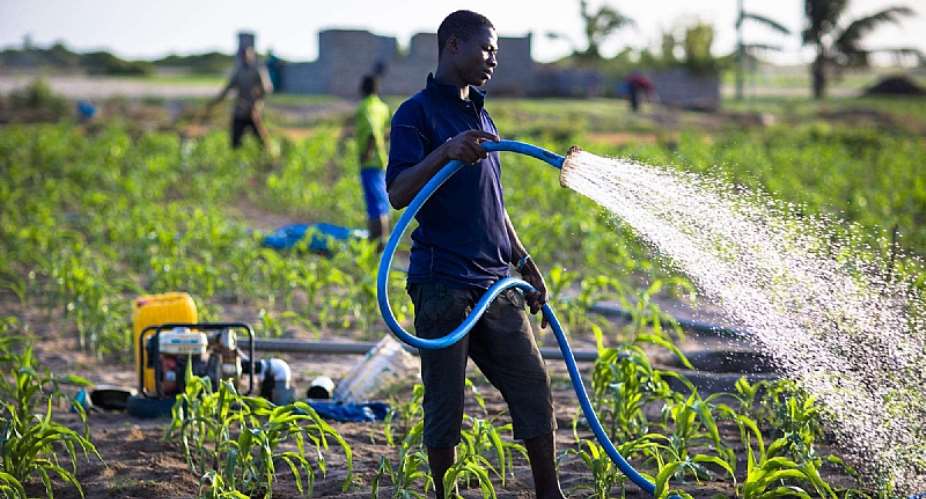
Let me start with a number that should embarrass every Ghanaian who cares about what we eat. Ghana spends hundreds of millions of dollars every year importing rice. Not luxury rice. The rice that ordinary Ghanaians eat every day. We also spend millions importing frozen chicken, even though we have land, water, and labour to raise our own. That is not just a trade deficit. It is a failure of policy and investment. The government has announced an ambitious plan to change that. The AgriConnect Compact, launched with support from the World Bank Group, aims to attract $3.5 billion in investments and create more than 2.6 million jobs over the next five years. That is not a small target. That is a bet on agriculture as the engine of Ghana's economic transformation. If it works, it will change the country. If it fails, it will be another expensive lesson.
Let me break down what the Compact actually is and why it matters.
According to Accra Street Report, the initiative is designed to channel investment into multiple agricultural value chains, with a focus on priority sectors including rice, maize, cocoa, oil palm, and poultry. These are not random choices. Rice is a staple food and a major import. Every bag of rice we import is a bag of foreign exchange leaving the country. Maize is a staple and a key input for poultry feed. If we want to grow poultry locally, we need affordable local maize. Cocoa is Ghana's traditional export earner. It pays for many of our imports. Oil palm has industrial and food uses, from cooking oil to cosmetics to biodiesel. Poultry is a growing protein source and another major import. The selection reflects a balance between import substitution, rice and poultry, traditional exports, cocoa, and domestic food security, maize and oil palm.
The emphasis on integrated value chains is critical. The Compact is not just about increasing crop yields. It is about building entire value chains. Input supply, seeds, fertiliser, machinery. Production. Processing. Storage. Logistics. Marketing. Retail. Employment generation is expected to come from multiple segments. Irrigation services. Mechanisation. Processing. Logistics. Digital agriculture. Agribusiness entrepreneurship. The target of 2.6 million jobs across five years averages 520,000 jobs annually. That is a significant contribution to Ghana's employment needs, especially for young people.
Vice-President Prof. Jane Naana Opoku-Agyemang said the challenge facing the country goes beyond increasing output and includes mobilising the scale of capital required to transform agriculture from subsistence activity into commercial production supported by integrated value chains. That is the right diagnosis. Subsistence agriculture is what keeps farmers poor. Commercial production, with access to markets, finance, and technology, is what builds wealth.
The West Africa Rice Investment Roundtable, where the Compact was launched, reiterated the need for coordinated investments to help the region move towards rice self-sufficiency by 2035. Ghana's Compact aligns with this regional ambition. Investments in irrigation, seed systems, machinery, milling, storage, and transport are needed to reduce import dependence. The World Bank's Vice-President for Planet, Guangzhe Chen, noted that West Africa possesses both the pipeline and leadership needed to accelerate transformation in the rice sector. He added that Ghana's AgriConnect Compact demonstrates how agricultural investment can deliver jobs, strengthen resilience, and support inclusive growth at scale.
The African Development Bank also highlighted the employment potential embedded within the agricultural sector. Richard Ofori-Mante, Director of Agricultural Finance and Rural Development, argued that agriculture should be recognised as a productive economic sector capable of driving growth, creating jobs, and supporting industrialisation. He specifically pointed to opportunities across irrigation services, mechanisation, processing, logistics, digital agriculture, and agribusiness entrepreneurship. These are not farming jobs in the traditional sense. They are higher-value opportunities requiring skills and training.
ECOWAS Commission President Dr. Omar Alieu Touray called for stronger investor confidence, accelerated financing for bankable opportunities, and reinforced partnerships to support a more resilient regional rice economy. The Compact provides a framework for translating those regional ambitions into measurable national outcomes for Ghana. But a framework is not the same as results.
The $3.5 billion investment target over five years is substantial. For context, Ghana's total annual foreign direct investment inflows are approximately $2 billion to $3 billion. Mobilising $3.5 billion for agriculture alone will require significant domestic and international private investment, complemented by public finance from the government budget and development partners. The Compact must create a pipeline of bankable projects that can attract institutional investors, impact funds, and commercial agribusiness. That is not easy. Agriculture is perceived as risky by many investors. The government must provide guarantees, de-risk investments, and demonstrate that the returns are real.
The employment target of 2.6 million jobs is ambitious but plausible. Agriculture employs approximately 40 percent of Ghana's workforce, mostly in smallholder farming. The jobs created by the Compact are expected to be higher-value opportunities. Technicians. Machine operators. Logistics coordinators. Quality control officers. Agribusiness entrepreneurs. The shift from subsistence to commercial agriculture increases labour productivity but also changes the nature of employment. Some traditional farming jobs will disappear. New, more skilled jobs will appear. The government must ensure that workers are trained for these new roles.
The focus on youth employment is strategic. Africa's youth population is growing. Creating jobs for young people is a political and economic imperative. The Vice-President noted that agricultural transformation must be viewed in terms of its ability to create jobs for young people, generate incomes for farmers, and strengthen economic resilience against future shocks. That is the right framing. Agriculture is not just about food. It is about jobs, incomes, and stability.
The food security objective is equally important. Ghana imports significant quantities of rice, poultry, and other agricultural products. Reducing import dependence saves foreign exchange, stabilises prices, and strengthens national resilience. The Compact's focus on productivity and value chains aims to increase domestic supply, reducing the need for imports. That is not protectionism. That is common sense.
The gender dimension is not explicitly stated but is implied. Agriculture is a major employer of women in Ghana. Investing in processing, storage, and logistics can create formal employment opportunities for women, who are often concentrated in informal, low-income activities. The Compact should include specific targets for women's participation and benefits.
The success of the Compact depends on execution. Agricultural transformation requires not just capital but also policy consistency, infrastructure, roads, electricity, irrigation, extension services, and market access. The government must create an enabling environment. Development partners must provide technical assistance. The private sector must invest. And the government must coordinate across ministries, Agriculture, Trade, Finance, Lands, agencies, and development partners. Fragmentation has been a weakness of past agricultural programmes. The Compact must be implemented coherently.
For farmers, the Compact promises access to improved inputs, seeds, fertiliser, irrigation, mechanisation, and extension services. Productivity gains should increase yields and incomes. However, smallholders must be able to access these benefits. The Compact must include mechanisms for reaching smallholders, not just large commercial farms.
For agribusinesses, the Compact creates investment opportunities. Companies that provide inputs, seeds, fertiliser, machinery, processing services, logistics, storage, and digital solutions will find a growing market. The focus on integrated value chains means that opportunities exist at every stage, from farm to fork.
For food security, the Compact aims to increase domestic production of staple foods like rice, maize, and poultry. Reduced import dependence would lower the risk of supply disruptions due to global price spikes or trade restrictions and stabilise prices. The regional goal of rice self-sufficiency by 2035 aligns with Ghana's national objective.
For the economy, the Compact's $3.5 billion investment target and 2.6 million job target would have significant multiplier effects. Higher agricultural incomes increase demand for goods and services in rural areas, stimulating local economies. Export earnings from cocoa and processed products would strengthen the trade balance.
The government's ability to execute will determine the Compact's fate. Ghana has had many agricultural programmes. Some have succeeded. Others have not. The Compact's design is sound. The challenge is implementation. Establish a dedicated implementation unit. Monitor progress against targets. Adjust as needed. Engage the private sector early. Communicate successes to maintain momentum.
Agricultural transformation is a priority across Africa. The African Development Bank's Technologies for African Agricultural Transformation initiative, the World Bank's Feed Africa strategy, and the Comprehensive Africa Agriculture Development Programme all aim to increase agricultural productivity, value addition, and trade. The Ghana Compact is part of this continental push.
Ethiopia has invested heavily in agriculture, with a focus on smallholder productivity and commercial farming. The results have been mixed. Growth has been strong, but land tenure issues and political instability have limited investment. Rwanda's agricultural transformation has focused on value chains, coffee, tea, horticulture, with success in exports. Ghana can learn from both.
The role of irrigation is critical. Ghana's agriculture is rain-fed, making it vulnerable to climate variability. The Compact's focus on irrigation systems is essential for resilience. However, irrigation infrastructure is capital-intensive and requires ongoing maintenance. Public-private partnerships can mobilise private capital for irrigation.
The digital dimension is also important. Digital agriculture, precision farming, weather advisory services, mobile money for payments, blockchain for traceability, can improve productivity and reduce costs. The Compact's mention of digital innovation is welcome. The government should ensure that digital solutions are integrated.
The climate-smart agriculture component addresses the need to adapt to climate change. Ghana is vulnerable to droughts, floods, and changing weather patterns. Climate-smart practices, conservation agriculture, agroforestry, drought-resistant crops, can reduce vulnerability. The Compact's inclusion of climate-smart agriculture is a positive sign.
The AgriConnect Compact is an ambitious, well-designed programme. The $3.5 billion investment target and 2.6 million job target are significant. The focus on integrated value chains, youth employment, and food security is strategic. The support of the World Bank and the African Development Bank provides credibility. The challenge is execution. If successful, Ghana could become a model for agricultural transformation in Africa. If not, it will be another well-intentioned but underperforming initiative. The soil is ready. The seeds are ready. The question is whether the system is ready. Let us hope it is. Because 2.6 million jobs are waiting.


 ICC chief prosecutor Karim Khan dismissed over sexual misconduct allegations, so...
 'I shall continue to walk in late President Atta Mills' footsteps' — Mahama mark...
 Flood Mitigation Task Force begins demolition of structures on waterways in Accr...
 Refund GH¢60 deductions in two weeks — Service personnel to NASPA
 Parliament expected to adjourn sine die on July 31
 Police bust motorbike theft cartel, seven suspects arrested in Upper West
 GoldBod suspends Dominic Bonsu Ventures' gold trading licence, secures bench war...
 Being better than the last NPP gov't should never be the standard — Sulemana Bra...
 Migration challenges will not strain Ghana-South Africa relations — Ronald Lamol...
 'You had your priorities wrong' – NPP's Peter Ayinbisa rejects govt's new SHS fo...

