




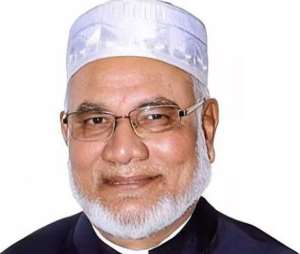
The death of A.K.M. Rehmatullah on June 2, 2026, at the age of 75 marks more than the passing of a veteran politician and academic. It signals the gradual departure of a generation that emerged from the crucible of Bangladesh’s birth and went on to shape nearly every major institution of the republic. Rehmatullah’s life was not merely a personal journey through academia and politics. It was a reflection of the ambitions, achievements, compromises, and contradictions that defined post-independence Bangladesh itself.
Few public figures embodied the intersection of intellectual authority and political power as completely as Rehmatullah. Over a career spanning four decades, he moved comfortably between the classrooms of Dhaka University and the turbulent arena of national politics. In many ways, his story illustrates a reality that has long characterized Bangladesh: the most influential actors are often those capable of operating simultaneously within the worlds of ideas and power.
His passing invites not only remembrance but also reflection. It raises larger questions about the role of universities in political life, the evolution of Bangladesh’s ruling elite, and the difficult balance between democratic ideals and the practical demands of governance.
From the Liberation Generation to the Republic’s Institutions
To understand Rehmatullah, one must first understand the historical moment that produced him.
Like many members of his generation, his political and intellectual identity was shaped by the events surrounding the Liberation War of 1971. The generation that came of age during Bangladesh’s struggle for independence carried with it a profound sense of mission. For them, the state was not an inherited institution but a hard-won achievement that required constant defense.
This mindset profoundly influenced Bangladesh’s post-independence political culture. Many academics, lawyers, journalists, and civil servants viewed themselves not as neutral observers but as active participants in the nation-building project. Rehmatullah belonged firmly within this tradition.
As a law professor and later Dean of the Faculty of Law at Dhaka University, he helped educate generations of judges, lawyers, bureaucrats, and policymakers. Former students frequently recalled his rigorous approach to legal reasoning and his insistence that law could never be separated from the realities of statecraft.
At a time when Bangladesh was still consolidating its institutions, figures like Rehmatullah played an important role in strengthening professional education. The country’s legal system, despite its many challenges, benefited from a cadre of scholars committed to developing legal expertise within a young republic still finding its footing.
Yet the significance of his academic career extended beyond the classroom. He represented a model of public intellectual engagement that has become increasingly rare in many parts of the world. He believed universities should not stand apart from national struggles but should actively participate in them.
The Promise and Peril of Politicized Academia
However, this belief also placed him at the center of one of Bangladesh’s most enduring debates.
Supporters viewed Rehmatullah as a defender of secular and progressive values during periods when universities became battlegrounds for competing ideological visions. They argue that his involvement in university politics helped protect institutions from forces seeking to undermine the principles upon which Bangladesh was founded.
Critics see the matter differently.
For them, Rehmatullah represented a broader trend that transformed universities into extensions of national political competition. They argue that the growing influence of party affiliations within academic administration weakened meritocratic norms and contributed to a culture where political loyalty occasionally carried greater weight than scholarly achievement.
This debate extends far beyond any single individual. It reflects a structural challenge that has confronted many developing democracies. Universities are expected to remain centers of independent thought, yet they are often deeply affected by the political conflicts unfolding outside their gates.
Rehmatullah neither created this reality nor escaped it. Rather, he became one of its most prominent embodiments.
The truth likely lies somewhere between the competing narratives. His academic contributions were substantial and widely acknowledged. At the same time, his career illustrates how difficult it became to separate intellectual leadership from partisan engagement in modern Bangladesh.
A Political Career Shaped by Persistence
If Rehmatullah's academic life revealed his intellectual ambitions, his political career demonstrated his organizational skill and resilience.
Unlike many politicians whose influence rises and falls with a single electoral cycle, Rehmatullah built a durable presence across multiple eras of Bangladesh’s political development. Beginning his parliamentary journey in the mid-1980s, he remained relevant through periods of military influence, democratic transition, intense partisan conflict, and the consolidation of Awami League dominance.
Such longevity is rarely accidental.
Bangladeshi politics has often been unforgiving. Political fortunes can change rapidly, alliances shift unexpectedly, and electoral landscapes evolve with remarkable speed. Rehmatullah's ability to remain influential for decades suggests a deep understanding of grassroots organization and party management.
His election victories in Dhaka constituencies reflected more than personal popularity. They demonstrated his capacity to adapt to the changing character of the capital itself.
Dhaka transformed dramatically during his political lifetime. What was once a relatively compact city became one of the world's largest urban centers. Millions migrated from rural districts in search of opportunity. Infrastructure struggled to keep pace. New neighborhoods emerged almost overnight.
Politicians who succeeded in Dhaka had to navigate not only ideological disputes but also practical concerns involving transportation, housing, education, sanitation, and employment. Rehmatullah understood that political survival increasingly depended upon addressing these everyday realities.
Development, Power, and Democratic Tensions
The strongest arguments in favor of Rehmatullah's political legacy revolve around development.
His supporters point to improvements in local infrastructure, educational facilities, and public services during his years of influence. They argue that Bangladesh's remarkable economic rise required disciplined political leadership capable of delivering tangible results.
Indeed, Bangladesh's transformation over the past three decades has been extraordinary. Once dismissed internationally as a development basket case, the country emerged as one of South Asia's most significant economic success stories. Improvements in life expectancy, female education, poverty reduction, and industrial growth have drawn global recognition.
Rehmatullah belonged to the political generation that oversaw much of this transformation.
Yet development alone cannot settle debates about political legacy.
His critics argue that the pursuit of stability and development often came at the expense of political pluralism. As a senior leader within the ruling party structure in Dhaka, he became associated with a political system increasingly criticized by opponents for narrowing the space available for dissent.
This criticism was not directed solely at Rehmatullah. It reflected broader concerns about the trajectory of Bangladeshi politics during a period of intense polarization.
The tension between effective governance and robust democratic competition is hardly unique to Bangladesh. Similar debates have appeared across Asia, Africa, and Latin America. The central question remains difficult: how should societies balance the need for political stability with the imperative of preserving democratic contestation?
Rehmatullah's career offers no easy answers. Instead, it serves as a case study in the complexities of governing a rapidly developing nation.
The Legacy of a Transitional Figure
History rarely remembers individuals in simple terms. The most consequential figures often leave behind legacies that resist easy classification.
A.K.M. Rehmatullah was neither a detached academic insulated from political realities nor a conventional politician lacking intellectual substance. He occupied a space between those worlds, drawing strength and controversy from both.
Future historians will undoubtedly continue debating his impact. Some will emphasize his contributions to legal education, institutional development, and urban governance. Others will focus on the politicization of academia and the increasingly partisan nature of public institutions during his era.
Both perspectives contain elements of truth.
What seems beyond dispute is that Rehmatullah belonged to a generation that shaped modern Bangladesh at a pivotal moment in its history. Their achievements helped transform the country into a more prosperous and capable state. Their decisions also left unresolved questions about the future of democratic institutions and political culture.
As Bangladesh moves toward a new political era, the lives of figures like A.K.M. Rehmatullah offer an opportunity for reflection. They remind us that nation-building is never a straightforward process. It is a continuous negotiation between ideals and realities, principles and power, aspiration and compromise.
Rehmatullah spent his life navigating those tensions. In doing so, he left an enduring imprint on both the institutions of the republic and the story of the nation itself.
M A Hossain is a senior journalist and international affairs analyst, based in Bangladesh. He can be reached at: [email protected]


 S.Africa asks regional summit for unity after anti-migrant backlash
 Lamour leaves key FIFA position after criticising Infantino
 EOCO leading AKSA bribery probe because case may involve money laundering not un...
 Ghana Cedi appreciates against US dollar from GHS11.75 to 10.94 in one week
 COCOBOD deploys directors to all 16 regions to improve cocoa production
 Bongo: Completed Gurigo mortuary abandoned for six years, families still travel ...
 New Defence Minister Kenneth Gilbert Adjei officially takes charge
 We will formalise mining to create jobs for young people, curb galamsey – Mahama
 ECG announces planned power outages in Greater Accra, Ashanti and Central region...
 ‘GoldBod is a very big scandal awaiting us; there are things we know that they d...

