




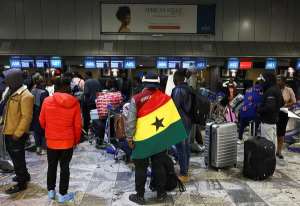
On 29 May 2026, a chartered flight carrying Ghanaian nationals landed in Accra. Many had chosen to leave South Africa because they no longer felt safe amid growing xenophobic tensions and anti-immigrant hostility.
The images were difficult to watch. Men, women and families who had travelled to South Africa in search of work, opportunity and a better future were returning home under circumstances few had imagined.
For many Ghanaians, the event raised troubling questions. How did we arrive at a point where Africans feel unsafe among fellow Africans? How did South Africa, once celebrated as a symbol of liberation and hope, become a place where some African migrants fear for their safety?
Beyond poverty and unemployment
The renewed wave of xenophobic attacks and vigilante actions against migrants from Ghana, Zimbabwe, Malawi, Kenya and other African countries has once again drawn attention to growing tensions in South Africa. Much of the anger has been linked to unemployment, poverty, pressure on public services and anti-immigrant campaigns associated with groups such as Operation Dudula.
These explanations contain some truth. South Africa faces serious social and economic challenges. Unemployment remains extremely high. Inequality remains among the highest in the world. Many communities continue to struggle with poverty, inadequate services and limited opportunities. Yet economic hardship alone cannot explain what is happening.
Many countries face unemployment and poverty without experiencing repeated waves of xenophobic violence. South Africa has witnessed major outbreaks of anti-immigrant violence before, including the deadly attacks of 2008, as well as later incidents in 2015, 2019 and 2021. The fact that such violence continues to reappear suggests that deeper forces are at work.
The long shadow of Apartheid
To understand those forces, we must look beyond today’s headlines and examine the long shadow cast by apartheid.
Most discussions of apartheid focus on politics, race and economics. These are important. Apartheid denied millions of Black South Africans basic rights and opportunities. It controlled where people could live, work and travel. It separated families, communities and entire populations. But apartheid did more than organise society. It also shaped how people related to one another.
For decades, South Africans lived in a system built on division, hierarchy and exclusion. People were classified, separated and treated differently according to racial categories. Communities were forced into competition over scarce resources and opportunities. Trust was damaged. Human dignity was denied. Such experiences leave psychological and emotional scars that do not disappear simply because laws change. Political systems can change quickly. Psychological wounds often take much longer to heal.
The psychology of oppression
More than thirty years after the end of apartheid, many Black South Africans continue to experience poverty, unemployment and social exclusion. The promise of liberation brought hope for a more just and inclusive society, but for many people, that hope remains only partly fulfilled. This is where the psychology of oppression becomes important.
Oppression affects more than material conditions. It also affects identity, emotions and social relationships. Long experiences of exclusion and humiliation can create frustration, resentment and insecurity.
When people feel that society has failed them, they often search for explanations. Sometimes they also search for someone to blame. Migrants then become an easy target. It becomes easy to portray them as the cause of problems that are actually rooted in much deeper historical and structural conditions. Yet migrants did not create apartheid. They did not create South Africa’s inequality.
Fanon’s warning
The great anti-colonial thinker Frantz Fanon offered an important insight into this process. Fanon argued that systems of oppression leave psychological wounds that often survive long after formal liberation. When the deeper causes of suffering remain unresolved, frustration may be redirected towards other vulnerable groups rather than towards the structures that continue to produce inequality.
This helps explain one of the tragic ironies of xenophobic violence. Many of those who attack migrants are themselves descendants of people who experienced oppression, exclusion and discrimination. Many of the migrants they target also come from societies shaped by colonialism, poverty and political instability. Both groups carry histories of hardship, yet they find themselves positioned against one another. The result is a painful cycle in which people who share similar experiences of suffering become divided.
A painful lesson for Ghana and Africa
For Ghanaians, these developments are particularly painful. Ghana was among the African countries that strongly supported the struggle against apartheid. Long before South Africa became a democracy, many African governments and citizens stood in solidarity with the anti-apartheid movement. They understood that the struggle for freedom in South Africa was also a struggle for the dignity of all Africans.
The arrival of Ghanaian returnees in Accra, therefore, carries powerful symbolism. It reminds us that political liberation alone does not automatically heal the wounds created by decades of oppression. The end of apartheid removed unjust laws, but it could not instantly erase inequality, trauma or social division.
This does not mean that South Africans are uniquely intolerant or that all South Africans support xenophobic violence. On the contrary, many South Africans have repeatedly condemned the attacks and shown solidarity with migrant communities.
The work of liberation is not finished
The challenge is therefore not about blaming South Africans as a people. It is about recognising how historical injustice, persistent inequality and unresolved social wounds can create conditions in which fear and frustration are directed towards vulnerable groups.
The return of Ghanaians on a chartered flight should concern not only South Africa but the entire African continent. It reminds us that the work of liberation remains unfinished. Freedom is not only about removing oppressive laws. It is also about building societies where dignity, justice and opportunity are shared by all. Until that happens, the ghosts of the past will continue to appear in new forms.
Xenophobic violence in South Africa is not separate from the history of apartheid. It is one of its afterlives. It reveals how deeply systems of oppression can shape societies long after they have formally ended. More importantly, it reminds us that the future of Africa depends not only on economic growth or political stability, but also on our ability to recognise our shared humanity and resist the temptation to turn our frustrations against one another.
The Ghanaians who stepped off that plane in Accra on 29 May 2026 brought home more than suitcases and personal belongings. They brought home a reminder that the struggle for justice, dignity and African solidarity is not yet complete.


 Ghana announces visa-free travel to Maldives, Zambia and Antigua and Barbuda
 Mahama swears in three new Supreme Court justices, urges judicial independence
 'Aren’t you over dramatising after you advised Akufo-Addo to give us ugly financ...
 Hopeson Adorye urges security agencies to investigate Obiri Boahen’s warning to ...
 'Administer justice without fear or favour, affection or ill will' — Mahama tell...
 Tema Port congestion alone cannot justify GHS12 cement price increment – GPHA
 UTAG-KNUST threatens legal action over Pro-VC and Dean appointments
 NPP is recycling failed politicians in its upcoming national executive elections...
 30,000 job creation projection for Accra-Kumasi Expressway is even conservative ...
 'You can't use profits to finance the creature comforts of management and boards...


