




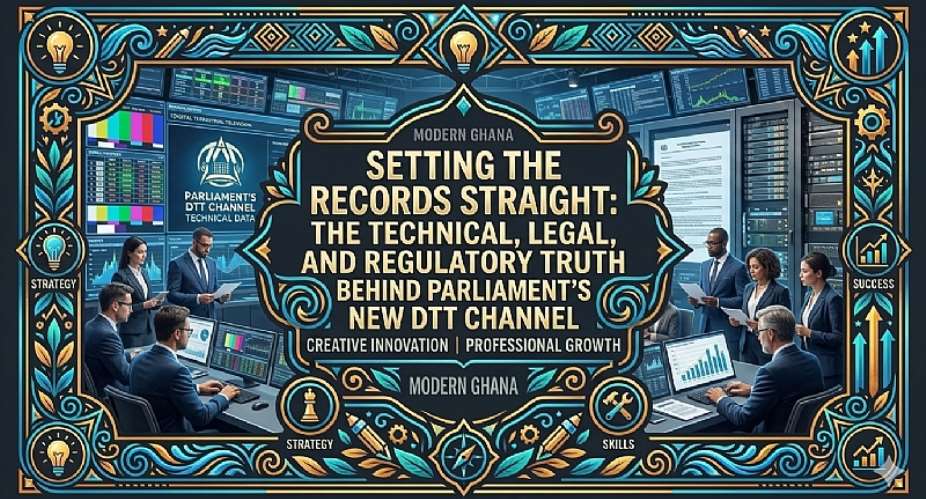
ACCRA, GHANA — In a rapidly evolving digital media landscape, accurate public information is the bedrock of national development and democratic governance. Recent discourse surrounding how the Parliament of Ghana secured its television slot on the National Digital Terrestrial Television (DTT) platform has sparked vital conversations. To ensure Ghanaians are accurately informed, it is essential to clarify the technical, legal, and administrative pathways that enabled this historic broadcasting milestone.
Far from bypassing established state protocols, the integration of the parliamentary channel stands as a prime example of inter-institutional collaboration. By utilizing the existing infrastructure of the state broadcaster, the Ghana Broadcasting Corporation (GBC), and operating strictly under the regulatory oversight of the Ministry of Communications and Digitalisation (MoCD) and the National Communications Authority (NCA), this initiative sets a benchmark for efficient resource management in public interest broadcasting.
The Technical Reality: How the Channel Was Secured
From an institutional and infrastructural perspective, the deployment of the parliamentary channel was executed through a strategic partnership within the public sector, optimizing state resources rather than creating redundant infrastructure.
- The GLTV Handover: GBC legally relinquished its dedicated Learning Channel (GLTV) space, transferring it directly to Parliament to facilitate the birth of the legislative channel.
- Multiplex Access: Through this resource transfer, Parliament secured its technical footprint on both the GBC-operated DTT multiplex (T1) and the National DTT multiplex (T2).
- Zero Infrastructure Waste: This arrangement saved the state millions of dollars by eliminating the need to procure new broadcast frequencies or independent transmission hardware.
Underscoring the collaborative and lawful nature of this technical arrangement, the Director-General of GBC, Prof. Amin Alhassan, stated:
"Parliament passed through GBC to secure a space on the National DTT (T2) and the GBC-operated DTT (T1). GBC gave out its Learning Channel (GLTV) to Parliament to operate its channel. Parliament cannot bypass the Ministry of Communications and the NCA."
The Legal Framework: The Regulatory Roles of MoCD and NCA
Under Ghanaian law, no state agency, including Parliament, can independently establish a broadcast presence on the national spectrum without clearing strict statutory hurdles. The process strictly respected the mandates of Ghana's communication regulators:
- The Ministry of Communications and Digitalisation (MoCD): As the policy-making organ of the state, the MoCD oversees the overarching national digital migration strategy, ensuring that all spectrum use aligns with Ghana’s national development goals.
- The National Communications Authority (NCA): Operating under the Electronic Communications Act, 2008 (Act 775), the NCA is the sole legal custodian of the nation's radiofrequency spectrum. Parliament did not, and cannot, bypass the NCA; all technical parameters, compression standards, and multiplex assignments remain fully subject to NCA authorization and compliance monitoring.
Aligning with International Best Practices
The collaboration between GBC and Parliament mirrors global standards for public service broadcasting and digital spectrum management.
- ITU Compliance: The International Telecommunication Union (ITU) strongly advocates for the structural separation of content production and signal distribution to maximize spectral efficiency. Ghana's approach follows this directive perfectly.
- The EBU Model: The European Broadcasting Union (EBU) frequently showcases models where public service broadcasters share infrastructure with civic, educational, and parliamentary bodies to lower operational costs and protect public funds.
- Democratic Transparency: Universally, providing unhindered, free-to-air access to parliamentary proceedings strengthens democracies by fostering civic engagement, a standard Ghana is proudly upholding.
Commitment to Public Transparency and Information Accessibility
A core tenet of modern democratic governance is the right to information. For public sector partnerships to remain accountable, structural details regarding national spectrum agreements must be completely transparent.
- Multi-Format Dissemination: Full technical, legal, and operational information regarding this partnership must be made publicly available and easily accessible across all media platforms.
- GBC Digital Repository: If it is not already available, this data should be permanently published and clearly archived on the official GBC website, ensuring researchers, journalists, and citizens can verify the facts at any time.
Strategic Recommendations for Ghana’s Broadcasting Future
To build upon this success and secure the long-term viability of Ghana's DTT ecosystem, the following policy interventions are recommended:
- Codify Public-Public Partnerships: Government should create a formalized legal framework that allows state institutions to share digital multiplex space seamlessly, preventing commercial exploitation of public spectrum.
- Establish a Dedicated Civic Tier: A specific, ring-fenced tier should be created on the T1/T2 multiplexes dedicated exclusively to education, culture, governance, and legislature, protected from commercial bidding.
- Secure Sustainable Funding: Parliament and GBC should collaborate on an independent, state-guaranteed funding mechanism to ensure high-quality production and continuous transmission of civic content without relying on commercial advertisements.
- Strengthen NCA Technical Oversight: The NCA must be equipped with advanced, automated monitoring tools to manage bandwidth allocation dynamically, ensuring optimal picture and audio quality across all public channels.
The entry of Parliament into the national DTT space is a triumph of regulatory adherence and institutional synergy. By working within the lawful boundaries managed by the Ministry of Communications and Digitalisation and the NCA, and by leveraging GBC’s existing T1 and T2 multiplex infrastructure, the state has demonstrated how to deploy public assets responsibly. This milestone does more than just inform the public; it deepens Ghanaian democracy, honors international communication standards, and provides a clear, sustainable blueprint for the future of public service broadcasting in Africa.
✍️ Retired Senior Citizen
For and on behalf of all Senior Citizens of the Republic of Ghana 🇬🇭
Teshie-Nungua

 Mysterious illness leaves children struggling to walk, hear in Mafi Kope
 ‘We’ve come back to make sure our father's ideas never die’ – Nkrumah family
 Ghana Jollof: Akosua Manu appeals to Naana Jane to use her influence to free Sal...
 Yellow fever confirmed in Sissala East after 21 mysterious deaths
 Kenyasi man allegedly attacked by prison officers and inmates over yam theft cla...
 Germany’s far-right AfD makes strong gains in two state elections
 Savannah Regional Minister, IGP Yohuno visit Gbindabuor following lynching of po...
 Jehovah's Witnesses make blood component decisions a matter of personal conscien...
 Road contractors fed on contracts for years without completing projects – Alhass...
 Ghana Jollof saga: ‘She has no right to do what she’s doing’ – Inusah Fuseini


