




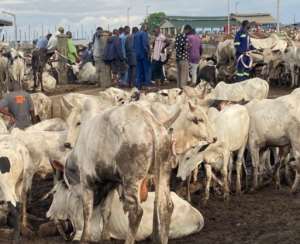
From the cattle corridors of the Sahel to the abattoirs of Lagos and Accra, a convergence of jihadist predation, export bans, climate shocks, and currency collapse has shattered a livestock trade that once fed hundreds of millions. The animals are still there but fewer people can afford them, and the supply chain that once moved them has been hijacked, fragmented, and weaponized.
May 2026. The price was once a matter of negotiation. Today, it is a matter of impossibility. In the run-up to Eid al-Adha in 2025, traders at Lagos’s Kara livestock market one of the largest in West Africa watched as buyers circled animals they could not afford and walked away. Ram prices had doubled year-on-year. Premium cattle breeds were selling for between ₦1.5 million and ₦2 million, sums that would have been unthinkable even two years earlier.
The festive slaughter, central to the religious and social life of millions of Muslim families across the region, had become a luxury for all but the wealthy. Across the border in Benin, beef prices had risen by at least 17 percent over the previous year. In northern Ghana, cattle markets near the Burkina Faso frontier were being quietly supplied by animals whose origins no one was asking too many questions about.
In Niamey, the Nigerien government had placed a ban on livestock exports so sweeping it covered cattle, sheep, goats, and camels a measure that, in severing one of the region’s most critical supply arteries, sent shockwaves through markets from Cotonou to Abuja.
The livestock crisis in West Africa did not happen overnight, and it does not have a single cause. It is the product of a compound emergency: a security catastrophe in the Sahel that has destroyed pastoral livelihoods; a cascade of trade policy decisions made by governments under pressure; a currency crisis that has made imported feed and veterinary supplies prohibitively expensive; and a climate-driven degradation of grazing land that is shrinking the productive base of an industry that supports more than 80 million people across the sub-region.
The Backbone of a Regional Economy To understand
The scale of the disruption, it helps to understand what was once in place. West Africa’s livestock sector is not a peripheral industry. In the Sahelian countries Niger, Mali, Burkina Faso, Chad livestock production accounts for 10 to 15 percent of GDP and provides livelihoods for the majority of rural households.
The animals raised on the semi-arid grasslands of the Sahel have historically flowed south through a network of trade routes developed over centuries, supplying coastal markets in Nigeria, Ghana, Benin, Ivory Coast, and beyond with the beef, mutton, and goat meat that form the protein backbone of local diets. Niger alone had for decades served as the regional livestock reservoir.
Its vast pastoral zones held some of the largest cattle herds in West Africa, and live animal exports were a cornerstone of rural income, with Nigerien livestock flowing in substantial volumes to Nigeria, Ghana, Côte d’Ivoire, and Benin. The trade was informal by the standards of international commerce but highly organized in practice, governed by networks of Hausa and Fulani traders, market intermediaries, and transporters who had developed the system across generations. That system is now under existential pressure from multiple directions simultaneously.
The Sahel’s War Economy Comes
For the Herds The first and most violent disruption has come from the insurgency that has swept across Mali, Burkina Faso, and Niger since 2012 and that has intensified sharply in the years since. Jihadist groups principally Jama’at Nusrat al-Islam wal-Muslimin (JNIM), an al-Qaeda affiliate, and Islamic State Sahel Province have turned cattle rustling into one of their primary revenue streams.
The scale of the theft is staggering. Since 2017, the Food and Agriculture Organization estimates that over eight million heads of livestock have been stolen in Burkina Faso alone. JNIM militants manage what researchers have described as a sophisticated and lucrative operation: seizing cattle from Fulani herders in their forest bases, then funneling the animals into the legal livestock market through a chain of trusted intermediaries agents, butchers, transporters, traders, and, in some cases, corrupt local officials. In northern Burkina Faso alone, JNIM was reportedly earning between 25 and 30 million CFA roughly $44,500 to $53,400 per month from livestock theft in 2021.
The proceeds fund weapons, fuel, motorbikes, and logistics. But the economic damage extends far beyond the direct financial loss to herders. A July 2025 study by the Global Initiative Against Transnational Organized Crime documented how the trade has become embedded in the broader livestock economy of coastal West Africa, with stolen Sahelian cattle being laundered into Ghana’s licit markets through intermediaries near the Burkina Faso border.
The Clingendael Institute, in a separate report published the same month, traced the same pipeline through the tri-border region of Burkina Faso, Ghana, and Togo, finding that rustled cattle from the Sahel was financing extremist recruitment as well as operations.
The consequence for legitimate herders is devastating. Pastoralists who once moved their animals along established corridors are now operating in territories controlled or taxed by armed groups. Those who resist face beatings, death, or sexual violence. Many have fled across borders, taking their animals with them or abandoning them altogether.
The productive base of the Sahelian livestock economy once home to 9.6 million cattle, 15 million goats, and 10 million sheep in Burkina Faso alone has contracted severely. Niger Shuts the Tap If the insurgency has destroyed supply at the point of production, a series of political decisions have compounded the damage at the point of distribution. The most consequential of these was the military coup in Niger in July 2023, which triggered an ECOWAS response that included the closure of the 1,060-kilometre border corridor linking Cotonou to Niamey.
That corridor had previously seen around 1,000 vehicles crossing every day, carrying goods in both directions. Its closure strangled Niger’s trade with its southern neighbors and introduced an immediate shock to the supply of Nigerien livestock reaching coastal markets. But Niger then compounded the problem domestically. Facing its own rising meat prices driven by internal scarcity, Niamey moved to restrict livestock exports. In May 2025, ahead of Eid al-Adha, the government blocked exports to limit supply pressures. The measure was lifted days after the holiday but prices remained elevated. Then, on March 3, 2026, Niger’s Ministry of Commerce reactivated the ban in a more structural form, with strengthened enforcement covering all main livestock species: cattle, sheep, goats, and camels.The impact on neighboring markets was immediate and measurable. In Benin, beef prices rose by 17 percent year-on-year in 2025.
The October 2025 SIM-Bétail bulletin recorded annual price increases ranging from 18 to 32 percent depending on the category. Benin itself had become a coveted supply zone, with buyers arriving from Nigeria, Niger, and Burkina Faso to compete for animals at Beninese markets.
In Nigeria, Africa’s most populous nation, the arithmetic was brutal. Nigeria imports the bulk of its livestock from Niger, Mali, and Chad. By 2025, prices had escalated sharply across all size categories. Small cows that had sold for under ₦300,000 were trading at ₦500,000 to ₦600,000 in Abuja’s Durumi livestock market. Medium animals had crossed the ₦1 million thresholds. Large premium breeds, such as Sokoto Gudali, were reaching ₦1.5 million to ₦2 million. For Eid al-Adha 2025, ram prices jumped by 100 percent year-on-year.
Currency, Cost, and the Collapse of Purchasing Power
The price shock in livestock markets did not occur in isolation. It was amplified and accelerated by a broader economic collapse that has eroded household incomes across the sub-region. Nigeria’s naira lost more than half its value between 2023 and 2025 following the removal of fuel subsidies and the unification of the foreign exchange market.
The devaluation made imported livestock feed, veterinary medicines, and transport fuel all priced in dollars or Euros at the point of origin dramatically more expensive in local currency terms. Livestock farmers who depended on commercial feed saw their input costs surge. Those costs were passed on to consumers, compressing demand even as supply was falling. Ghana’s cedi had undergone a similarly painful adjustment in the wake of its 2022 debt default and subsequent IMF programme.
Inflation, which reached 54 percent at its peak in late 2022, had eased but not reversed the damage to household purchasing power. For Ghanaian consumers, the imported cattle and small ruminants that arrive via the northern border already more expensive due to supply disruptions were now competing for a cedi that bought far less than it once did.
The result, documented across markets from Accra to Abuja to Cotonou, was a paradox familiar to food economists: prices rising and demand falling simultaneously, as the market contracted at both ends. Traders reported low livestock sales even during festive seasons when demand would normally surge.
The Climate Dimension Underlying
all of the above, and rarely discussed in its full implications, is the long-term degradation of the natural resource base on which West African pastoralism depends. The Sahel has been warming at approximately 1.5 times the global average, and erratic rainfall patterns have become the norm across the pastoral zones of Mali, Niger, Burkina Faso, and northern Nigeria.
Droughts reduce the availability of water and pasture, forcing herders to move their animals in search of grazing increasing costs, extending transit times, and causing weight loss in animals that reach market in poorer condition. Floods, which struck Niger, Ghana, Nigeria, Chad, Mali, and Guinea severely in 2024, destroyed pasture, killed animals directly, and disrupted the movement of livestock along trade routes.
Desertification is advancing across the northern pastoral zones. Herders are being pushed south, into contact with sedentary farming communities, generating the farmer-herder conflict that has claimed tens of thousands of lives across the Middle Belt of Nigeria and the equivalent zones of the Sahel. Land that was once available for grazing is now contested or inaccessible. Security costs for herders moving animals through conflict zones have risen sharply, and those costs are built into the prices that eventually reach urban consumers.
The Stolen Market: How Jihadist Cattle Reaches Your Plate
One of the most troubling dimensions of the current crisis is the degree to which the livestock supply chain has been corrupted at its source. Researchers at the Clingendael Institute, the Global Initiative Against Transnational Organized Crime, and the Africa Defense Forum have separately documented a pipeline in which cattle stolen by jihadist groups in the Sahel is laundered into West Africa’s licit livestock markets through networks of intermediaries.
In Ghana, stolen livestock is typically sold at cattle markets near the Burkina Faso border, where it enters the formal supply chain through butchers and traders who mix it with legitimately sourced animals. The perverse economics of this trade have had a distorting effect on market prices.
Stolen cattle, sold by armed groups at below-market prices to generate quick cash for operations, undercuts legitimate producers who bear the full cost of rearing their animals. At the same time, the theft of animals from Sahelian herders removes them from the legitimate supply chain, tightening overall supply even as stolen replacements flood in at artificially low prices.
The result is a livestock market that is simultaneously over- and under-supplied: awash with animals of dubious provenance at one price point and denuded of legitimately produced animals that the market cannot sustain at the prices needed to cover production costs. Legitimate herders are being driven out. Criminal and insurgent actors are being incentivized. And the consumer, at the end of this distorted chain, faces prices that reflect not the normal operation of supply and demand but the premium of a market at war with itself.
What Comes Next
The response from regional governments has been piecemeal and, in some cases, counterproductive. Niger’s export ban protects Nigerien consumers in the short term but deepens supply crises in Nigeria, Ghana, and Benin, and may ultimately encourage the very informal and illicit trade it is designed to prevent. Nigeria has launched livestock sector reform initiatives but these remain in early stages against a backdrop of worsening insecurity in the north. At the regional level, the November 2024 Nouakchott Declaration on livestock development and pastoral systems security, signed by fifteen West African and Sahelian governments, acknowledged the structural nature of the crisis and called for co-ordinate regional action.
But the political fractures exposed by the Sahel coups Niger, Mali, and Burkina Faso have all withdrawn from ECOWAS make regional co-ordination harder to achieve precisely when it is most needed. For ordinary West Africans, the policy debates are a distant abstraction. What is immediate is the cost of meat at the market stall, the empty plate during a feast day, and the quiet decision to forgo the animal sacrifice that marks a religious occasion.
Across the sub-region, millions of families have already made that calculation. The livestock crisis is not a crisis of production alone it is a crisis of access, and of the economic dignity of households that once took their place in a market that worked. That market, the product of generations of pastoral tradition and regional commerce, is now under pressure from forces that no single government and no single policy instrument can address alone. Until the Sahel’s security crisis is brought under control, until trade policy is co-ordinate rather than competitive and until the long-term degradation of pastoral land is reversed, the stalls will stay expensive and for many, they will stay empty.
Reporting draws on: Global Initiative Against Transnational Organized Crime (GI-TOC) cattle rustling reports (2024–2025); Clingendael Institute “Cattle Wahala” (July 2025); The Africa Report; The New Humanitarian; Nigeria’s The Nation; Modern Ghana; SIM-Bétail market bulletins; FAO GIEWS regional roundups; World Bank Nouakchott Declaration (November 2024).
Mustapha Bature Sallama.
Medical/ Science Communicator,
Private Investigator, Criminal investigation and Intelligence Analysis.
International Conflict Management and Peace Building.USIP
[email protected]
+233-555-275-880


 Miracles Aboagye arrest: 'You looted and your reaction is that the tables will t...
 Police arrest two with 73 parcels of suspected cannabis, reject GH¢300,000 bribe
 NACOC traces 73 assets linked to suspected drug traffickers
 Government seeks financial clearance to recruit 400 scientists – Armah Kofi-Buah
 Ya‑Naa Abubakari II laid to rest at Gbewaa Palace
 NPP will reinstate workers unlawfully sacked by NDC government - Chairman COKA
 'Neglecting grassroots dangerous' – GFL warns NDC, NPP
 'No money, no vote' — Bongo NPP delegates tell contestants in constituency execu...
 NAM1 files witness statements in Menzgold trial, seeks to rely on seven defence ...
 Miracles Aboagye’s wife raises health concerns over husband's detention by EOCO

