




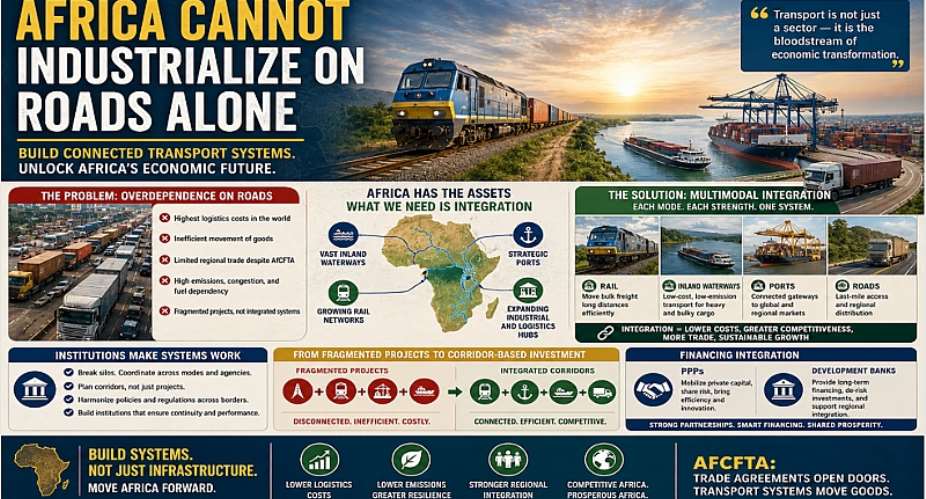
For decades, Africa’s development ambitions have been framed around industrialization, regional integration, and economic transformation. Governments have launched national visions, regional blocs have signed trade agreements, and billions have been invested in infrastructure. Yet beneath all these ambitions lies an uncomfortable truth: the continent is still trying to build a 21st-century economy on a largely 20th-century transport logic.
Africa moves too much of its future on roads.
From Lagos to Nairobi, Accra to Johannesburg, trucks dominate freight movement. Highways carry everything, fuel, cement, food, minerals, machinery, containers, and agricultural products. Roads have become the default answer to nearly every transport challenge. But while roads are essential, they were never designed to shoulder the entire burden of continental development. This overdependence is now becoming economically, environmentally, and strategically unsustainable.
The issue is not that Africa lacks infrastructure investment. The issue is that much of the investment has been fragmented, politically driven, and insufficiently integrated. Railways are rehabilitated without logistics connectivity. Ports are expanded without efficient inland corridors. Inland waterways remain disconnected from national transport strategies. What emerges is not a system, but a collection of projects competing rather than complementing one another. Africa has some of the highest logistics costs in the world. In many countries, transport expenses consume a substantial share of the final price of goods. Farmers struggle to move produce efficiently to markets. Manufacturers face delays and high freight charges. Cross-border trade remains slow despite the promise of the African Continental Free Trade Area (AfCFTA). In effect, transport inefficiency has become a hidden tax on African development. Yet the continent possesses something extraordinary: natural and strategic transport assets that remain underutilized.
Africa has vast inland waterways, major river systems, expanding port infrastructure, and growing rail ambitions. From the Congo River Basin to Lake Victoria, from the Niger River to the Volta Lake system, the foundations for integrated transport systems already exist. What is missing is not geography, it is coordination, governance, and long-term strategic thinking. This is why the future of African transport cannot be road-dominated. It must become multimodal.
A modern African transport system should function as an integrated network where each mode plays its most efficient role:
- Railways move bulk freight across long distances
- Inland waterways carry heavy cargo at low cost and low emissions
- Ports serve as connected logistics gateways
- Roads provide last-mile accessibility and regional distribution
This is how the world’s most efficient economies move goods. Europe’s Rhine Corridor integrates inland waterways, rail, and ports into one seamless system. China’s logistics transformation was built on coordinated transport corridors linking rivers, railways, industrial hubs, and export zones. These systems succeeded not because they built more infrastructure, but because they built connected infrastructure.
Africa now faces the same strategic choice.
The urgency extends beyond economics. Climate change is redefining infrastructure priorities globally, and transport sits at the center of that conversation. Road freight produces significantly higher emissions compared to rail and inland water transport. As African cities grow and trade volumes increase, continuing to rely overwhelmingly on trucks will intensify congestion, pollution, and fuel dependency. Green transport is no longer a luxury discussion reserved for developed economies. It is becoming a core development issue for Africa itself.
Rail and inland waterways offer a pathway toward lower emissions, greater energy efficiency, and more resilient logistics systems. In an era of rising fuel prices and climate vulnerability, this transition is not ideological, it is practical. But infrastructure alone will not solve the problem.
Africa’s greatest transport challenge is institutional. Ministries operate in silos. Rail agencies rarely coordinate with port authorities. Inland water transport often falls outside mainstream policy planning entirely. Cross-border corridors face regulatory inconsistencies and administrative bottlenecks. In many cases, infrastructure exists but systems fail because governance is fragmented. This is why the future of African transport will depend as much on institutions as on engineering.
The continent must move away from project-based thinking toward corridor-based planning. Investments should no longer be evaluated in isolation, but as part of integrated regional logistics systems. Financing models must evolve from standalone infrastructure projects toward multimodal corridor development supported by development banks, private capital, and regional partnerships. Most importantly, Africa must begin planning transport beyond political cycles.
A railway corridor takes decades to mature. Inland water systems require long-term maintenance and governance frameworks. Industrial logistics ecosystems evolve gradually over generations, not election periods. Countries that transformed their transport systems did so because they sustained strategic continuity over time. This may be the most important lesson Africa must now confront: development is not built through isolated announcements, but through consistent systems thinking. The African Continental Free Trade Area has created an unprecedented opportunity for integration. But trade agreements alone cannot move goods. Corridors move goods. Systems move economies.
If Africa truly intends to industrialize, reduce trade costs, strengthen regional value chains, and compete globally, then transport must stop being viewed as a sector and start being understood as the bloodstream of economic transformation.
The continent does not merely need more roads.
- It needs railways connected to ports.
- Ports connected to inland waterways.
- Waterways integrated into regional trade corridors.
- Institutions capable of coordinating all of them together.
Africa’s future will not be determined by how much infrastructure it builds alone, but by whether that infrastructure functions as a coherent system.
And until that shift happens, industrial ambition will continue to move too slowly, stuck in traffic on roads that were never meant to carry the weight of an entire continent’s future.
Author: Joseph Fuseini ([email protected])


 'Stop excessive financial demands before sharing information with us' — Interior...
 EC will serve national interest, not partisan politics – Deputy Chair Dr Kwaku A...
 I expect no preferential treatment from EC for myself as President, my party or ...
 Afenyo-Markin meets management, proposes reforms to turnaround struggling ECG
 ECG management commends Afenyo-Markin for reforms during short stay as Board Cha...
 Mahama tasks new EC deputy chairpersons to uphold impartiality
 Attorney-General urges court to reject Adu-Boahene’s no-case submission
 Nyaho Medical Centre ordered to report to CID over expired data protection certi...
 Mahama swears in new Electoral Commission deputy commissioners
 PTAAM-Africa calls for government probe into alleged World Cup visa fraud


