




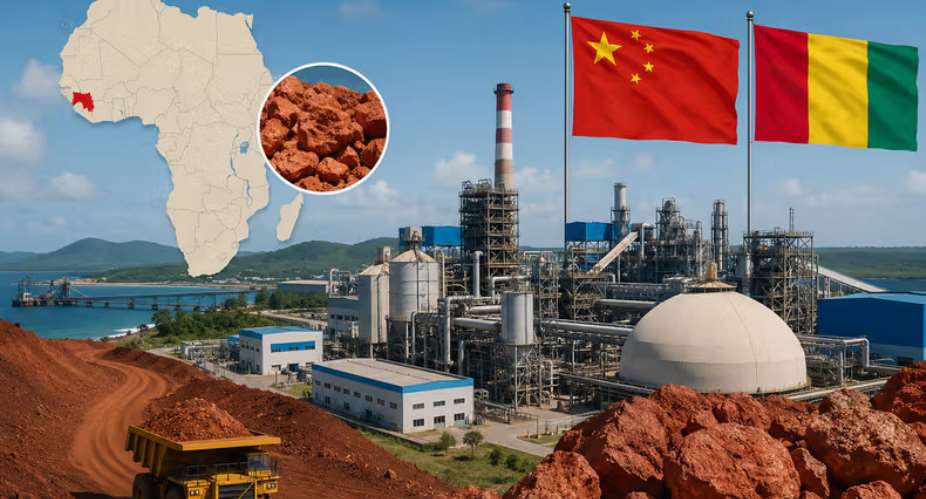
Beginning with a number that exposes Africa's oldest economic weakness. Twenty-nine percent. That is the share of global bauxite reserves that Africa holds. The continent is sitting on nearly a third of the world's supply of the raw ore that is turned into aluminium, which is then used to make everything from soda cans to airplane parts. But here is the shameful number that follows. Less than one percent. That is Africa's share of global alumina refining capacity. In simple language, Africa digs the bauxite out of the ground and ships it to China, Europe, and North America, where it is refined into alumina and then smelted into aluminium. Africa gets the dust and the environmental damage. Other continents get the jobs, the industrial development, and the profits. That pattern may finally be starting to change. Guinea, Africa's top bauxite producer, has just secured a $1 billion commitment from China's largest state-owned aluminum producer to build a new alumina refinery. And every Ghanaian should be watching closely.
Let me explain what has happened. Aluminum Corp of China, known as Chalco, has agreed to invest $1 billion in building a new alumina refinery in Guinea per report by Accra Street Journal. This will be Chalco's first alumina refinery outside China. The company has been mining bauxite in Guinea for over a decade at its Boffa mine. But until now, they shipped the raw ore to China for processing. Under the new agreement, they will build a refinery in Guinea to process the ore locally before shipping it. The refinery will have a capacity of 1.2 million tons per year. The Guinean government will initially receive a 5 percent stake at little or no cost, with the option to increase its holding to as much as 35 percent at market value. That means Guinea will own a piece of the value chain, not just tax the extraction.
This is a big deal for several reasons. First, it breaks the pattern. For decades, multinational companies have extracted Africa's minerals and shipped them out raw. Governments have been too weak to demand local processing, and companies have had no incentive to invest in expensive refineries when shipping raw ore was cheaper. But that calculus is changing. China is approaching a government-imposed domestic production cap on aluminum aimed at reducing emissions. Chinese smelters are already responsible for more than half of global aluminum production, but they cannot expand further at home. So they are looking to move processing closer to the source. Guinea is the logical place. It has the world's largest bauxite reserves. It has a government that is increasingly demanding local processing. And it has a Chinese mining presence that is already established.
Second, it sends a signal to other bauxite-rich countries, including Ghana. Ghana has significant bauxite deposits, particularly at Awaso and Nyinahin according to The High Street Business reports. For years, there have been plans to build an integrated aluminium industry, mining bauxite, refining it into alumina, and smelting it into aluminium using power from the Volta River Authority. Those plans have moved slowly. The Volta Aluminium Company, VALCO, has operated below capacity for years. The Ghana Integrated Aluminium Development Corporation was established to coordinate the sector, but progress has been incremental. The Chalco investment in Guinea is a reminder that Ghana's neighbours are moving. If Ghana does not act, its bauxite may stay in the ground while Guinea's bauxite feeds Chinese refineries.
Third, it highlights the changing nature of China-Africa economic relations. For years, China's engagement with Africa was focused on extracting raw materials and building infrastructure in exchange. That model is evolving. China is now investing in processing and manufacturing in Africa, driven by its own domestic constraints and by African governments' demands for local value addition. The Chalco refinery is not charity. It is a business decision driven by Chinese emissions caps and the economics of shipping alumina versus raw bauxite. But the effect is the same. Africa gets more processing capacity. Africa gets more jobs. Africa captures more value.
Let me also talk about the tensions that accompany these investments. Last year, Guinea revoked a major bauxite concession held by Emirates Global Aluminium's subsidiary, citing mining code violations. The company called the decision a breach of contractual rights. That dispute is ongoing. It is a reminder that while African governments want local processing, they also need to maintain a stable, predictable investment climate. Companies will not invest $1 billion in a refinery if they fear their concession could be revoked arbitrarily. Balancing national interest with investor confidence is difficult. Guinea is learning that lesson. Ghana should watch and learn.
The Chalco investment is part of a broader trend. Across Africa, countries are pursuing billion-dollar refinery projects. Ghana is planning an integrated aluminium industry. Cameroon is developing bauxite deposits. Nigeria is exploring its own bauxite potential. But the gap between planning and execution remains wide. Africa holds 29 percent of global bauxite reserves but less than 1 percent of refining capacity. Closing that gap requires billions of dollars in investment, reliable power supply, political stability, and predictable regulation. Those are not easy conditions to meet.
For Ghana, the lessons are clear. First, the government must prioritise the development of the integrated aluminium industry. The bauxite is there. The power potential is there. The market is there. What has been missing is the political will and the private sector partnership. The Chalco investment in Guinea should be a wake-up call. If Ghana does not move, its bauxite will remain stranded. Second, Ghana must create a stable investment climate. Mining and refining companies need long-term certainty. They need to know that contracts will be honoured, taxes will not be changed retroactively, and concessions will not be revoked arbitrarily. Third, Ghana must invest in the infrastructure that makes refining viable. Alumina refining is energy-intensive. Ghana has hydroelectric power, but it is not limitless. The government must ensure that power supply is reliable and affordable for industrial users.
The Chalco refinery also has implications for the global aluminium market. China is the world's largest aluminium producer, but its domestic production is capped for environmental reasons. Moving refining to Guinea allows Chinese companies to maintain or expand their market share without exceeding domestic caps. It also shortens the supply chain. Shipping alumina instead of raw bauxite is more efficient. The weight is lower, and the value is higher. That benefits both the producer and the consumer.
Let me also address the role of the Guinean government. Under the agreement, Guinea gets an initial 5 percent stake at little or no cost. That is a common structure for such projects. It allows the government to participate without upfront capital. The option to increase the stake to 35 percent at market value gives Guinea room to increase its ownership if the project succeeds. That is a reasonable balance. It rewards the government for facilitating the investment while allowing it to benefit from upside. The challenge will be ensuring that the government has the technical expertise to evaluate the project's value and negotiate effectively. That is where development partners and technical advisers come in.
The broader story is that Africa is finally beginning to process more of its own minerals. This is not just about bauxite. It is about lithium, cobalt, copper, gold, and oil. For decades, the continent has exported raw materials and imported finished goods. That is the definition of underdevelopment. The shift to local processing is slow, but it is happening. The Chalco refinery in Guinea is a milestone. It shows that Chinese companies are willing to invest in processing in Africa. It shows that African governments can negotiate better terms. And it shows that the old model of extract and export is not the only model.
For the ordinary Ghanaian, what does this mean? It means that the bauxite in the ground in the Western Region or the Eastern Region could eventually create jobs in Ghana, not just in China. It means that the dream of an integrated aluminium industry, from mine to refinery to smelter to finished product, is still alive. It means that Ghana does not have to accept being a raw material exporter forever. But it also means that Ghana must compete. Guinea is moving. Cameroon is moving. If Ghana does not move, its bauxite will stay in the ground, and its children will continue to look for jobs that are not there.
So here is my call to action. The Ministry of Lands and Natural Resources and the Ghana Integrated Aluminium Development Corporation should study the Chalco-Guinea deal. What terms did Guinea negotiate? What incentives did they offer? What infrastructure did they provide? Ghana can learn from both the successes and the mistakes. Parliament should hold hearings on the state of the aluminium industry. Why has progress been so slow? What are the obstacles? How can they be overcome? And the private sector, both Ghanaian and international, should see the Chalco investment as a signal. The time for bauxite processing in West Africa is coming. Those who position themselves early will capture the value. Those who wait will be left behind.
The $1 billion Chalco refinery is not the end of Africa's bauxite story. It is the beginning of a new chapter. Whether that chapter includes Ghana depends on the choices we make today. Let us choose wisely. Let us choose boldly. And let us ensure that the next billion-dollar refinery in West Africa is built not just in Conakry, but in Accra, Takoradi, or Nyinahin. That is the future we should be working toward. Not digging and shipping. But digging, refining, smelting, and manufacturing. That is how you build a nation. That is how you create jobs. And that is how you finally break the cycle of exporting raw materials and importing finished goods. The bauxite is ours. The aluminium should be too.
.

 Macron promises tough punishments for rioters during nationwide day of action
 Trump endorses embattled Israeli PM Netanyahu ahead of October 27 election
 We are going to provide emergency airstrip in regions without airports — Mahama
 Nana Konadu maiden memorial mass set for October 23
 'Double standards are not helpful, wrong yesterday is wrong today' – Ablakwa on ...
 NPP has resolve internal wrangling — Bawumia
 Ghana, US Virgin Islands agree on recruitment of Ghanaian teachers, nurses
 “Soldiers Will Stay There”—Mahama Declares Permanent Military Presence in Forest...
 ‘No Borrowing Involved’ — Mahama Rolls Out US$10bn New Economy Policy
 “Ask Jean Mensa to resign first”—Tanko-Computer fires back


