




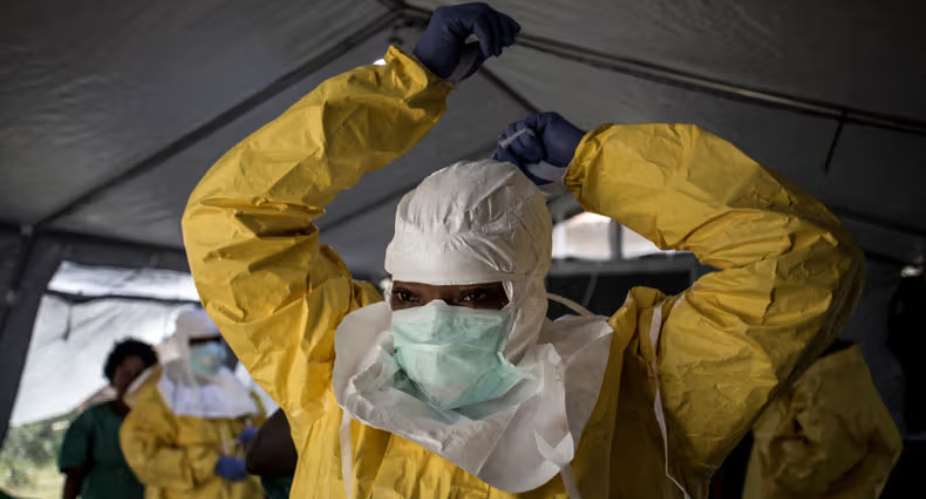
Let me start with a location that should send a chill through every public health official in Africa. Goma. That is a city of nearly one million people, packed tightly against the Rwandan border, with a busy airport, a bustling cross-border market, and roads leading to major transport hubs across Central and East Africa. And Ebola is now there. Not near Goma. In Goma. The same virus that has already killed at least 118 people in the Democratic Republic of Congo has spread to this densely populated urban centre. It has also crossed into Uganda, where two cases and one death have already been confirmed.
The World Health Organisation has declared this an international health emergency. And the reason is simple. When Ebola reaches a city of one million people, the math changes. When it crosses an international border, the politics change. And when both happen at the same time, the world needs to pay attention.
Let me update you on the numbers because they are moving fast. As of the latest reports, more than 390 suspected cases have been recorded. The death toll has climbed to 118. But as I warned in my previous column, the true numbers may be higher. The MRC Centre for Global Infectious Disease Analysis has modelled that there could be substantial under-detection. In plain English, there are likely more sick people out there who have not been counted. And each undetected case is a potential spark for a new chain of transmission.
The virus is the Bundibugyo strain, the rare one for which there is no approved vaccine. That is not a detail. That is a crisis multiplier. For the Zaire strain, the one that caused the 2014-2016 West Africa outbreak that killed over 11,000 people, we have a vaccine. It works. We know how to use it. We have stockpiles. But for Bundibugyo, nothing has been approved. That means the response must rely entirely on the old tools. Finding every case. Tracing every contact. Isolating the sick. Burying the dead safely. Educating communities. Those tools work, but they are slow, labour-intensive, and require trust. In a region devastated by conflict, where health systems have been destroyed and communities have good reason to distrust outsiders, those tools are even harder to deploy.
The spread to Goma is particularly alarming. Goma is not a remote village. It is a regional hub. It has an airport with flights to Kinshasa, to Nairobi, to Addis Ababa, to Dubai. It has a border crossing into Rwanda that sees thousands of people every day, traders, families, refugees, moving back and forth. And it is under the control of Rwandan-backed rebels. That last part is crucial. It means that the Congolese government may not have full access to the city. It means that health workers may need to negotiate with armed groups to reach patients. It means that the normal chain of command for a public health response does not apply. In the middle of an Ebola outbreak, that is a nightmare scenario.
The spread to Uganda is equally serious. Uganda confirmed two cases and one death linked to the same strain. Uganda has experience with Ebola. They have managed previous outbreaks effectively. But experience does not make you immune. And every new country that the virus touches multiplies the coordination challenges. Different health systems. Different reporting protocols. Different border controls. Different political calculations. The US Centres for Disease Control and Prevention has warned that cross-border movement between Congo and Uganda could complicate containment measures, particularly in areas with weak healthcare infrastructure and high population mobility. That is diplomatic language for "this could get much worse."
Let me also update you on the geography. New infections have been detected in Nyakunde in Ituri Province and Butembo in North Kivu. These are not random dots on a map. They are proof that the virus is expanding beyond its initial hotspots. It is not contained. It is spreading. And each new location requires a new response team, new contact tracers, new isolation facilities, new supplies of personal protective equipment. The WHO has released almost 4 million dollars, but that is a fraction of what will be needed. A full-scale regional response will cost tens of millions. And the WHO is already stretched thin by multiple global health emergencies.
The Red Cross warning that I quoted in my previous column bears repeating. Ebola can escalate quickly if cases are not identified early, communities lack information, and health systems are overwhelmed. And they said, "We are seeing all those conditions." That was days ago. Now we see those conditions spreading to new cities and new countries. The window for containment is closing.
What does this mean for Ghana? Let me be direct. The risk of Ebola reaching Ghana remains low, but it is not zero. We are not directly connected to Goma by regular flights. But we are connected to the world. And the world is connected to Goma. A traveller from Goma could fly to Nairobi, then to Addis Ababa, then to Accra. That journey takes less than 24 hours. The incubation period for Ebola is up to 21 days. That traveller could arrive in Accra feeling perfectly healthy and develop symptoms a week later. That is exactly how Ebola reached Nigeria in 2014. A single traveller. A single flight. And a small outbreak that killed several people before it was contained.
So the message to Ghana's Ministry of Health and the Ghana Health Service is simple. Do not wait for a case to arrive. Review your preparedness plans now. Check that screening equipment at Accra International Airport is working. Ensure that health workers at the port health unit are trained and vigilant. Refresh the training of clinicians at major hospitals on how to recognise Ebola symptoms and take appropriate precautions. Make sure that isolation facilities are ready and stocked with personal protective equipment. And coordinate with WHO and neighbouring countries on information sharing. Preparedness is not expensive. But the cost of being unprepared is measured in lives.
The message to the general public is equally important. Do not panic. Ebola is not in Ghana. The risk remains low. But stay informed. Rely on official information from the Ministry of Health and the WHO, not rumours on social media. Practice good hygiene. Wash your hands regularly with soap and water. Avoid contact with people who are sick with fever, bleeding, or unexplained symptoms. If you have travelled to Central or East Africa recently, monitor your health for 21 days after your return. Seek medical attention immediately if you develop fever, headache, muscle pain, vomiting, or diarrhoea. And when you seek care, tell the health worker about your travel history. That last point is critical. Many imported cases are missed because patients do not volunteer that they have travelled.
Let me also address the broader implications for Africa. This outbreak is a test of the continent's health systems and its commitment to regional cooperation. The Africa Centres for Disease Control and Prevention was established precisely for situations like this. But its funding and capacity remain limited compared to the WHO. The African Union must step up. Member states must contribute resources, personnel, and funding to support the response. Because what happens in DR Congo will not stay in DR Congo. That is the lesson of every outbreak. And it is a lesson we cannot afford to learn again.
The conflict in eastern DR Congo is also a factor that cannot be ignored. The presence of armed groups, the displacement of millions of people, the destruction of health facilities, all of these create conditions that allow Ebola to spread. The international community has spent billions on peacekeeping and humanitarian aid in the region. But the results have been mixed. Until the underlying drivers of conflict are addressed, outbreaks will continue to emerge and spread. That is not an excuse for inaction. It is a call for a different approach, one that integrates public health into peacebuilding and development.
I also want to talk about the communities affected by this outbreak. They are scared. And their fear is justified. A man named Bigboy told the BBC that people are "really scared" and doing what they can to protect themselves, such as washing hands with clean water, but they lack access to face masks and other protective supplies. Another local, Alfred Giza, said people are waiting to receive face masks but would not know what to do if a family member or friend contracted the disease. That is the reality. Fear, uncertainty, and a lack of knowledge. And that is exactly how Ebola thrives. When people do not know what to do, they do the wrong things. They touch the sick. They wash the dead. They attend funerals. And each of those actions is an opportunity for the virus to jump to a new person.
The response must include a massive community engagement effort. Not top-down messaging from the capital. But trusted local voices, community leaders, religious figures, traditional healers, explaining what Ebola is, how it spreads, and what to do if someone falls ill. This is painstaking work. It requires fluency in local languages, respect for local customs, and patience. But without it, even the best-funded medical response will fail.
So here is where we stand. The Ebola outbreak in DR Congo is accelerating. It has reached a major city. It has crossed an international border. The death toll is climbing. And the response is struggling to keep pace. The WHO has declared an international emergency, which is a formal mechanism to trigger global attention, mobilise resources, and coordinate response. But declarations alone do not save lives. Funding does. Personnel does. Equipment does. Community trust does. And all of those are in short supply.
For the rest of Africa, including Ghana, this is a moment for vigilance and preparation. Not panic. But not complacency either. The next few weeks will determine whether this outbreak is brought under control or becomes the next major global health crisis. Let us hope that the world has learned the lessons of 2014. Let us hope that the response is swift and sufficient. And let us do our part, here in Ghana, to ensure that we are ready, just in case. Because the virus does not care about borders. It only cares about finding its next host. And our job is to make sure that host is not in Accra.
.


 Mid-Year Budget Review: 'GH¢30bn in promised projects remain unexecuted' — Oppon...
 'This is the first Mid-Year Review that failed to account for programme executio...
 Police arrest 'fake' pastor over alleged marriage scam and intimate image blackm...
 'Ato Forson is spending prudently, not recklessly' — Titus Beyuo
 Zenith University College Law Faculty ranks among Ghana's top five at Supreme Co...
 Mid-Year Budget Review: 'The Finance Minister was loudly silent on the 24-hour e...
 GES sets August 15 for dispatch of teacher promotion letters
 Mahama welcomes Gabon's President for three-day bilateral talks on trade, securi...
 Multiple deaths in Japan mall collapse after 7.1-magnitude earthquake
 Anglican Church leader visits slave trade project on Africa tour

