




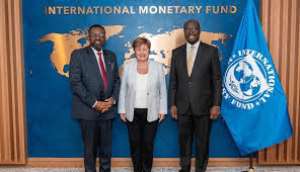
Ghana is transitioning from its Extended Credit Facility (ECF) bailout to a 36-month, non-financing Policy Coordination Instrument (PCI) with the International Monetary Fund. The IMF Executive Board will have a final review of Ghana's ECF program in July, and formally approve the Policy Coordination Instrument (PCI) arrangement, which acts as an official policy anchor to sustain macroeconomic stability gains and attract long-term investment.
Ghana recently completed its IMF-supported $3 billion Extended Credit Facility programme ahead of schedule and is expected to transition into the PCI framework by July 2026. The country is now seeking a three-year Policy Coordination Instrument (PCI) – a non-financing arrangement under which the IMF will continue to monitor and assess the country’s economic policies. While no new IMF money is involved, Ghana is effectively declaring that it still needs an external economic policy monitor to ensure that it adheres to sound economic management.
This development raises a troubling question: Why can’t Ghana manage its economy responsibly without placing itself under yet another IMF program after going through periods of austerity?
The Policy Coordination Instrument is an IMF surveillance platform without cash. The PCI is not a bailout. It provides no direct financing. Rather, it is a formal arrangement through which the IMF evaluates a country’s fiscal, monetary, and structural reforms against agreed benchmarks. In practical terms, Ghana is voluntarily asking the IMF to remain in the driver’s seat as a policy monitor, even after completing the ECF program. This is an implicit admission that domestic institutions and political leaders do not fully trust themselves to maintain discipline without external oversight.
However, Article IV Consultations were already available to Ghana. Every IMF member country, including Ghana, is subject to regular Article IV consultations. During these consultations, IMF economists review economic performance, identify risks, and make policy recommendations. Some countries rely on, and benefit from these consultations without entering into prolonged IMF monitoring arrangements.
Ghana could have chosen this path by relying on the Article IV consultations of the IMF to manage its economy without any external institutional support. By relying solely on Article IV consultations, the country would still receive technical advice and policy recommendations while retaining greater autonomy and demonstrating confidence in its own institutions. Instead, Ghana has opted for a structured IMF monitoring arrangement, suggesting that ordinary surveillance is considered insufficient to keep policymakers on course.
This suggests there is a crisis of institutional credibility. Ghana’s repeated engagements with the IMF are not fundamentally a technical issue; it is an institutional and political one. The country has entered into IMF-supported programs many times over the years. Each cycle follows a familiar pattern of fiscal indiscipline, unsustainable debt levels, rising inflation etc.
Stability returns whenever the government turns to the IMF for policy credibility and financial support, but discipline erodes once external monitoring ends. The decision to adopt a PCI indicates that policymakers fear a return to this cycle if left entirely to domestic oversight. Economic management in Ghana is often undermined by political pressures: Election-year overspending, weak enforcement of fiscal rules, heavy state-owned enterprise losses, off-budget and quasi-fiscal activities and delays in implementing structural reforms.
When the IMF is formally involved, the government can point to external commitments to justify difficult decisions such as expenditure restraint, tax reforms, and subsidy reductions. In effect, the IMF becomes a commitment device that helps governments do what they might otherwise avoid. Ghana’s transition from the ECF to the PCI conveys several uncomfortable truths. It indicates, for instance, that fiscal rules alone are not enough, legal frameworks mean little if political actors can bypass them, domestic institutions remain weak, bodies responsible for oversight and accountability have not consistently prevented policy slippages.
It is very clear that markets trust IMF monitoring more than local assurances, and so the government intends to use the IMF to gain the trust of markets, both domestic and foreign markets. The PCI is intended to reassure investors and development partners that reform momentum will continue. Without external constraints, the temptation to postpone difficult reforms remains strong.
Supporters of the PCI argue that it strengthens credibility and supports continued reforms without borrowing more money. This is true. However, there is a deeper issue. A country that requires international supervision to maintain prudent policies has not fully internalized the habits of sound economic management. True economic sovereignty is not merely the absence of borrowing from the IMF; it is the ability to uphold discipline independently.
Several countries use IMF advice selectively without placing themselves under ongoing formal monitoring. They have built institutions that can withstand political pressures and preserve macroeconomic stability over time. Ghana’s reliance on the PCI suggests that its institutional foundations are still not robust enough to guarantee policy consistency on their own.
It appears Ghana has not yet developed a durable culture of economic discipline. Rather than demonstrating confidence that it can maintain stability after the ECF, the country has chosen continued IMF supervision through the PCI. This decision may be realistic and even beneficial in the short term. But it also underscores a longstanding weakness in governance: prudent economic management remains dependent on external oversight rather than internal assurance.
Ghana could have exited the ECF and relied solely on the IMF’s Article IV consultations, signalling that it had learned the lessons of past crises and could manage its economy autonomously. Instead, by requesting a Policy Coordination Instrument, the country is effectively acknowledging that it still needs the IMF to monitor and reinforce discipline.
Reliable and existing evidence draws attention to the fact that Ghana has made progress in stabilization, but it has not yet built the institutional and political culture necessary to sustain sound economic management without an external watchdog like the International Monetary Fund (the IMF).
Emmanuel Kwabena Wucharey
Economics Tutor, Advocate and Religion Enthusiast

 Kojo Bamba’s election will hurt NPP’s appeal to the middle class – Solomon Owusu
 Sidelining the Church is fuelling indiscipline in schools – Most Rev. Gyamfi
 Minority demands dismissal of Kofi Adams, GTA boss over alleged World Cup visa s...
 Ghana’s inflation hits 5.2% in September, up from 5.0% in August – GSS
 ‘I became their slave’: Israeli hostage recounts 500 days in Hamas captivity
 Finance Minister approves three quarters of rent allowances for security service...
 NDC cannot be written out of NHIS success story – Dr. Sammy Ayeh
 Mahama to cut sod for new 3,000-seater Accra Convention Centre – Felix Ofosu
 Kojo Bamba denies rift with Nana B, explains absence from NPP executives’ meetin...
 I have a strategy to win 70 'orphan' parliamentary seats for NPP in 2028 – Abang...


