




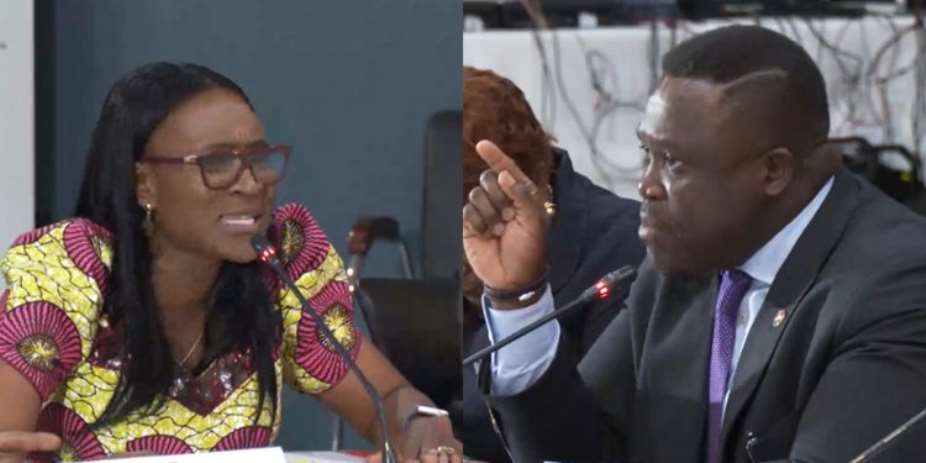
Let me start with a scene that played out in a committee room but belongs on a movie set. Two Members of Parliament, both respected, both known for speaking their minds, going at each other like rivals in a boxing ring. The issue? Poor network service. Dropped calls. Slow internet. The kind of frustration that makes you want to throw your phone against the wall. On one side, Samuel Nartey George, the Minister for Communications, Digital Technology, and Innovations. On the other side, Abena Osei Asare, the Chairperson of the Public Accounts Committee and a former Deputy Finance Minister. And in the middle, the truth that every Ghanaian knows but no one has been able to fix. Our networks are failing us.
Let me set the stage. The Public Accounts Committee was sitting to scrutinise how government agencies have been performing. The issue of poor telecom service delivery came up. Committee members were raising concerns about why it takes so long to fix network challenges. Why calls drop in the middle of important conversations. Why your data slows to a crawl when you need it most. These are not small complaints. In a country where mobile money is banking, where WhatsApp is how families communicate, where internet access is how students learn and businesses operate, poor network service is not an inconvenience. It is an economic drag.
The minister began by defending government actions. He argued that private telecom companies are in business to make profit, not to provide charity. And that over the past eight years, those same companies paid significant corporate taxes to the finance ministry, taxes that Abena Osei Asare, in her previous role as deputy minister, would have overseen. His point was simple. You cannot blame the current government entirely for a problem that has been building for a decade. Policy direction and leadership are needed to protect consumers, and he claimed that under the current government, steps have finally been taken.
But as he continued his submission, the Chairperson interrupted. She urged him to go straight to the point. And that is when the temperature rose. The minister pushed back, saying he was also a Member of Parliament and would not be heckled. She responded that she was not heckling, just asking him to be concise. He accused her of being unruly and unbecoming of a parliamentarian. She reminded him that he did not have the floor. He insisted that he did. She told him this was her committee. He retorted that if it was her committee, she should not invite him, but if she invited him and asked a question, she should listen to the answer. It was tense. It was personal. And it was broadcast for the whole country to see.
Now, let me step back from the drama and focus on what actually matters. Why is the network so bad? And what is the government actually doing about it? Because the minister, after the shouting subsided, eventually gave us some concrete information. He said that the government gave a policy direction in January. On the back of that direction, MTN is rolling out 800 new network sites. Telecel is rolling out 350 new sites. That is a total of 1,150 new sites this year. To put that in perspective, he said that over the past ten years, from 2016, the average number of new sites rolled out per year was 223. So 1,150 represents a 500 percent increase. That is dramatic. That is serious investment. But here is the catch that the minister himself admitted. These things take time.
You cannot just snap your fingers and build a new network site. First, you need to acquire the land or the location. Then you need to order the equipment. The radio equipment, the antennas, the base station devices. Those are not items you find in a shop on the high street. You place an order with an original equipment manufacturer, often in another country. Those manufacturers have their own production schedules, their own supply chains, their own delays. The minister said that most of the Mobile Network Operators are receiving their BTA devices, which is technical jargon for some of the key equipment, between July and August. That means the rollout will happen in the second half of the year. He expressed confidence that by the end of the third quarter, going into the fourth quarter, we will see a remarkable improvement in the network.
So what does that mean for you, the ordinary Ghanaian who just wants to make a call without it dropping? It means that the problem is being taken seriously. The government has set targets. The operators have committed to building thousands of new sites. But the equipment needs to arrive. The sites need to be constructed. The engineers need to do their work. That takes months, not days. The minister was essentially saying, "We are doing something, but you cannot will these things into being with a snap of a finger." That is a fair point. But it is also frustrating for customers who have been suffering for years.
The deeper issue here is one of accountability. The Public Accounts Committee exists precisely to ask tough questions and demand answers. Abena Osei Asare was doing her job by pushing the minister to be specific and not waste time on political rhetoric. Sam George was doing his job by defending his ministry's record and explaining the complexities of network infrastructure. The clash happened because both are passionate, both are strong-willed, and both genuinely believe they are right. That is not necessarily a bad thing. Democracy is supposed to have these moments. But for the ordinary Ghanaian watching, the shouting match can feel like politicians care more about winning arguments than solving problems.
Let me also connect this to the broader economic and technological story we have been following. Ghana is investing heavily in digital transformation. The national AI strategy, the one million coders programme, the 5G rollout, the MTN expansion, these are all real. But none of that matters if the basic network is unreliable. You cannot train coders on a connection that keeps dropping. You cannot run AI applications on a slow network. You cannot attract tech investment if your infrastructure is known to be poor. So the issue the committee was discussing is not a side issue. It is central to Ghana's digital future.
The minister mentioned that the National Communications Authority is going through the process of approving and coordinating these new sites. That is important. The NCA is the regulator. They have to ensure that new sites meet technical standards, that they do not interfere with each other, that they are placed in locations that actually improve coverage. That process takes time. And given that the previous administration reportedly averaged only 223 new sites per year, it is clear that the system has been moving slowly for a long time. Changing that requires not just money, but also a shift in mindset, in bureaucracy, in how quickly approvals are granted.
Now, let me talk about the politics of the exchange. Abena Osei Asare told the minister, "We are tired of this politics." That is a phrase that will resonate with many Ghanaians. People are tired of politicians who take forever to answer questions, who turn everything into a speech, who defend rather than admit problems. The Chairperson wanted straight answers. The minister wanted to tell the full story. Both had valid positions. But in the eyes of the public, the one who looks worse is the one who seems defensive. The minister would have been wiser to acknowledge the frustration first, then explain the timeline, then ask for patience. Instead, he got into a shouting match with a colleague. That does not inspire confidence.
That said, the specific numbers he provided, 1,150 new sites, 500 percent increase, equipment arriving in July and August, improvement by Q4, those are concrete. They are measurable. They can be verified. If by the end of this year, the network has not improved, the committee will have every right to haul him back and demand answers. And if the network does improve, he will have earned the right to say, "I told you so." That is how accountability should work.
For the rest of us, the advice is to be patient but vigilant. The network problems we face did not start yesterday. They have been building for years. They will not be solved overnight. But we should also not accept excuses indefinitely. If the equipment promised for July and August does not arrive, or if the sites are not built, or if the improvement does not come, we must demand answers. Not through shouting matches in committee rooms, but through consistent, persistent pressure on our leaders to deliver what they promised.
The heated exchange between Sam George and Abena Osei Asare was uncomfortable to watch. But it was also a sign that someone is watching the watchmen. The Public Accounts Committee exists to hold the executive accountable. The minister exists to defend his ministry. The tension between those roles is healthy. What is not healthy is when the tension becomes personal and the substance gets lost. Let us hope that the next time they meet, they focus on the 1,150 sites, the equipment delivery dates, and the quality of service improvements. Because at the end of the day, that is what matters. Not who shouted louder. Not who had the floor. But whether your next call drops or holds. Whether your data works. Whether the digital future we keep talking about actually arrives. That is the only question worth fighting over.
.


 Mid-Year Budget Review: 'GH¢30bn in promised projects remain unexecuted' — Oppon...
 'This is the first Mid-Year Review that failed to account for programme executio...
 Police arrest 'fake' pastor over alleged marriage scam and intimate image blackm...
 'Ato Forson is spending prudently, not recklessly' — Titus Beyuo
 Zenith University College Law Faculty ranks among Ghana's top five at Supreme Co...
 Mid-Year Budget Review: 'The Finance Minister was loudly silent on the 24-hour e...
 GES sets August 15 for dispatch of teacher promotion letters
 Mahama welcomes Gabon's President for three-day bilateral talks on trade, securi...
 Multiple deaths in Japan mall collapse after 7.1-magnitude earthquake
 Anglican Church leader visits slave trade project on Africa tour

