




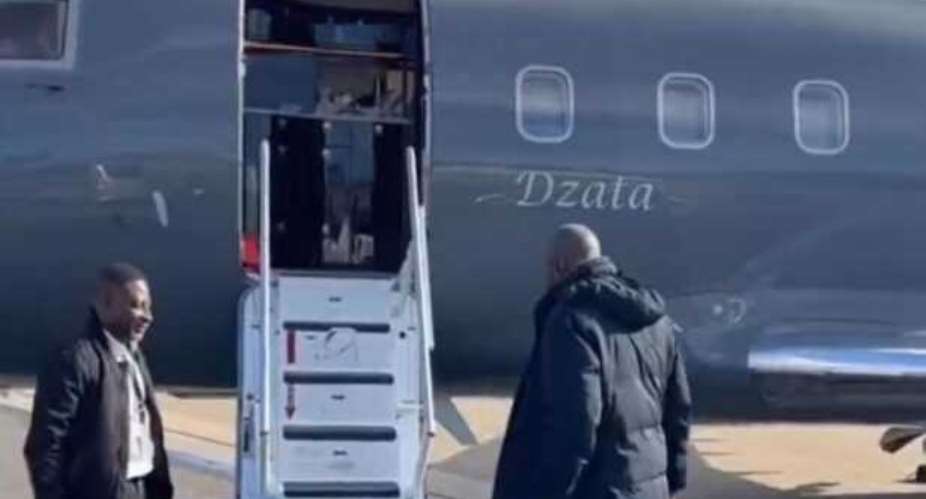
The first shock came when Mr. Ibrahim Mahama purchased a private jet worth about $25 million. The second—an aircraft reportedly exceeding $70 million—left many Ghanaians stunned, questioning whether the President’s brother had lost all sense of proportion, priority, and responsibility.
Ghana is not a country where one casually acquires two private jets, no matter one’s wealth. It is certainly not a place to flaunt extravagant luxury—especially when you are the President’s brother, a position that inevitably raises suspicions about whether such wealth is truly private or merely a polished façade for state‑enabled enrichment. In any nation grappling with deep socio‑economic crises, the purchase of a private jet would provoke outrage. In Ghana’s case, it signals a disturbing insensitivity to the country’s urgent needs.
For years, the government led by Mr. Mahama’s own brother has struggled to pay workers. Nurses, teachers, and other public servants have gone months without their wages. Cocoa farmers have seen their incomes slashed. Contractors remain unpaid for completed projects. Economic activity has slowed to a crawl, and the state’s capacity to fund essential services has deteriorated.
Meanwhile, the North—home to Ibrahim Mahama, President Mahama, and many senior government officials—remains trapped in extreme poverty. At independence, free education was introduced in the North to address the historical deprivation caused by the slave trade, harsh climate, and lack of opportunity. Yet nearly seven decades later, little has changed. Many communities still lack schools, electricity, clean water, and basic infrastructure. Mud houses with thatched roofs remain the norm. Some towns suffer widespread blindness; others host “witch camps” where vulnerable women are exiled to lives of misery.
During my own visit to the North as a Project Officer with Prof. Opoku Agyemang (now Vice President), I witnessed firsthand the depth of poverty and felt compelled to act. My attachment to the people of the North has remained strong ever since.
Yet those who escaped this poverty—often through state sponsorship—have abandoned their obligations. Many northern elites have relocated to the South, amassed wealth, married into Akan families, and left their kinsmen behind. Northern women, driven by hardship, migrate southward to work as kayayei, carrying loads under dehumanizing conditions.
Against this backdrop, Ibrahim Mahama’s purchase of a second private jet is not merely excessive—it is emblematic of a deeper moral failure. Historically, the northern wealthy man’s pride was a simple Buzanga Volvo. Today, the symbol of success has mutated into a grotesque display of consumption that ignores the suffering of one’s own people. His opulence reflects a disconnection from ancestral duty and communal responsibility.
Those defending this extravagance are equally misguided. National resources—including the talents and labour of the people—belong to all Ghanaians and must be used for collective upliftment. Even the wealthiest individual owes a primordial duty to the land that shaped him. That is how nations are built.
Yet Ibrahim Mahama’s wealth has not meaningfully transformed the lives of his own people. As long as his hometown and region remain impoverished, the optics of his acquisitions insult reason and affront wisdom.
Is he the most hardworking Ghanaian? Where was this wealth before his brother became President? What has he contributed to Ghana to justify such staggering riches? When a nation is burning for lack of water, the wise man does not irrigate his private garden—he helps extinguish the flames.
To ignore such opulence while millions suffer only reinforces racist stereotypes that Africans are incapable of prioritizing development. Buying jets from abroad merely strengthens foreign economies while neglecting Ghana’s own.
His donation of the first jet as a “national ambulance” is a symbolic gesture born of embarrassment, not patriotism. Where will such a jet land, except in already developed areas? How will it be retrofitted for medical emergencies without exorbitant cost? Ghana does not need a hand‑me‑down aircraft. It needs salaries paid, jobs created, farmers supported, and poverty addressed.
A country must operate by its priorities. A private jet is a white elephant. Its donation saddles the nation with maintenance costs it cannot bear.
Moreover, no Ghanaian business generates the kind of profit required to legitimately purchase two private jets in under a decade. To spend $100 million on aircraft, one would need profits approaching $1 billion. Ghana’s economic data does not support such a possibility. By simple inference, the money was not earned—it was diverted. It was stolen.
In summary:
- Moral Responsibility: Can the President’s brother justify buying two private jets while his own people live in deprivation?
- Economic Reality: Does Ghana’s tax and income data support the claim that anyone could legitimately afford such purchases?
- National Priorities: How does this extravagance advance Ghana’s development agenda?
Rawlings once warned of “babies with sharp teeth” indulging in reckless consumption. Former Special Prosecutor Martin Amidu spoke of “gargantuan corruption.” With the President’s brother acquiring two jets in less than ten years, opulent consumption and corruption have fused into a single, inseparable entity—the Siamese twin of the Mahama era.


 'Some NPP members did not vote in 2024 election because I left NPP' – Alan Kyere...
 How €225 million cocaine from Ghana traced to fugitive Dutch drug kingpin based ...
 'Galamsey remains an existential threat' – Gyampo demands more action
 'I’m like Akpeteshie, I don’t need adverts to win' – Hawa Koomson storms home tu...
 'Excessive bail conditions must be reviewed' – GBA President
 Ketu South: Four-year water crisis deepens hardship in Agbozume
 Show evidence of higher operating costs to justify fare hike – NPA CEO to transp...
 Four Ghanaians arraigned over alleged €225 million cocaine shipment to France
 Agbogbloshie: Police kill suspected robber, recover AK-47, 186 rounds of ammunit...
 DVLA opens 29 new offices in 18 months; 62 offices nationwide - CEO



Comments
Sarfo, have you bothered to check the legitimacy of his company? Frankly, we are more interested in the whereabouts of Ken Ofori Atta. Nsem hu nu no do so!