




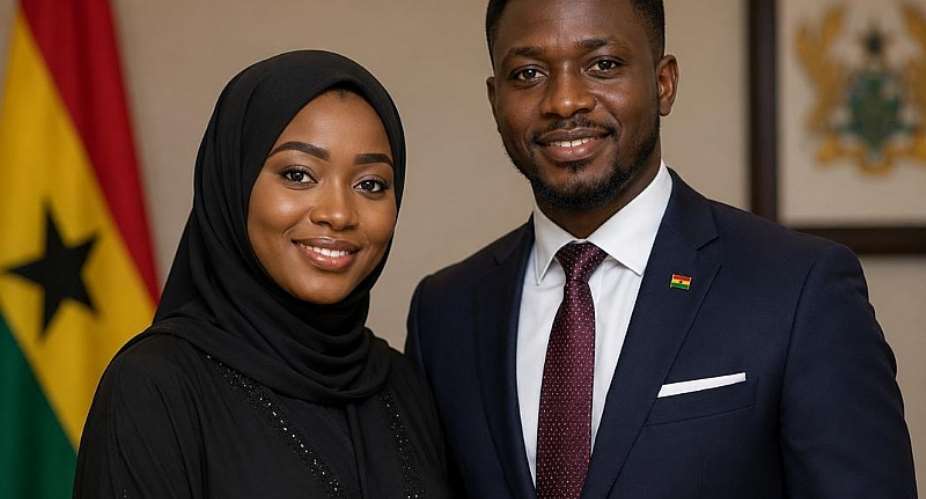
A growing number of Ghanaian Gen-Z Muslims on social media are strongly pushing for the right of Muslim women to marry non-Muslim men, particularly Christians. This challenges long-held traditional interpretations of Islamic law that frown on Muslim women marrying Christian men.
Members of this segment of the Muslim Ummah argue that there is no sacrosanct Qur’anic verse that prohibits Muslim women from marrying non-Muslim men, particularly Christians. Critics say the restriction is based on scholarly consensus rather than clear scriptural text.
What the Texts Say
The commonly cited reference is the Holy Qur’an (Surah al-Baqara 2:221); which warns against marriage between believers and polytheists until they accept faith.
Surah al-Baqara 2:221 “Do not marry polytheistic women until they believe; for a believing slave-woman is better than a free polytheist, even though she may look pleasant to you. And do not marry your women to polytheistic men until they believe, for a believing slave-man is better than a free polytheist, even though he may look pleasant to you."
They invite you to the Fire while Allah invites you to Paradise and forgiveness with His grace. He makes His revelations clear to the people, so perhaps they will be mindful. Most mainstream Islamic scholars interpret this verse as prohibiting Muslim women from marrying non-Muslim men, including Christians and Jews.
The consensus, known as ijma, holds that such a marriage is invalid under Islamic Shariah. Members of this group are convinced that the marriage contract would be considered void, and any children born from it would be deemed born out of wedlock under Shariah. However, the children are still considered Muslim if the mother is Muslim.
Gen-Z’s Forward-Thinking Call
Gen-Z’s call for a paradigm shift on disallowing Muslim women from marrying non-believers is premised on the view that the verse addresses polytheists, not Christians and Jews.
They argue that the long-standing prohibition is a later scholarly extrapolation rather than a direct divine command. For them, the absence of an explicit ban means the matter should be open to reinterpretation, especially when couples commit to raising their children as Muslims and seek the blessing of both families.
Global Context and Examples
The debate is not unique to Ghana. In the UK, imams report being approached by at least two interfaith couples per week, with rising numbers of Muslim women seeking to marry outside the faith.
In Germany, studies on Muslim women in interfaith partnerships show some women use temporary marriage contracts or informal agreements to navigate religious restrictions. Scholars note that classical jurists were aware the Qur’an is silent on Muslim women marrying non-Muslims, and that the prohibition is largely derived from scholarly consensus.
Muslim men can more easily marry non-Muslim women because of the belief that men can influence their partners’ religious practice. Historical examples also surface. Yasser Arafat, former Palestinian leader, married Suha Tawil, a Palestinian Christian from a Catholic family, in 1990. In Ottoman history, intermarriages between Muslim rulers and Christian women were not uncommon.
Local Realities in Ghana
In Ghana, Muslim and Christian communities often live side by side. St. Kizito Catholic Church in Kumasi’s Asawase and in Nima, Accra, are examples of where the two faiths mingle daily.
Despite this, many Muslim families remain reluctant to approve marriages between Muslim women and Christian men, even when they are aware both partners are happily enjoying their relationship. Researchers studying young Muslim women in Southern Ghana note that identity tensions often arise between religious commitment, national belonging, and gender expectations.
UNFPA Ghana has also facilitated interfaith dialogues, strengthening inter-religious inclusivity on issues affecting young people and recognizing religious leaders’ influence on youth attitudes toward marriage and sexuality.
Local Context and Examples
Kalsoume Sinare, Ghana’s Ambassador to Spain, a staunch Muslim and wife of former Ghana international footballer Anthony Baffoe. Her husband was a Christian before converting to Islam before their marriage.
A notable example is found in the family of President John Dramani Mahama. His father, Emmanuel Adama Mahama, a Presbyterian Christian, married Hajia Abiba Mahama, a Muslim, without either partner changing faith, reflecting long-standing instances of religious coexistence within Ghanaian households. If that marriage had been forcefully cut short on religious grounds, a President wouldn't have been born for us today.
Similarly, Efua Stephens, a Christian woman, married Musah Domingo, a Muslim, and they raised three children—one son and two daughters. In an interesting development, their son later became a Catholic priest, while the daughters also identify as committed Catholics, underscoring the varied religious paths that can emerge within interfaith families.
What’s Next
For now, mainstream Islamic authorities in Ghana maintain that a valid Islamic marriage requires the husband to be Muslim. Clerics advise that if a couple wants their union recognized as halal, the Christian partner must embrace Islam before the nikah.
The debate, however, shows no signs of slowing among Ghana’s younger generation, who see interfaith marriage as part of a broader conversation about gender, agency, and religious interpretation in a pluralistic society.
The bottom line is that Gen-Z’s push to make it possible for Muslim women to marry non-Muslim men, especially Christians, on the basis of fundamental human rights, is open for further discussion.

 Bank of Ghana warns public against ‘Daily Wealth Guide’ crypto investment scam
 Corruption steals resources meant to improve lives of vulnerable — Bawumia
 The Japanese idealist behind the last deradicalisation NGO in Somalia
 New Winneba clash: Get into the community and arrest perpetrators — Afenyo-Marki...
 PRESEC-Legon reaches NSMQ semi-finals after kicking out defending champions, Mfa...
 'Correct misinformation visibly, quickly with same prominence' — Cybersecurity A...
 'You become the nation’s steady hand when you report truthfully during tension' ...
 No NPP General Secretary who lost election has ever been retained – Boakye Antwi
 G.Bissau votes 'yes' in referendum for new constitution
 IMF reaches agreement with Senegal on new $2.2 bn loan programme

