




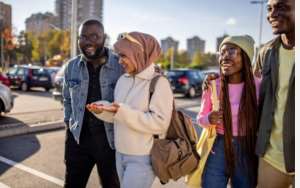
At the intersection of faith, freedom, and a changing Ghana, a new generation of Muslim women is quietly rewriting the rules of marriage
In the dense, bustling neighborhoods of Accra's Zongo communities Nima, Madina, Mamobi something is quietly shifting. In the mosques, the elders still invoke the longstanding consensus: a Muslim woman shall not marry a man outside the faith. Yet in university lecture halls, on TikTok comment sections, in WhatsApp group chats, and in private confessions shared between friends, a new conversation is taking shape among Ghana's Generation Z Muslim women.
They are educated. They are urban. They are digitally connected to a globalised world. And a growing number of them are questioning whether the man of their dreams must necessarily be Muslim.
This is not a revolt against Islam. It is something more nuanced a generation negotiating between inherited religious identity and the realities of modern Ghanaian life. Understanding why Gen Z Muslim women in Ghana are increasingly open to interfaith marriage requires looking at the country's unique social history, its constitutional framework, the transformation of its cities, and the enormous power of this generation's digital consciousness.
Ghana's Unique Religious Landscape
To understand interfaith marriage in Ghana, one must first appreciate just how intertwined its religious communities are. Ghana is approximately 71 percent Christian and about 20 percent Muslim, with a small percentage practicing African traditional religion. Unlike many countries where these communities live in near-total separation, Ghana's history has produced something quite different.
Zongo communities, which were once predominantly Muslim, are now religiously and ethnically pluralistic, with a discernible mix of adherents of other religions living side by side. These communities the word Zongo is a Hausa term historically associated with itinerant Muslim traders have become the crucible in which Ghana's interfaith social reality has been forged over generations.
In Ghana, the boundaries between Muslims and Christians are not fixed and non-negotiable, and through interfaith marriages and other forms of conjugal relations, adherents of both religions crisscross each other's religious boundaries.
This is not merely the observation of outside researchers it is lived, daily experience for millions of Ghanaians who grow up with Muslim aunties and Christian cousins, who share meals during Ramadan and Christmas alike, who attend each other's funerals and naming ceremonies without a second thought.
Both Christians and Muslims invoke history and religious texts to discourage interfaith marriages. Nevertheless, interfaith marriages including marriage between a Muslim woman and a non-Muslim man between these two religions remain an existential social fact in Zongo communities. It is into this complex, living reality that Gen Z Muslim women have been born.
The Islamic Doctrinal Position and Its Contested Ground
The official position of mainstream Islamic jurisprudence on this matter is well established. A Muslim woman cannot marry any non-Muslim man Christian, Jewish, Hindu, or otherwise unless he first converts to Islam. This is derived from a scholarly consensus rooted in Qur’anic interpretation and classical fiqh, underpinned by the reasoning that a non-Muslim husband might compromise a Muslim woman's faith or the Islamic upbringing of their children.
Yet even within Islamic scholarship, this consensus is not without its critics. Some contemporary Muslim scholars argue that the absence of any explicit prohibition in the Quran indicates that Islam leaves the decision regarding whom to marry up to the Muslim woman, and that she should consider her conditions and her prospective husband's attitude toward her religious faith before making the decision for herself.
Some religious scholars, such as Kecia Ali, would claim that to interpret the Quran as prohibiting women from interfaith marriage is itself a "significant interpretative leap, going beyond the verse itself."
This scholarly debate, once confined to academic journals, has now migrated to the Smartphone of Gen Z women in Kumasi and Tamale. A young woman in Accra who reads these arguments online is no longer solely dependent on her local imam's interpretation of the text.
The Forces Driving Change
Education and Urbanization
Perhaps the most powerful engine of attitudinal change is education. Ghana's investment in female education over the past three decades has produced a generation of young Muslim women who have spent years in shared classrooms with Christians, formed deep friendships across religious lines, and developed a sense of individual identity that is not solely defined by faith or family.
Education has significantly expanded opportunities for both men and women, reducing economic vulnerability and narrowing gender disparities, particularly in urban areas. Women's access to higher education has increased, enabling them to contribute financially to their households and challenge traditional expectations of domesticity.
A Muslim woman who has put herself through university, who earns her own income, and who is financially independent, approaches the marriage market differently from her mother's generation. Her checklist for a life partner is likely to include character, ambition, and compatibility qualities that do not necessarily map onto religious identity.
Research shows that older individuals have more negative attitudes toward interfaith marriage, and those living in rural areas have more negative attitudes than those living in urban areas. Ghana's rapid urbanization is therefore not a neutral demographic fact it is reshaping the marriage expectations of the young.
The Transformation of Zongo Communities
Youth migration from rural to urban areas gives young people some degree of religious independence. Quite often, youth who migrate from the North to the South easily sever religious affiliations if doing so has a pragmatic benefit. The fact that most Zongo communities are heterogeneous migrant communities has produced instances where persons freely convert to other religions without the fear of immediate social ostracism from their families. Western education has brought Muslims and Christians together and closer than hitherto.
When a young Muslim woman from the Upper East Region arrives in Accra for university, she enters a world where her social network is no longer defined exclusively by the Muslim community her parents knew. Her classmates are mostly Christian. Her lecturers may be Christian. Her employer almost certainly serves a mixed clientele. The enforced religious insularity of the village gives way to the practical cosmopolitanism of the city.
For many respondents, ethnicity, neighborliness, and sometimes shared political affiliation tend to blunt the entrenched divisiveness embedded in the two theologies during day-to-day relationships. Zongo communities have lived religious experiences that in some ways potentially curtail religious extremist tendencies and which in the long run encourage interfaith marriages.
Ghana's Secular Constitution
Unlike many countries where religious law is embedded in civil law, Ghana's constitution provides a secular framework that gives its citizens including Muslim women agency that women in Muslim-majority countries often lack.
Irrespective of citizens' religious faith or ethnic identity, all Ghanaian citizens are governed by a body of laws known as British Common Law, applied simultaneously with customary laws. Individual citizens have the option to decide which law customary or secular state to apply in their personal relationships or engagements such as marriage, divorce, and inheritance.
Not only do Muslim women have several options to choose from regarding marriage such as deciding between a monogamous or polygamous marriage but they also have agency on where to resolve their marital conflicts, either through the work of Islamic religious authorities or through the state secular system.
This legal pluralism is quietly revolutionary. It means that a Muslim woman who wishes to marry outside her faith is not breaking the law of the land she is exercising a constitutional right. The only prohibitions she faces are religious and social, not legal. And for a self-determining Gen Z woman, that distinction matters enormously.
Social Media and the Globalization of Islamic Feminist Thought
No force has done more to reshape the inner world of Gen Z Muslim women in Ghana than social media. TikTok, Instagram, Twitter/X, and YouTube have connected young Ghanaian Muslim women to a global conversation about Islam and gender that their mothers never had access to.
Technology influences religious identity, practices, and dynamics in Muslim societies, and such intersections catalyze transformative shifts in religious practices, community formations, and identity reconstructions in the digital sphere challenging conventional paradigms of Islam in the digital age.
Through their screens, young Muslim women in Accra encounter Muslim feminist scholars arguing for re-reading classical jurisprudence through a gender-equitable lens. They watch Muslim women in the West who have married Christian partners and maintained their faith. They read threads debating whether the prohibition on women's interfaith marriage has a Qur’anic basis or is merely a patriarchal scholarly construction. These encounters do not necessarily pull them away from Islam they complicate and deepen their engagement with it.
Gen Z women are openly embracing feminism and re-evaluating their relationship to religious institutions, a trend documented across multiple religious communities globally. In Ghana's Muslim communities, this manifests less as a rejection of Islam and more as a demand to distinguish between what God actually said and what male scholars have long claimed He meant.
The Voices of a Generation
The young Muslim women navigating these questions are not a monolith. Some are driven by pragmatic reality: in a country that is 71 percent Christian, finding a Muslim partner of matching education, values, and ambition is genuinely difficult. Others are motivated by a principled conviction that love is not bounded by religion. Still others are deeply devout Muslim women who have simply fallen in love with a Christian man and are wrestling privately with what their faith requires of them.
What unites them is a refusal to accept that their only options are to suppress their feelings, marry someone they do not love, or be branded apostates for following their hearts.
Reform movements within both Christianity and Islam are increasingly advocating for broader acceptance of interfaith marriages, signaling a potential for changing attitudes and interpretations surrounding mixed-faith unions. In Ghana, some imams in Accra's more cosmopolitan mosques have begun quietly acknowledging the reality of Muslim-Christian relationships in their communities, even if they stop short of endorsing them.
The Pushback
The resistance to these shifting attitudes is real and should not be minimized. Conservative Islamic revival movements some funded by Gulf States have strengthened their presence in Ghana since the 1980s, and many Zongo communities have become more religiously orthodox, not less, in recent decades. Interfaith marriages in Ghana face significant doctrinal challenges, and while awareness and acceptance may be growing, religious prohibitions remain central reference points for many communities.
Family pressure remains intense. A young Muslim woman who announces she intends to marry a Christian man risks social ostracism, family rupture, and in some communities, a form of informal shunning. The fear of bringing shame to her family and of being cast outside her community is not an abstraction it is the lived experience of many who have walked this path.
The present phenomenon of conjugal relations between the adherents of the two religions does not obscure the differences and intolerance that characterize them. Tolerance and intolerance co-exist in the same communities, sometimes in the same families.
What This Moment Means
The question of interfaith marriage among Gen Z Muslim women in Ghana is ultimately a question about who gets to define a Muslim woman's faith, her body, and her future. It is a question about the distance between doctrine and lived experience. And it is a question that Ghana with its historically porous religious boundaries, its secular constitution, and its rapidly educating and urbanizing population is especially well-placed to navigate thoughtfully.
Muslim-Christian conjugal relations are a social reality in religiously plural Zongo communities today, and the laws of Ghana and the conceptualizations of marriage by religious groups must be revisited to adequately address this reality.
Gen Z Muslim women in Ghana are not rejecting Islam. They are insisting that their generation's Islam must be capacious enough to accommodate their full humanity including the full complexity of who they love.
The elders may not yet be ready to hear that. But the conversation has already begun, and it will not be easily silenced.
This article draws on academic research from the University of Florida's African Studies Quarterly, the African Economic History Network, the Social Science Research Council's Kujenga Amani platform, and peer-reviewed journals on Islamic law and interfaith marriage.
Mustapha Bature Sallama.
Medical/ Science Communicator,
Private Investigator, Criminal investigation and Intelligence Analysis.
International Conflict Management and Peace Building.USIP
[email protected]
+233-555-275-880

 Thousands attend Kenya opposition rally amid anger over political violence
 Trump slams AI sceptics as Altman pauses OpenAI IPO plans over safety concerns
 WASSCE: School officials helped students cheat for years, but we now see the tru...
 Probe alleged military killing of lecturer in Bawku – Kusaug Youth demands
 ‘If we all pay GH¢1,000 each, we should be able to construct National Cathedral’...
 Mahama inspects proposed site for Upper West Regional Airport
 Mahama reiterates government's commitment to end double-track SHS system
 Police interdict officer over death of 23-year-old Ivan Baidoo on Tema Motorway
 Improved invigilation is exposing true performance of Ghanaian students — Mahama...
 There's no policy to introduce Arabic, Chinese in all public schools — Mahama


