




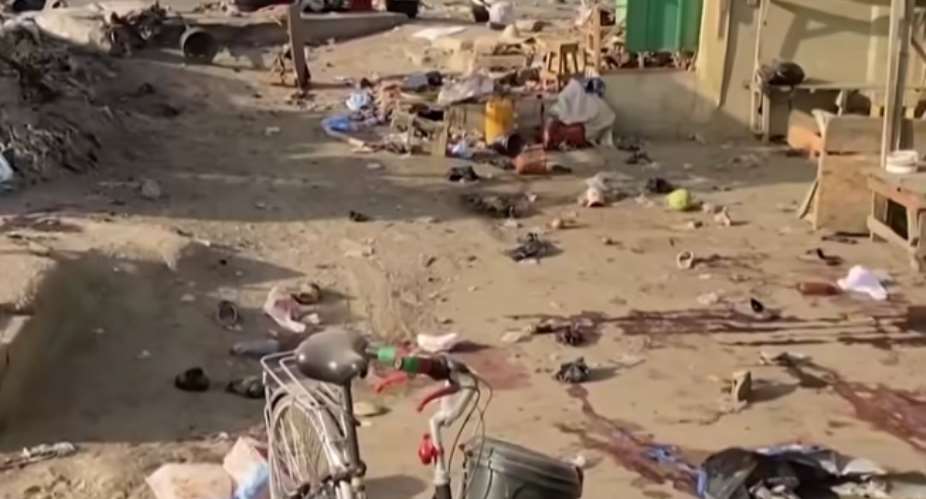
A Sunday Market, Then the Jets Came
It was a typical Sunday trading session at Tumfa market in Zurmi district, Zamfara State a remote weekly gathering where farmers, petty traders, and community members converged to buy and sell grain, food, and household goods. Young girls sat behind their trays of millet porridge and tofu. Mothers haggled over produce. Children ran between the stalls.
Then military jets appeared in the sky above.
According to a source who spoke to AIT on condition of anonymity, the incident happened around noon when an aircraft was first seen conducting surveillance over the area, before returning around 2 p.m. to launch what he described as multiple airstrikes, leaving about 100 persons dead and over 30 others injured.
What followed was one of the bloodiest single incidents of collateral damage in Nigeria's long and troubled military campaign against banditry in the northwest and one that has sent shockwaves of grief, outrage, and demands for accountability across the nation and the international community.
The Death Toll: A Disputed but Devastating Count
The precise number of those killed is contested but every version of events points to catastrophe. A community leader in the area, Garba Ibrahim Mashema, put the number of dead at 72, but acknowledged that the actual death toll was difficult to establish, as some bodies had been "blown beyond recognition."
Amnesty International, in a statement issued on Tuesday, said at least 100 civilians were killed in the strike on Tumfa market in Zurmi district, adding that dozens of injured people were being treated at hospitals in Zurmi and nearby Shinkafi, and that many of those killed were women and girls.
A resident of Zurmi town, Aliyu Musa, who lives just seven kilometres from the market, put the toll even higher at 117, saying: "Many young girls selling millet porridge and tofu in the market were killed."
Amnesty International Nigeria Director Isa Sanusi told the Associated Press: "In one village alone, 80 people were buried and there is no evidence that any of those people killed is a bandit. They are all civilians. The majority of them are young girls and small boys."
Photographs shared by Amnesty International Nigeria showed patients receiving treatment at the Yariman Bakura Specialist Hospital in Gusau a grim visual testament to the scale of the carnage.
A Second Market Strike in a Month
The Tumfa airstrike was the second to kill scores of people at a crowded market in northern Nigeria within a single month, marking a disturbing pattern that human rights organizations say can no longer be explained away as isolated errors.
Just weeks prior, the Jilli Market bombing had drawn widespread condemnation and editorial calls for the military to exercise greater care in target selection. Amnesty International, commenting on the Jilli tragedy, had said that "launching air raids is not a legitimate law enforcement method by anyone's standard," while calling for an immediate and impartial investigation.
That investigation had barely begun before Tumfa happened.
The Military's Justification And the Community's Reality
The Nigerian military did not deny that an airstrike took place. Operation FANSAN YAMMA, the military campaign responsible for air operations in the northwest, confirmed carrying out an airstrike in the area.
However, the military's account of what was hit diverges sharply from what survivors and rights groups describe.
In a statement, the military said it had targeted "terrorist leaders and commanders from across the West African sub-region." Defence Headquarters spokesman Major General Michael Onoja flatly denied reports of civilian deaths, saying they were "not true," even as the military said it would investigate.
A separate spokesperson, Maj. Gen. Michael Onoja, told the Associated Press: "Civilians are not the target, and everything is being done to avoid civilian casualties," adding that military operations were continuing in the area.
Community members told a very different story. Aliyu Musa of Zurmi acknowledged the complicated reality: "To be frank, Tumfa market is under the control of bandits. It is their stronghold, any person who goes there knows he is on their turf." Yet the people gathered there on Sunday were not fighters they were ordinary Nigerians trying to buy and sell food.
As Garba Ibrahim Mashema, the community leader put it plainly: "Everybody, residents and bandits, goes to the market. People are at the mercy of the bandits. There is nothing they can do."
A Bloody Sunday: Bandits Struck Too
The Tumfa massacre did not occur in isolation. The same Sunday May 11, 2026 was one of the bloodiest single days of the country's conflict against armed groups, with bandits and the military both killing civilians across the northwest and north-central regions.
In one of the deadliest bandit attacks on the Zamfara road network in 2026, gunmen ambushed travelers along the Magami–Dansadau highway, killing 30 people in a coordinated assault on motorists and commuters. The Zamfara Community Protection Guard spokesperson confirmed that 21 civilians, 8 local hunters, and one community protection guard were killed.
Separately, bandits launched coordinated attacks in Katsina State the same day, killing 12 more people, according to a UN security report seen by AFP. In Niger State, families told AFP that a different Nigerian Air Force airstrike targeting bandits killed 13 civilians.
Within the space of a single Sunday, the convergence of military firepower and bandit violence had consumed well over 150 civilian lives across Nigeria's troubled north.
A Shameful Pattern: Years of Deadly Mistakes
The Tumfa market strike is not an anomaly it is the latest chapter in a deeply troubling record of collateral damage that has accumulated over nearly a decade of military air operations in northern Nigeria.
Since 2017, approximately 400 civilians have died in military airstrikes in northern Nigeria, according to SBM Intelligence. Zamfara State alone has witnessed multiple deadly airstrikes, including a December 2022 strike that killed over 100 civilians and a January 2025 strike that killed 16 people.
The timeline of these tragedies is a sobering indictment of systemic operational failures. In December 2023, no fewer than 88 people were killed following a military airstrike in Tudun Biri village, Igabi Local Government Area of Kaduna State. Similar unfortunate strikes killed several people in Rann, Borno State in 2017; the Sububu area of Zamfara State in 2021; Kurebe village in Niger State in April 2022; Southern Kaduna in June 2022; Mutunji community in Zamfara State in December 2022; and Kwatiri, a rural community in Nasarawa State in January 2023.
In June 2025, another strike between the villages of Maraya and Wabi in Maru Local Government Area killed at least 20 civilians’ local vigilantes who had been pursuing bandits responsible for cattle rustling and kidnappings. Rather than hitting the bandits, the military jet bombed the vigilantes.
Why the Mistakes Keep Happening
Military and security analysts who have followed Nigeria's counter-banditry campaign point to a cluster of structural failures that make collateral damage not merely possible but near-inevitable under current operational conditions.
The fluid and complex nature of combat in Zamfara, where local vigilantes often operate independently or with limited communication with formal military units, dramatically increases the risk of misidentification. This lack of integration between the military and community defence groups leaves civilians vulnerable to being mistaken for hostile forces.
The situation in market towns is especially precarious. Zamfara's remoteness means many communities have no choice but to continue using markets that bandits frequent or control. Staying away means starvation; attending means proximity to military targeting zones. For civilians, it is an impossible calculation one that the military's intelligence apparatus has repeatedly failed to factor in with adequate precision.
The impact on local communities goes far beyond the immediate loss of life. These airstrikes deepen mistrust between civilians and the military, undermining the cooperation essential for effective security operations. Vigilante groups, which have emerged as grassroots defence mechanisms in the absence of adequate state protection, may become reluctant to collaborate with military forces complicating the very effort to defeat banditry.
Calls for Accountability
Amnesty International was swift and categorical in its condemnation. The organization urged Nigerian authorities to open an immediate investigation into the Tumfa market airstrike.
This Day Live, in a searing editorial on the earlier Jilli market strike, had warned: "We are particularly concerned that this tragedy of accidental bombings keeps recurring. In discharging its constitutional mandate to defend the country and protect its citizens, the military must be careful in the selection of their targets."
The editorial called for the federal government to conduct a detailed account of security challenges and institute an effective long-term strategic plan. Human rights groups have also questioned the legal framework under which these strikes are conducted. If a market is known to be frequented by both civilians and bandits as community leaders openly acknowledge of Tumfa striking it with no attempt at civilian evacuation or advance warning may constitute a violation of international humanitarian law's basic principles of distinction and proportionality.
The Broader Crisis: Zamfara's Endless War
Zamfara State has long been a hotspot of insecurity, with criminal gangs terrorizing communities through kidnappings, cattle theft, and violent raids. Unlike the jihadist insurgency in Nigeria's northeast, these bandits are primarily motivated by economic gain making them simultaneously more fluid and harder to eliminate through aerial bombardment alone.
Governor Dauda Lawal has publicly mourned the victims of each attack. His government has walked a difficult line supporting military operations while acknowledging their human cost. The Zamfara Community Protection Guard, whose members have themselves been killed in friendly-fire incidents, continues to operate alongside a military that has repeatedly struck them by mistake.
For the families of those killed in the Tumfa market on Sunday, the question of banditry and counter-banditry strategy is secondary to a more immediate reality: their loved ones many of them young women who rose before dawn to hawk food at a rural market are dead. They did not carry weapons. They carried trays.
Conclusion: When the State Becomes the Danger
Nigeria's northwest is caught in a lethal triangle of violence bandits who prey on civilians, a military that kills civilians in the pursuit of bandits, and a state apparatus that has so far been unable to break the cycle. Each successive strike that kills innocent market-goers or vigilante defenders makes the next harder to justify and the next round of intelligence cooperation less likely.
The call from This Day Live resonates with renewed urgency: "It is time for the federal government to carry out a detailed account of the security challenges across the country, and institute an effective long-term strategic plan capable of ending the threat that has plagued the nation for nearly two decades." Until that reckoning happens until accountability matches condolence, and strategy replaces improvisation the markets of Zamfara will remain killing grounds. Not just for bandits, but for the civilians who have nowhere else to go.
Reporting compiled from Amnesty International, AFP, Associated Press, AIT, AfricaNews, Times Live, Daily Sabah, Daily Post Nigeria, ImpACT International, and This Day Live. Death toll figures vary by source; the range reported is 72–117, with Amnesty International citing at least 100. The Nigerian military disputes civilian casualty claims. May 12, 2026.
Mustapha Bature Sallama.
Medical/ Science Communicator,
Private Investigator, Criminal investigation and Intelligence Analysis.
International Conflict Management and Peace Building.USIP
[email protected]
+233-555-275-880


 Iran says it expects US response Tuesday on plan to reopen Strait of Hormuz
 'If God will judge people we call holy, what about us?' — Evangelist asks after ...
 Nigerian evangelist shares list of top Nigerian pastors he saw in hell weeping f...
 How suspected phone thief swallowed five SIM cards during arrest on Kasoa-Bawjia...
 Two arrested over alleged possession and trafficking of suspected narcotics at K...
 Agric Minister urges Finance Minister to reverse Ghana's withdrawal from food re...
 S&P holds Ghana at B-/B as fiscal risks persist
 Mahama exposes 'humiliating' requirements in trashed US Health Compact
 NSA releases PIN codes for private candidates, defaulters and foreign-trained gr...
 Toyota Hiace crashes Toyota Voxy from behind at Tsibu-Bethel Junction


