





Several major illegal mining and cybersecurity cases will go to court this week as part of the government’s efforts to fight corruption under the ORAL initiative.
The cases will be heard between Monday, May 11, and Thursday, May 14, 2026. The courts will continue hearing evidence from prosecution witnesses in the ongoing trials.
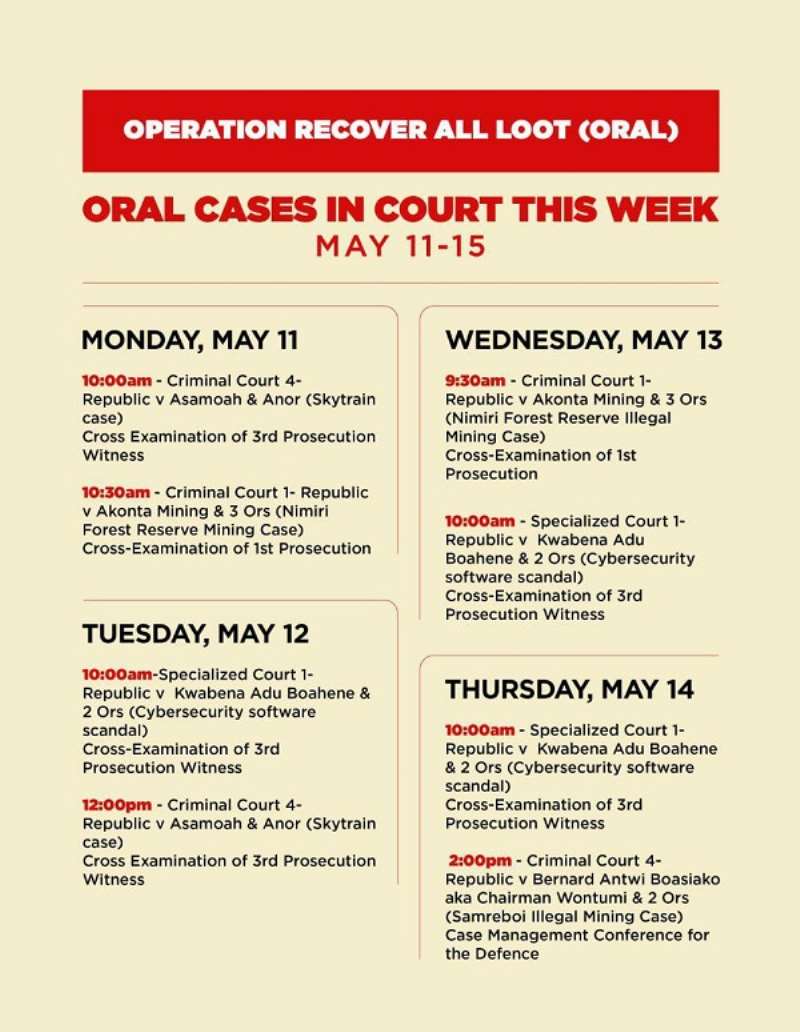
On Monday, May 11, the Republic v Asamoah & Anor, also known as the Skytrain case, will be heard at Criminal Court 4 at 10:00 am. The court will continue cross-examining the third prosecution witness.
At 10:30 am, Criminal Court 1 will hear the Republic v Akonta Mining & 3 Ors, also known as the Nimiri Forest Reserve illegal mining case. The court will cross-examine the first prosecution witness.
On Tuesday, May 12, the Republic v Kwabena Adu Boahene & 2 Ors, linked to the cybersecurity software scandal, will be heard at Specialised Court 1 at 10:00 am. The court will continue cross-examining the third prosecution witness.
The Skytrain case will also return to Criminal Court 4 at 12:00 pm for more cross-examination.
On Wednesday, May 13, the Akonta Mining case will continue at Criminal Court 1 from 9:30 am, while the cybersecurity case will continue at Specialized Court 1 at 10:00 am.
The cybersecurity case will continue again on Thursday, May 14, at 10:00 am at Specialised Court 1.
Later that day at 2:00 pm, Criminal Court 4 will hold a case management conference in the Republic v Bernard Antwi Boasiako & 2 Ors, also known as the Samreboi illegal mining case.
Deputy Attorney General and Minister of Justice Justice Srem-Sai shared an update on the cases on Facebook on Monday, May 11, 2026. He said the cases are part of efforts to recover state resources.
According to him, the government has improved the rights of citizens during its 16 months in office.
“This NDC government has advanced the civil and political rights of citizens considerably within its 16 months in office.
“Today, citizens habitually exercise their right to demonstrate and hold protests freely, even right in front of the seat of the President, the Flagstaff House. That place was, for years before the return of President John Mahama, treated as a no-go zone for public protest - often resulting in extreme armed brutality to protesters,” he said.
Srem-Sai also said accused persons are now taken to court within the 48-hour constitutional deadline. He added that state prosecutors are now more focused on bail conditions instead of opposing bail applications.
“Today, accused persons are habitually presented before the court ahead of the constitutional deadline of 48 hours. State prosecutors habitually refrain from opposing bail applications in courts, and are increasingly focused more on the conditions of bail, which will secure the presence of accused persons at trial,” he said.
He also said suspects now have better access to lawyers because police and investigators often arrange interrogations ahead of time.
“Suspects’ access to legal counsel has also seen a major improvement. Our police, law enforcement and investigative agencies now, in appropriate cases, habitually schedule interrogations ahead of time. That way, lawyers do not have to spend long hours at detention centres to have access to suspects,” he stated.


 'Our conscience will not allow us to lie' — South Africa evacuees accuse NPP of...
 Second batch of GAF recruits begins six-month basic military training
 'We can only win together' – Kojo Bamba rallies NPP members for 2028
 ‘Congratulations!’: World leaders hail Lula’s election victory in Brazil
 'Stop overthinking, Sammy Gyamfi spoke simple language not PhD thesis' — Frankli...
 IMF broadens engagements as first review of Ghana’s PCI enters second week
 Government rejects GH¢873.94m in Treasury bill bids despite strong investor dema...
 President Mahama woos British investors, urges global debt reforms
 Ashanti Regional Minister impressed with progress of 24-Hour Economy model marke...
 GTA issue: Sanction whoever leaked Abeiku Santana’s letter to Tourism Minister –...


