




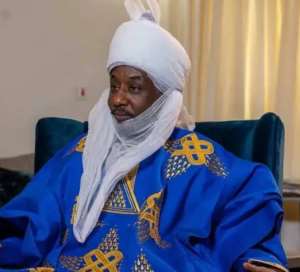
Nigeria's Most Outspoken Economist Turns the Spotlight on Debt
In a week that rattled Nigeria's fiscal establishment, the Emir of Kano, Muhammadu Sanusi II former Governor of the Central Bank of Nigeria, former Emir, and one of Africa's most respected economic minds delivered a sharp, two-pronged verdict on President Bola Tinubu's economic management: the subsidy removal was right, but the borrowing binge that followed is deeply wrong.
The Man Who Always Stood Against Subsidy
Sanusi’s credibility on this issue is unimpeachable he has long been one of the most consistent critics of Nigeria's fuel subsidy regime, long before its eventual removal became politically palatable.
The former Central Bank of Nigeria governor stated that while the removal of fuel subsidy and the liberalization of the exchange rate were necessary, the timing and lack of fiscal discipline are threatening to erase the potential benefits. He stressed that Nigeria's practice of supporting foreign refineries while its domestic refining capacity remained dormant was a systemic failure that needed to be addressed.
He pointed to improvements in local refining capacity, particularly the operations of the Dangote Refinery, noting that Nigeria is no longer heavily reliant on imported petroleum products a development he described as positive for the economy.
The Moment He Said "Enough Is Enough"
Sanusi spoke at the The Niche Annual Lecture 2026 in Lagos, themed 'Governing the Economy: Choices, Trade-offs, and National Priorities.' His remarks came shortly after President Bola Tinubu requested approval from the National Assembly for a $516 million external loan to finance portions of the Sokoto–Badagry superhighway project. Earlier in March, lawmakers had already approved a separate $6 billion external borrowing plan, partly aimed at settling existing debt obligations.
His verdict was blunt and unsparing. Sanusi challenged the government's continued borrowing, insisting that savings from subsidy removal should translate into fiscal consolidation rather than increased debt.
In his own words: "We've removed the subsidy. We're now spending it. What we should not see is fiscal consolidation being ignored while borrowing continues. You cannot remove wastages and continue borrowing. If you're not paying the subsidy and you've got the money, why are we still borrowing and borrowing? What are we borrowing for?"
The Timing Problem: A Critique of Policy Sequencing
Sanusi’s criticism goes beyond the borrowing itself he raises a more sophisticated concern about how the reforms were implemented. While defending key reforms such as subsidy removal and foreign exchange liberalization as necessary policy decisions, Sanusi maintained that both were implemented at the wrong time and that complementary measures were not adequately considered. He warned that introducing these reforms without first tightening monetary conditions placed additional pressure on the naira.
He explained: "If you decide to remove subsidy and liberalize exchange rates in an environment of very loose monetary conditions, before you have tightened money supply, the Naira drops to a bottomless pit. That was a timing issue."
He reiterated that ending the subsidy was unavoidable, particularly at a time when government revenue was almost entirely consumed by debt servicing: "When you get to a point where 100 percent of your revenue goes into debt service, you cannot continue," he said.
Nigeria's Debt: The Numbers Behind the Alarm
The numbers validate Sanusi’s alarm. Nigeria's debt stock climbed from $94.23 billion in 2024 to $110.97 billion in 2025 an increase of $16.75 billion in a single year. On a quarter-on-quarter basis, public debt grew from ₦153.29 trillion in September 2025 to ₦159.28 trillion in December 2025. Domestic borrowing continues to dominate Nigeria's debt structure, accounting for 53.27% of total debt. Domestic debt alone rose from ₦74.38 trillion in December 2024 to ₦84.85 trillion in December 2025.
Total debt service rose to about ₦16 trillion in 2025 an increase of ₦2.98 trillion or 22.9% from ₦13.02 trillion in 2024. Federal Government bonds alone accounted for about ₦5.35 trillion, representing roughly 65% of total domestic interest payments.
Earlier this month, the Federal Government increased its 2026 borrowing projection by ₦11.31 trillion, pushing total projected borrowing to ₦29.20 trillion.
Where Are the Savings? The Accountability Question
Sanusi stated that the core rationale for removing fuel subsidies was to free up government revenue for development spending and reduce borrowing needs. He asked directly why borrowing persists despite the policy shift, stressing that the expected financial relief has not translated into reduced debt levels. Sanusi urged the government to provide clear accounting of revenues generated from subsidy removal and how these funds are allocated, stressing that transparency is essential to maintaining public trust.
He noted that Nigeria has even moved toward local refining and is now exporting refined products to Europe a positive development but said the government should now show clear improvements in public finances rather than increasing debt.
Sanusi Is Not Alone: Growing Chorus of Concern
The borrowing plan has drawn criticism from several quarters, including former Vice-President Atiku Abubakar, who described the Sokoto–Badagry Superhighway project as commendable but urged the government to explore alternative funding options rather than further increasing the country's debt burden.
Conclusion: Reform Without Discipline Is a Mirage
Sanusi Lamido Sanusi's message in April 2026 is one of the most important economic warnings issued to any Nigerian government in recent years. It carries extra weight precisely because it comes from a man who championed the very reforms now being questioned not because they were wrong, but because their benefits are being swallowed by an insatiable borrowing appetite.
The subsidy is gone. The naira has been liberalized. The Dangote Refinery is running. But if the savings are disappearing into a debt spiral rather than into the lives of ordinary Nigerians, then, as Sanusi would say, the reform has been won on paper and lost in practice.
Mustapha Bature Sallama.
Medical/ Science Communicator,
Private Investigator, Criminal investigation and Intelligence Analysis.
International Conflict Management and Peace Building.USIP
[email protected]
+233-555-275-880

 'We have spent 60years arguing about Nkrumah and rather less time doing what he ...
 Judge recounts attempted MoMo scam on him moments after jailing scammer
 'Systemic failure due to NACOC removal from port inspections' – Inusah Fuseini o...
 Akyem Oda commercial drivers raise fares arbitrarily amid commuter concerns
 Two arrested over alleged GH¢22,000 SHS placement scam
 Police uncover alleged network behind Ghana Jollof videos
 NACOC says cocaine suspects were under surveillance for up to two years
 Suhuyini assures Accra-Kumasi Expressway won’t miss December 2028 deadline
 Foreign Affairs Ministry releases 200-page RTI response on GH¢49.7m South Africa...
 Chartered flights account for GH¢27.18m of South Africa evacuation cost


