




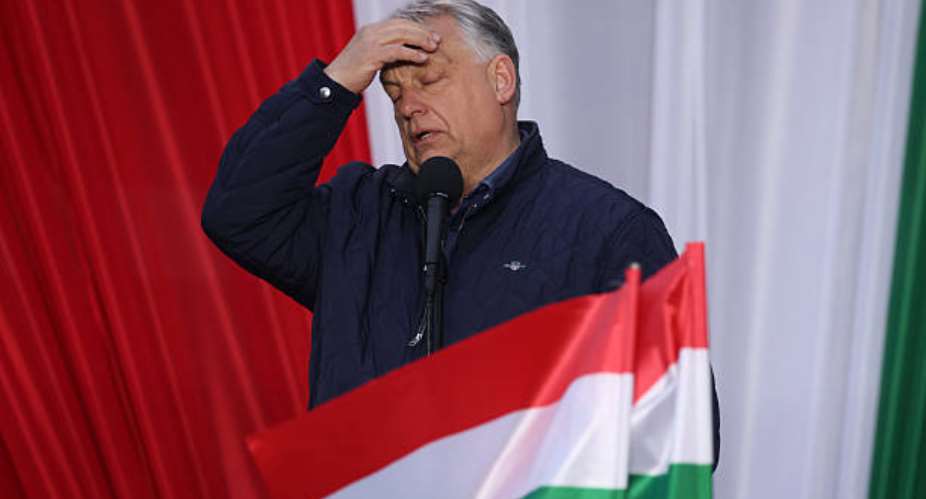
Viktor Orbán’s Hungary has become one of the most consequential internal friction points in the European Union’s response to Russia’s war in Ukraine. This is not because Hungary is economically dominant or militarily significant, but because EU foreign policy is structurally vulnerable to unanimity. In that narrow procedural gap, Orbán has exercised outsized influence, turning what should be a coordinated continental strategy into a recurring exercise in crisis management.
The blunt reality is this: Ukraine’s relationship with the EU has been shaped not only by battlefield developments in Donbas or diplomatic alignment in Brussels, but also by the domestic political calculus of a single leader in Budapest. Whether on sanctions, financial assistance or accession talks, Hungary under Orbán has consistently acted as the EU’s internal constraint. The question of what happens after him is therefore not theoretical. It is central to understanding the future tempo and cohesion of Europe’s Ukraine policy.
The Institutional Choke Point
To understand Orbán’s leverage, one must start with the design of EU foreign policy. Key decisions: sanctions renewals, macro-financial assistance packages and enlargement steps, require unanimous approval among member states. This means that even one dissenting government can delay or reshape policy for all 27 members.
Since Russia’s full-scale invasion of Ukraine in February 2022, the EU has adopted 13 major sanctions packages against Moscow. These measures have targeted Russian banks, energy exports, defense industries and thousands of individuals and entities. While politically unified at the surface, several packages required last-minute negotiations due to Hungarian objections, particularly on energy exemptions and individual sanction listings.
Hungary has repeatedly used this veto leverage not necessarily to block policy outright, but to extract concessions, ranging from energy carve-outs to assurances on frozen EU funds. This pattern has turned EU decision-making into a cycle of negotiation under pressure, especially when Ukraine-related measures require rapid renewal.
Financial Assistance Under Pressure
One of the clearest illustrations of Orbán’s impact came with the EU’s €50 billion Ukraine Facility, approved in early 2024. The package was designed to provide predictable, multi-year financial support to Ukraine through 2027, covering budgetary stability, reconstruction planning and institutional reform.
Hungary initially vetoed the agreement during a high-stakes European Council summit, forcing EU leaders into an emergency recalibration of the funding structure. Only after extensive side negotiations, reportedly involving guarantees on EU funds frozen under rule-of-law mechanisms, did Budapest agree to lift its objection.
This episode was not an exception but a pattern. Since 2022, Ukraine has received over €33 billion in EU military assistance alone, alongside tens of billions in macro-financial and humanitarian support. Yet nearly every major funding tranche has carried the risk of delay due to intra-EU bargaining dynamics in which Hungary has played a central role.
The strategic consequence is not just financial. It introduces uncertainty into Ukraine’s wartime planning, where predictability of external support is as critical as the volume of assistance itself.
EU Enlargement
Ukraine’s EU accession process, formally opened in December 2023, represents one of the most politically sensitive enlargement tracks in the Union’s history. Candidate status was granted in June 2022 in a symbolic gesture of unity, but the transition to actual negotiations exposed the complexities of consensus politics.
Hungary has been among the most cautious voices regarding Ukraine’s accession. Orbán has cited issues such as minority rights for ethnic Hungarians in western Ukraine, particularly in the Zakarpattia region, as well as broader concerns about institutional readiness during wartime. While some of these concerns reflect genuine policy debates, their political function has been to slow procedural progress.
EU accession is divided into 35 negotiating chapters covering governance, judiciary, economy and regulatory alignment. Each stage requires unanimous approval. This means Hungary does not need to permanently block Ukraine’s membership to exert influence; it only needs to delay key milestones.
Even symbolic steps matter. Delays in opening or closing chapters signal uncertainty to investors, weaken reform momentum in candidate countries and reduce the credibility of EU enlargement as a geopolitical tool.
Strategic Messaging
Beyond formal decision-making, Orbán’s position has had an informational and psychological impact on the EU’s Ukraine strategy. In geopolitical terms, unity is not only operational; it is communicative. The perception of cohesion strengthens deterrence, reinforces allied confidence and signals resolve to adversaries.
Hungary’s repeated divergence from EU consensus positions on Russia sanctions and Ukraine aid has provided Moscow with a consistent narrative: that Europe is divided and vulnerable to internal fracture. This narrative is particularly potent in the context of Russia’s broader strategy of prolonging the war and weakening Western resolve through political attrition rather than battlefield victory.
While 26 EU member states have maintained a largely unified position since 2022, Hungary’s dissent ensures that unity is never absolute. Even if policy outcomes ultimately pass, the process itself becomes contested, visible and politically noisy.
The Domestic Logic Behind Orbán’s Strategy
Orbán’s Ukraine policy cannot be understood purely through external geopolitics. It is deeply rooted in domestic political economy and electoral strategy. Hungary remains significantly dependent on Russian energy imports, particularly natural gas, which has historically accounted for a large share of its consumption.
Though EU-wide diversification efforts have reduced dependency on Russian energy since 2022, Hungary has maintained relatively stable energy ties with Moscow compared to many other member states. This economic structure creates incentives for cautious foreign policy alignment.
Domestically, Orbán has framed Hungary’s position as one of “strategic neutrality” or “peace advocacy”, appealing to segments of the electorate that are skeptical of military escalation with Russia. In this narrative, Hungary is not obstructing Europe but preventing escalation.
However, in institutional terms, this position translates into recurring friction with EU consensus-building, especially on Ukraine-related policy.
What Orbán’s Departure Has Actually Changed
With Viktor Orbán no longer in power following Hungary’s electoral transition, EU-Ukraine relations have entered a noticeably different phase, one defined less by repeated institutional deadlock and more by procedural continuity. While his exit does not remove all political divergence within the EU, it has eliminated the most consistent veto-centered pressure point in recent years.
First, decision-making has become faster and more predictable. The absence of a leader who frequently used veto threats as a negotiating instrument has reduced the pattern of last-minute brinkmanship around sanctions renewals and financial assistance packages. Even if Hungary’s new leadership remains cautious on aspects of EU foreign policy, it has so far been less inclined to systematically obstruct collective decisions.
Furthermore, Ukraine’s accession trajectory has gained a measure of procedural stability. Enlargement fatigue persists across several member states, but the removal of a single entrenched blocker has reduced the likelihood of repeated institutional deadlock at key stages of the accession process. This has improved continuity in technical negotiations and reduced uncertainty around timelines.
Moreover, EU external signaling has become more coherent. Financial markets, reconstruction partners, and NATO-aligned states tend to interpret EU unity as a proxy for strategic durability. With fewer internal fractures visible at critical moments, the Union’s commitments towards Ukraine are now perceived as more predictable, even if underlying policy disagreements have not disappeared.
However, the structural constraints remain unchanged. The unanimity rule still governs key areas of EU foreign policy. Other member states can still exercise veto power on specific issues and broader internal debates, over fiscal responsibility, migration and long-term security commitments, continue to shape the limits of collective action.
The Deeper Structural Problem
Orbán’s departure has reduced a highly visible source of friction, but it has not resolved the underlying institutional challenge within the European Union: a foreign policy architecture built on consensus in an environment that increasingly demands speed, coherence and scale.
The war in Ukraine has intensified this tension. The EU has demonstrated substantial capacity to mobilize financial and military support, amounting to tens of billions of euros since 2022, but it has done so through mechanisms that remain politically vulnerable to individual national positions.
In this context, Hungary under Orbán did not fundamentally redirect EU strategy, but it did increase the cost, complexity and unpredictability of execution. His absence has lowered that friction. Yet the broader reality remains: in modern geopolitical competition, even temporary delays and procedural uncertainty can function as strategic constraints in their own right.
Conclusion
Viktor Orbán’s Hungary has functioned less as a wall against Ukraine’s European integration and more as a recurring bottleneck within it. Ukraine has still advanced toward EU membership, secured unprecedented financial support, and maintained a broad coalition of European backing. However, each major step has required negotiation not only among allies, but also with internal dissent operating within the EU’s unanimity framework.
The central issue is therefore not Hungarian policy alone, but the structural vulnerability of EU foreign decision-making. Hungary under Orbán has not fundamentally redirected EU strategy on Ukraine, but it has increased the cost, complexity and uncertainty of its execution, particularly at moments when speed and unity are strategically important.
Even if Hungary’s position were to moderate in the future, the underlying institutional constraint would remain. The unanimity rule in foreign policy continues to give individual member states leverage over collective action, meaning that similar dynamics could reappear in different forms under different governments.
In a war where time, predictability and coherence are strategic resources, the EU’s internal decision-making structure itself becomes part of the geopolitical environment. Hungary’s role under Orbán has simply made that reality more visible.
The writer holds a PhD in Journalism. He is a journalist, journalism lecturer, and a member of the Ghana Journalists Association, the Society of Professional Journalists, Investigative Reporters and Editors, the Ida B. Wells Society for Investigative Reporting, and the African Journalism Education Network. Email: [email protected]


 ‘Too arrogant, too sure of itself’ France confronts its legacy in Africa
 Nigeria's unwritten power-sharing rule looms over presidential race
 Several killed, dozens wounded in Jordan church shooting
 ‘I killed lots of terrorists, but it didn’t make me feel better’: The trauma hau...
 Casualties feared as multi-storey building collapses in Nairobi
 Cabinet approves bill to regulate public relations practice – Shamima Muslim
 Bawumia was right; NDC's economy is only on paper, not in people's pockets – Kwa...
 NDC should credit Bawumia for introducing gold-for-reserves policy – Kwadwo Poku
 Obuasi SHTS sex scandal: Gender Ministry deploys team to support affected studen...
 Adwoa Safo's Dome-Kwabenya comeback bid must push Elikplim Akurugu to deliver mo...


