




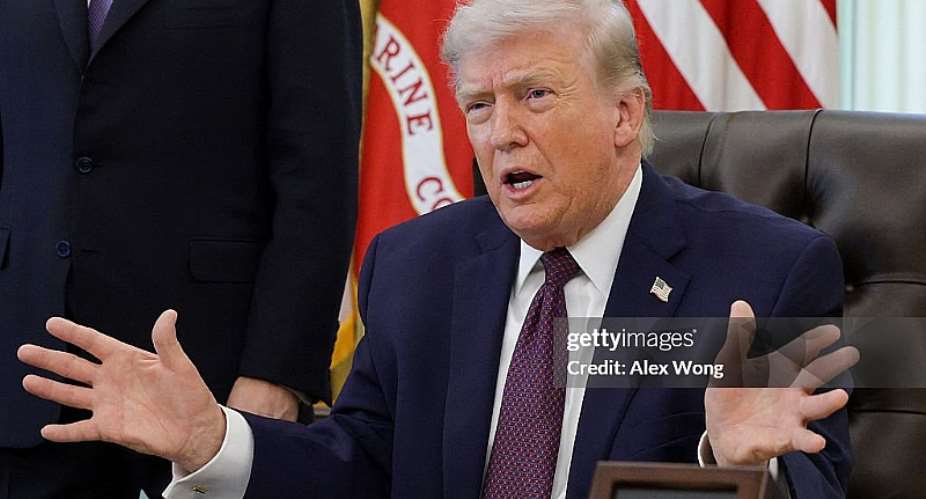
Demands for praise are rarely about performance alone. More often, they are about control: over how outcomes are interpreted, remembered and ultimately recorded. When a sitting American president urges the press to declare a “job well done”, the issue is no longer policy detail. It becomes a contest over something more elemental, who gets to define reality in public life.
Donald Trump’s recurrent clashes with major American news organizations, including The New York Times and CNN, are often presented as quarrels over tone or fairness. That framing is too modest. At stake is narrative authority in an already fragmented information order. The question is not simply whether journalism is right or wrong in its coverage, but whether it is expected to validate power when outcomes appear favourable or remain sceptical even when political actors demand affirmation.
In stable information systems, that question would be easier to answer. In contemporary democracies, it is not.
The politics of legitimacy
Accusations of media bias have become routine political currency. Yet they increasingly obscure a deeper structural condition: the erosion of shared informational baselines. In the United States, survey data from institutions such as the Pew Research Centre have long documented a widening partisan gap in trust towards news organizations. The divide is no longer marginal. It reflects two increasingly distinct interpretive communities, each with its own hierarchy of credible sources.
The result is not merely disagreement over interpretation, but disagreement over what counts as fact.
In such an environment, “bias” functions less as an analytical category than as a strategic instrument. It is deployed to delegitimize unfavourable reporting rather than engage with its substance. This dynamic is particularly visible in Trump’s relationship with the press. His repeated characterization of critical coverage as “fake” or “failed” does more than contest individual stories. It questions the legitimacy of the system producing them.
The cumulative effect is corrosive. If the referee is presumed compromised, every result becomes suspect.
Journalism under suspicion
It is important not to collapse all critical reporting into partisan motivation. Much of the negative coverage during Trump’s presidency reflects observable political reality: institutional conflict, legal disputes, policy reversals, and a governing style that frequently challenges established norms. Journalism, by its nature, gravitates towards tension. Power is most visible when it is contested, and most reportable when it produces consequences.
Still, the strategic dimension of presidential-media relations should not be ignored. By persistently framing scrutiny as hostility, political actors shift the terms of engagement. The press is no longer positioned as an intermediary of public information, but as a rival broadcaster competing in an attention economy.
In that environment, journalism is reclassified. It is no longer an institution tasked with interpretation and verification, but an obstacle to narrative control.
This inversion is central to populist communication styles. Courts, bureaucracies, and media organizations are not treated as neutral arbiters but as aligned structures obstructing direct expression of popular will. Criticism is therefore recoded as sabotage. Disagreement becomes obstruction. Reporting becomes intervention.
The spectacle of governance
Modern political communication increasingly blurs the line between governance and performance. Traditional filters, press briefings, institutional messaging, editorial mediation, have been partially displaced by direct communication through digital platforms.
This is not merely a stylistic shift. It alters the role of journalism itself.
When political messaging bypasses institutional channels, the press is repositioned from mediator to competitor. Its function is no longer to transmit or contextualize power, but to challenge it in real time. The implication is that journalism ceases to be a neutral observer and becomes part of the contest for narrative dominance.
Within this framework, demands for praise, whether on foreign policy outcomes, military actions, or diplomatic negotiations, acquire a different meaning. They are not simply expressions of frustration. They are attempts to redefine the evaluative role of journalism itself: from scrutiny towards endorsement.
That expectation sits uneasily with press freedom.
It also has a broader consequence. It encourages governance by spectacle. Policy is increasingly assessed through immediacy, visibility, messaging cycles and narrative impact, rather than through longer-term outcomes or structural effects.
Iran and the logic of escalation
Nowhere is the tension between tactical clarity and strategic uncertainty more evident than in US and Israeli policy towards Iran. The framework is familiar: economic sanctions, targeted military actions, intelligence operations and efforts to constrain regional influence through pressure on proxy networks.
The immediate objectives are often legible. Infrastructure is disrupted. Operational capacity is degraded. Deterrence signals are communicated.
But escalation rarely remains contained. Each act of pressure generates counter-pressure. Retaliation becomes expectation rather than exception. The theatre expands across borders, domains and instruments, from conventional strikes to cyber operations and asymmetric responses.
Iran’s strategic posture reflects this multi-layered reality. Its options, ranging from missile deployment to proxy mobilization, ensure that escalation is rarely linear. Instead, it is distributed across a network of actors and geographies.
Meanwhile, questions surrounding nuclear enrichment and monitoring continue to shape international assessments. Reduced transparency and fluctuating compliance deepen uncertainty about thresholds and timelines, complicating diplomatic calibration.
The regional consequence is not stability, but managed volatility.
Security gains, strategic ambiguity
Short-term operational success is often easier to identify than long-term strategic outcome. A targeted strike can be assessed quickly. Disruption can be measured. Damage can be reported.
But broader consequences are harder to contain. Each escalation produces secondary effects: retaliatory cycles, alliance recalibration, cyber exchanges, and proxy activation. The battlefield expands beyond geography into networks of influence and response.
In such conditions, “success” becomes an unstable category. A tactical gain may simultaneously increase long-term instability. Deterrence may hold in one domain while eroding predictability in another.
This is the central tension in contemporary Middle East security dynamics: operational precision coexisting with strategic ambiguity.
Should journalism applaud power?
Political pressure on media institutions to affirm successful outcomes is not new. It is, however, increasingly explicit. The expectation that journalism should recognize “good results” in foreign policy or military contexts reflects a misunderstanding of its function.
Journalism is not a scoreboard.
Acknowledging facts is essential. Reporting disruption, shifts in capability, or changes in strategic balance is part of describing reality. But acknowledgement is not endorsement. A policy can achieve immediate objectives while producing long-term instability. Both conditions can exist simultaneously.
The role of journalism is not to resolve that tension in favour of one narrative, but to hold it in view.
When political actors demand praise, they collapse this distinction. Scrutiny is reframed as hostility. Evaluation is recast as disloyalty. In doing so, they weaken the conditions necessary for accountability.
Press freedom under pressure
Periods of geopolitical tension tend to compress the space for dissent. Governments prioritize cohesion. Critics are more easily characterized as obstructive. In such moments, independent journalism becomes both more necessary and more exposed.
The structural pressures are not only political but technological. Accelerated news cycles reward speed over verification. Complex developments are compressed into simplified narratives. Nuance is often the first casualty.
Digital fragmentation compounds the problem. Selective exposure allows audiences to inhabit distinct informational environments with limited overlap. Shared reference points weaken. Competing narratives harden into parallel realities.
The consequence is not simply disagreement, but fragmentation of the public sphere itself.
Narrative control as political strategy
The struggle between political authority and journalism is not new. What has changed is its centrality to governance. Narrative management is now a core political instrument, alongside economic and military tools.
Governments seek coherence and legitimacy. Journalism introduces friction: contradiction, complexity, and institutional scrutiny. That friction is not a design flaw in democratic systems. It is one of their stabilizing mechanisms.
Attempts to eliminate it, whether through delegitimizing media institutions or demanding affirmative coverage, do not remove tension. They relocate it, often into less visible and less accountable spaces.
Control over narrative does not guarantee control over outcomes. It may shape perception, but it cannot stabilize reality.
Conclusion
The interplay between US, Israeli and Iranian strategic dynamics reflects a broader feature of contemporary politics: power is exercised simultaneously through force, economics and information. Yet none of these instruments produces certainty.
Tactical success does not eliminate strategic risk. Narrative management does not resolve material consequences. And political messaging cannot override structural instability.
In such an environment, journalism’s role is not to echo official assessments of success, but to test them against evidence. Not to validate power, but to examine its effects.
Credibility is not derived from proximity to authority. It is earned through independence from it.
And when political leaders demand applause, scrutiny becomes not optional, but essential.
The writer is a journalist, journalism lecturer, and member of the Ghana Journalists Association, the Society of Professional Journalists, Investigative Reporters and Editors, the Ida B. Wells Society for Investigative Reporting and the African Journalism Education Network. Email: [email protected]


 Germany’s far-right AfD landslide winner in key Saxony-Anhalt vote, early result...
 'The height of absurdity' — Ayew Afriye slams BNI over invitation of Efya Royal ...
 US envoys arrive in Moscow to thrash out plan to end war in Ukraine
 'Chief Justice was talking as a citizen; you have to look at the context in whic...
 Mandatory towing to remove broken-down, stationary vehicles from roads to begin ...
 Domelevo backs OSP probe into alleged GH¢70,000 payment to Appiagyei despite den...
 WAEC releases 2026 WASSCE results, cancels entire results of 861 candidates for ...
 Baffour Agyeman-Duah explains why profitability may not be only reason behind SO...
 5-year-old girl dies after falling into water-filled manhole at Winneba
 Sierra Leone ex-president to return after treason case dropped

