




Much has been said about Ghana’s problems. We blame politics. We blame corruption. We blame poor leadership, weak institutions, economic hardship, underdevelopment, unemployment, insecurity, rising mortality, and the collapse of industries that once promised stability and growth. All of these are real. All of them matter. Yet there is a deeper problem that receives far less attention, even though it quietly feeds many of the others. It is the national habit of presenting oneself as capable of what one has not been prepared to handle. It is the dangerous social belief that because another person did something, anyone else can also do it. That mindset, often dressed up as confidence, is in many cases a form of self-deception. And it is costing Ghana dearly.
This is not an argument against ambition. It is not an argument against growth, effort, or aspiration. It is an argument against the false equivalence between desire and capability. A nation does not progress because people say yes to every challenge. It progresses when people understand their strengths, respect their limitations, and build the right capabilities before stepping into responsibility. Ghana’s failure in many sectors can be traced, in part, to a culture that discourages people from saying, “This is not my field,” “I am not ready,” or “I do not have the capacity to handle this well.” We have made honesty about one’s limits look like weakness, while rewarding inflated self-belief as if it were strength.
The problem begins very early in life. Many children in Ghana are pushed into educational tracks that do not match their interests, aptitudes, or natural abilities. Parents often act less as guides and more as controllers. A child who is inclined toward one field may be forced into another because it sounds more prestigious, more profitable, or more socially admired. A student who might excel in design, technical work, communication, entrepreneurship, or applied practice is instead forced into a program chosen to satisfy family ego or comparison with another household’s child. The issue is not simply pressure. It is misdirection at a formative stage of human development.
What makes this especially damaging is that many of these children do not suddenly become suited to the imposed path just because they remain in it. They struggle. They endure. They memorize enough to survive. Some resit examinations multiple times. Some barely pass. Some move from one level to another without ever mastering the foundations. Yet because the system values completion over fit, many are pushed forward anyway. This creates a serious distortion in the development of human capabilities. On paper, the country looks educated. In practice, many have only been processed through a system that did not properly cultivate their real strengths.
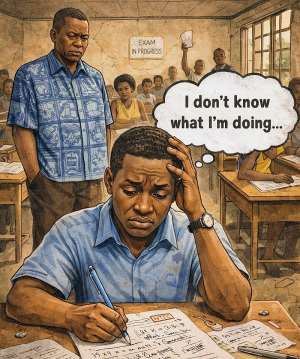
One of the clearest and most troubling examples appears in the examination room itself. There are students who sit for exams and know very well that they do not understand the questions before them. They know the answers they are writing are incorrect, yet they still fill page after page, not out of knowledge, but out of fear, image management, or habit. Some do not want invigilators, teachers, or fellow students to think they are incapable. Others simply believe that leaving a page blank is a form of disgrace. So they write anything. They stay until the end. They perform the appearance of readiness even in the very moment of failure. That behavior is not harmless. It is a training ground for a lifelong pattern of pretending.
This is where the problem becomes more than educational. It becomes psychological and cultural. A child who learns early that appearance matters more than fit, and that confidence matters more than understanding, may carry that mentality into adulthood. The same student who once filled an exam sheet with wrong answers just to avoid embarrassment may later fill a report with weak analysis, accept a professional assignment beyond his or her actual capabilities, or defend a public position he or she does not fully understand. The form changes, but the mentality remains. The habit of performance without sufficient preparation becomes normalized.
In professional life, the consequences become even more dangerous. Ghana is full of talented people, but it is also full of people who overstate what they can do. A carpenter may be skilled in making chairs but say yes to building cabinets, roofing frameworks, doors, and interior fittings without the necessary capabilities. The result is predictable: wasted materials, poor workmanship, delays, and customer dissatisfaction. A mason may claim readiness for structural work beyond his training. A consultant may promise delivery without adequate technical grounding. In each case, the problem is not effort. It is the refusal to distinguish between a specific capability and a broad claim of being able to do anything.
The same pattern appears in the professions. A lawyer may be called to the Bar and still not have the experience, depth, or specialization to handle a criminal case, a constitutional dispute, or a complex commercial matter well. Yet some will still take the case, perhaps because they need the fees, perhaps because they fear losing face, or perhaps because they genuinely believe that qualification alone is enough. But qualification is not the same as having the capabilities required in every subfield. When a lawyer takes a case outside his or her real capacity, the client does not merely receive poor service. The client may lose liberty, money, rights, or justice. The cost of overstating one’s capabilities in such a case is not symbolic. It is real.
This problem is not limited to law. It can be found in medicine, engineering, education, administration, and management. It also appears in public commentary, especially on radio and television, where individuals often speak with total certainty on matters they do not fully understand. They analyze national budgets without grasping fiscal mechanics. They debate public health issues without understanding healthcare systems. They make sweeping constitutional claims without legal grounding. They discuss education reform without knowledge of curriculum design, teacher development, or policy implementation. Because they speak fluently, confidently, and loudly, audiences often mistake assertion for insight. Yet public discourse suffers when commentary becomes performance rather than informed analysis.
This media culture deepens the crisis because it normalizes superficial certainty. Once a person is seen regularly on television or heard frequently on radio, visibility itself begins to substitute for actual capability. Panels become filled with familiar voices rather than qualified insight. Public understanding is then shaped by individuals who may be politically loud but analytically weak. In such an environment, the nation becomes vulnerable not only to poor leadership, but also to poor interpretation of leadership failure. Even diagnosis becomes corrupted. When the wrong people dominate analysis, the country does not merely struggle to solve problems. It struggles even to define them properly.
The culture that supports this problem must be confronted directly. In many Ghanaian settings, saying “I cannot do this” is treated as shameful. Admitting lack of readiness can be interpreted as weakness, disrespect, or failure. There is enormous pressure to project confidence even when one is not prepared. Families compare children. Communities celebrate status. Public life rewards boldness more visibly than accuracy. Even the language of everyday life often privileges the person who appears fearless over the person who exercises careful judgment. Over time, this creates a social order in which self-limitation is misunderstood and disciplined self-awareness is undervalued.
That cultural pressure also explains why specialization is often poorly respected. Instead of admiring the discipline of someone who knows exactly what they can and cannot do, society may admire the person who claims broad capability. Yet serious societies are built on specialization, apprenticeship, gradual mastery, and honest limits. A functioning system needs people who say, “This is my field, and that is not.” It needs teachers who guide rather than force. It needs parents who observe rather than impose. It needs institutions that reward demonstrated capability rather than confidence theater. Without such cultural correction, the cycle continues from household to classroom, from classroom to workplace, and from workplace into national governance.
And that is where the matter becomes most serious. The most dangerous expression of this culture is in leadership. Ghana has often placed people in positions of state authority where the demands of the office far exceed the individual’s preparation for the role. A country cannot be run on symbolic intelligence alone. Statecraft is not the same as debate. Managing a ministry is not the same as speaking well on a political platform. A PhD holder in political science may have deep theoretical knowledge of governance, public policy, and institutional design, yet still lack the operational, administrative, and managerial capabilities required to run a complex national ministry. Teaching political systems in a classroom is fundamentally different from coordinating budgets, managing personnel, navigating bureaucratic constraints, and executing policy at scale.
In some cases, those who are appointed may themselves know they are not the right fit for the office, yet still accept it. Why? Because in Ghanaian political culture, refusal is often seen as disloyalty, weakness, or a missed opportunity. There is also the persistent reasoning that if another parliamentarian or minister in a previous regime handled a similar portfolio, then one can do the same. But that logic is deeply flawed. The fact that someone else occupied an office does not prove capability. It merely proves rotation. And Ghana has suffered greatly from this politics of substitution, where the country keeps changing faces, changing names, changing parties, changing appointees, and yet living with the same poor outcomes.
This pattern of changing faces with the same disappointing results is one of the clearest signs that the problem is deeper than elections. New governments come with new promises. New ministers arrive with new slogans. New spokespersons dominate the airwaves. Yet the roads remain poor, the schools remain weak, the hospitals remain strained, youth unemployment remains high, industries remain fragile, and public confidence remains low. If the faces keep changing but the outcomes remain poor, then the issue is not simply who is in office. The issue is the system of selecting, rewarding, and defending people whose capabilities have not been seriously matched to the complexity of the task. A country cannot develop by rotating inadequacy.
This is why politicized leadership selection becomes so destructive. Once visibility, status, party loyalty, or rhetorical ability begin to substitute for sectoral knowledge and administrative experience, governance deteriorates. Ministries drift. Policies become inconsistent. Execution weakens. Institutional memory is lost. Reform becomes shallow. And the country keeps moving in circles while announcing progress. A minister who lacks substantive understanding of the technical field under his or her control may depend excessively on bureaucrats, consultants, or informal advisers, while still carrying the public authority of office. That combination is dangerous because it masks weak capability behind ceremonial legitimacy.
The broader result is a nation that appears stronger on paper than it is in practice. We have many intelligent people. We have many educated people. We have many ambitious people. But intelligence without alignment, education without fit, and ambition without developed capabilities do not produce sustained development. They produce frustration, inefficiency, and a cycle of recurring disappointment. The issue is not that Ghanaians lack potential. The issue is that our systems, our culture, and our leadership habits too often encourage people to occupy spaces they have not been properly prepared to manage.
Ghana does not need less confidence. It needs more honesty. It needs a national culture that respects preparation, specialization, discipline, and truth telling about capacity. It needs parents who guide children toward aptitude rather than prestige. It needs schools that identify strengths rather than merely enforce compliance. It needs professionals who know when to refer, when to decline, and when to train further. It needs media institutions that distinguish commentary from expertise. It needs leaders who can say no to roles for which they are unsuited. Above all, it needs to abandon the false and costly belief that because one person did something, anyone else can do it too. Nations do not rise on slogans of ability alone. They rise on the hard discipline of building and matching the right capabilities to the right responsibilities.
By: David Asante Ansong, Doctoral Researcher, Pennsylvania, USA


 NDC MP explains why Kevin Taylor was not arrested when he returned to Ghana
 Disruption of global order: 'We must expand opportunities for youth' – Mahama
 WN/R: Residents raise concern over abandoned truck on Benchemaa-Oseikojokrom hig...
 Gov’t invests GH¢4.12bn into road infrastructure in Bono Region — Asiedu Nketiah
 Mahama to cut sod for Sunyani Sports Stadium project in October
 Kwesi Pratt urges Ghana to revisit Nkrumah’s seven-year development Plan
 Ghana Jollof saga: 'Power is transient' — Annoh-Dompreh cautions against partisa...
 “I loved NDC but I’ve been disappointed and I’ve learned my lesson” — Mzbel
 Sista Afia laments how colleague musicians turned down her feature requests
 Joining NDC did me more harm than good – Mzbel


