




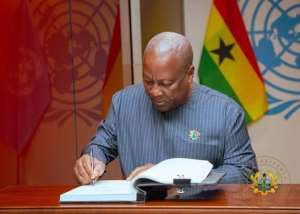
After years of anticipation and delays, the University of Engineering and Agricultural Sciences (UEAS) is finally poised to become a reality in Ghana. The Mahama-led government has secured a crucial $92 million financing agreement with a Korean contractor, paving the way for the commencement of construction on this vital institution. The university promises to be a significant driver of economic growth and development, focusing on critical sectors crucial to Ghana's future.
The flagship campus of UEAS will be strategically located in Bunso, in the Eastern Region of Ghana. This location offers several advantages, including proximity to agricultural hubs and existing research institutions, fostering collaboration and knowledge sharing. However, the vision for UEAS extends beyond a single location. The university will adopt a multi-campus model, with additional campuses planned for Kenyasi in the Ashanti Region and Acherensua in the Ahafo Region.
The strategic distribution of campuses underscores the government's commitment to providing access to quality education across the country. Kenyasi, a community within the Kwabre East Municipal District of the Ashanti Region, will benefit from the presence of a UEAS campus, bringing educational opportunities closer to the residents of this growing area. Similarly, Acherensua in the Ahafo Region, known for its agricultural potential, stands to gain immensely from the specialised training and research capabilities offered by UEAS.
The establishment of UEAS is not just about building physical structures; it is about investing in the future of Ghana's human capital. The university's curriculum will be carefully designed to address the evolving needs of the country's economy. With a strong emphasis on engineering and agricultural sciences, UEAS will equip students with the knowledge and skills necessary to drive innovation and productivity in these critical sectors.
Engineering programmes at UEAS are expected to cover a wide range of disciplines, including civil engineering, mechanical engineering, electrical engineering, and computer engineering. Graduates from these programmes will be well-prepared to contribute to the development of Ghana's infrastructure, energy sector, and technology industry. Furthermore, the agricultural science programmes will focus on modern farming techniques, sustainable agriculture, crop improvement, and livestock management. The aim is to produce graduates who can transform the agricultural sector, ensuring food security and promoting economic growth in rural communities.
The multi-campus model will also facilitate the specialisation of each campus, allowing them to focus on specific areas of expertise within engineering and agricultural sciences. This approach will foster centres of excellence, attracting leading researchers and faculty members to the respective campuses. The collaboration between the different campuses will further enhance the overall quality of education and research at UEAS.
The $92 million financing agreement is a significant step towards realising the vision of UEAS. With the funds now secured, construction is expected to begin in earnest. The development of the university will not only create educational opportunities but also generate employment during the construction phase. The long-term impact of UEAS on Ghana's economy and society is expected to be substantial.
Ultimately, the University of Engineering and Agricultural Sciences represents a significant investment in Ghana's future. The multi-campus approach, strategic location of campuses, and focus on critical sectors make UEAS a vital institution for driving economic growth and development. As construction commences, the anticipation and excitement surrounding the realisation of this long-awaited project are palpable. UEAS promises to be a game-changer, empowering the next generation of engineers and agricultural scientists to contribute to a more prosperous and sustainable Ghana.
Anthony Obeng Afrane

 Ghana gaining notoriety for cocaine — Bawumia
 Bawumia exposes NDC's ‘scam’ promises to Ghanaians
 NPP chairmanship: Sammy Crabbe backs John Boadu in last-minute show
 EOCO detention won't stop me from representing Salomey – Baffour Awuah
 NPP’s focus is to reclaim power in 2028 — Osahen Afenyo-Markin
 NPP must put aside differences, unite to rebuild party – Odeneho Kwaku Appiah
 NPP delegates approve 14 constitutional amendment motions
 NDC's 24-hour economy has turned into ‘24-hour demolition’ — Bawumia
 NPP adopts amendment to make flagbearer party leader
 NDC delegation exit NPP conference over delays, poor communication



Comments
Fantastic! Curriculum MUST include robotics, drone technology, internet-of-things, sensor technology, general automation, all with a heavy dose of AI.