




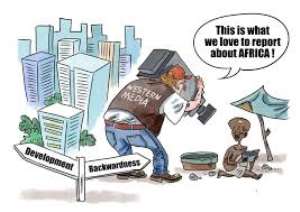
Western media does not operate in a vacuum. It reflects history, power, and interests. For Africa and the Global South, this has often meant being seen through a distorted mirror, one that magnifies weakness, ignores strength, and quietly reinforces the old idea that “White is right.” This is not always done openly or consciously, but the pattern is too consistent to ignore. Understanding it is not about anger; it is about clarity. And clarity is power.
For decades, Africa has been presented in Western news as a place of crisis, war, poverty, disease, and corruption. Research shows that international media coverage disproportionately highlights “conflict, corruption, poverty, disease and poor leadership,” creating a narrow and negative image of the continent. This is not just a storytelling issue. It has real consequences. The same report estimates that these stereotypes cost African countries billions in higher borrowing costs because investors perceive Africa as riskier than it actually is.
This pattern did not begin today. It has deep roots in colonial history. Scholars have long argued that Western narratives about Africa were shaped to justify conquest and exploitation. Books like Manufacturing Hate document how Africans were portrayed as “savages” or inferior, helping Europeans rationalise colonisation and resource theft. Even earlier academic studies show that Western media helped reinforce myths of Africa as a place of “danger, darkness, violence, poverty and hopelessness.” These images became so powerful that they often replaced reality in the global imagination.
Today, the language may be softer, but the structure remains. Western media often frames Africa as a problem to be solved, usually by the West itself. This is where the so-called “white saviour” narrative comes in. Stories frequently highlight Western aid workers, charities, or celebrities “helping” Africans, while local expertise and agency are sidelined. Critics argue that such portrayals continue the old colonial idea of the “White Man’s Burden”, the belief that Western societies must “save” others. Even humanitarian coverage can reinforce this imbalance by focusing on Western actors instead of African solutions.
We see similar patterns beyond Africa. In the ongoing war in Ukraine, for example, some Western journalists openly expressed greater sympathy for victims because they were “white,” “Christian,” or “European.” This exposed a deeper bias in global storytelling, one where suffering is not treated equally. Conflicts in Africa or the Middle East often receive less attention or are framed with less empathy. This is not accidental. It reflects a hierarchy of whose lives are seen as more valuable or relatable.
Another clear example is the spread of misleading narratives about Africa, especially when they align with Western political interests. Claims about a “genocide” against white farmers in South Africa, widely promoted in Western circles, have been dismissed as false by South African authorities. Yet such narratives gain traction because they fit into a broader ideology of white victimhood and superiority. They also serve political agendas abroad, showing how media narratives can reinforce foreign policy positions.
This brings us to a key point: Western media is not just about reporting facts; it is also about shaping global opinion in ways that often align with Western geopolitical interests. During the Iraq War, for instance, major outlets repeated claims about weapons of mass destruction that later proved false, helping justify the invasion. Similarly, coverage of Africa often emphasises instability in ways that justify external intervention or economic control.
But it would be too simple to say all Western media is deliberately malicious. Part of the issue is structural. News values prioritise drama and conflict: “if it bleeds, it leads.” This means negative stories are more likely to be reported everywhere, not just about Africa. However, the problem arises when this tendency interacts with historical biases and power imbalances. The result is a one-sided narrative that becomes normalised over time.
The danger of this narrative is psychological as well as political. When Africans constantly see themselves portrayed as victims, failures, or dependents, it can undermine confidence and self-belief. It shapes how the world sees Africa and how Africa sees itself. This is why the struggle over media representation is also a struggle over identity and dignity.
So what is to be done? The first step is awareness. Understanding how these narratives are constructed allows us to challenge them. As Chinweizu argued in The West and the Rest of Us, Africa must critically examine external influences while also addressing internal weaknesses. This means building strong, independent African media that tells African stories from African perspectives.
We are already seeing signs of change. African journalists, filmmakers, and scholars are increasingly pushing back against stereotypes and offering more balanced narratives. There is also growing global recognition that the old ways of portraying Africa are outdated and harmful. Even some Western organisations are beginning to rethink their approach, moving away from “white saviour” storytelling toward more inclusive and locally driven narratives.
However, the work is far from done. Western media remains powerful, and its narratives continue to shape global perceptions. For Pan-Africanists, this is not just a media issue; it is a political and cultural struggle. It is about reclaiming the right to define ourselves.
In the end, understanding the “enemy’s mindset” does not mean adopting it. It means seeing clearly how power operates, how narratives are built, and how they can be dismantled. The goal is not to reject all Western media, but to engage with it critically, confidently, and on our own terms.
Africa is not what Western headlines say it is. It is far more complex, far more dynamic, and far more powerful. The task before us is to ensure that the world and, more importantly, Africans themselves begin to see it that way.


 How IGP Yohuno led Police team to rescue victim, arrest four kidnappers in Assin...
 Akufo-Addo would have used Accra-Kumasi expressway for galamsey – Mahdi Gibrill
 Nigeria's Dangote refinery launches continent's biggest IPO
 Accra-Kumasi Expressway to cut travel time to 2hours, drive 120km per hour — Mah...
 'Our own money $2billion ready, we have not gone to borrow money from anywhere' ...
 Founder’s Day September 21 declared public holiday
 Council of State was not qualified to determine prima facie case against Torkorn...
 'Grounds for removal of Chief Justice and justice of superior court shallow, eph...
 Don't be a Bar that flips on principles but a Bar that is consistent — AG tells ...
 Prostate cancer may show no symptoms until advanced stage – Urologist warns


