




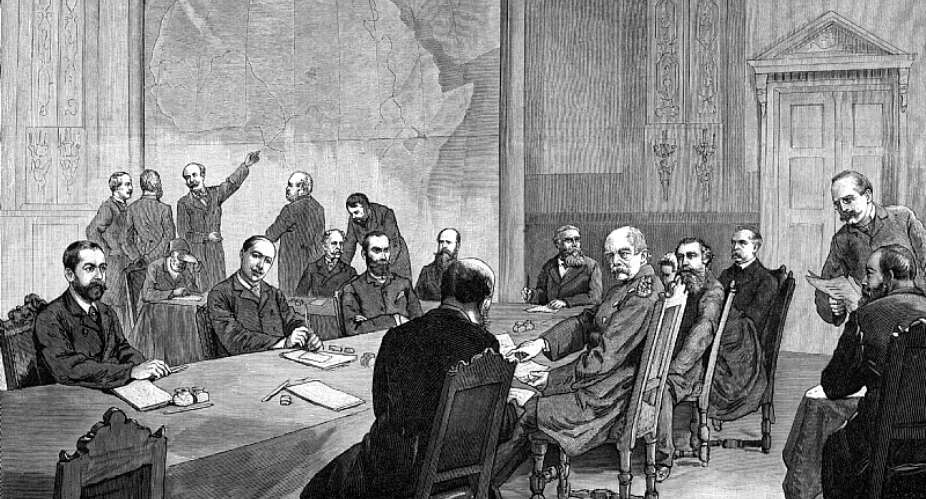
The anticipated Berlin Conference reflects a deeper and more fundamental dilemma regarding how the international community engages with the crisis in Sudan. The Sudanese government’s reservations about this conference cannot be viewed in isolation from a series of prior international gatherings—in Paris, London, and New York—that have consistently demonstrated a troubling disregard for Sudan’s sovereignty and the legitimacy of its government. While the conference presents itself as a platform to support peace and protect civilians, it may, in essence, represent an attempt to politically re-engineer Sudan from the outside, with the unintended—or perhaps deliberate—effect of weakening it as a sovereign state.
At the heart of the problem lies a flawed framing of the crisis itself, and an evasion of a reality that has become increasingly evident through ample evidence: Sudan, as a state, has for three years been subjected to a war marked by external aggression, supported by arms and mercenaries. This reality—the proverbial “elephant in the room”—is the principal driver of the humanitarian catastrophe and its escalation, rather than merely a byproduct of it. It is also important to highlight that the fulfillment rate of pledges made in previous iterations of such conferences has, at best, not exceeded 20 percent, underscoring a persistent gap between humanitarian rhetoric and tangible action on the ground.
The international community’s failure to uphold its credibility and its responsibility to protect is starkly illustrated in the case of tens of thousands of civilians in El Fasher, including women and children, who have endured a merciless siege for nearly 600 days. Forced at times to subsist on animal feed, many ultimately fell victim to lethal weaponry manufactured in Western countries—some of which are represented in these very forums—while the transfer of such arms through regional proxies to militias was met with inaction. This failure raises serious questions about the sincerity of current expressions of concern over Sudan’s humanitarian crisis.
Sudan’s position is firmly grounded in the lessons of past experience. Such initiatives, regardless of the slogans they invoke, risk serving as vehicles for imposing a form of disguised international tutelage, undermining national institutions and eroding their legitimacy. The language of peace and civilian protection is too often employed as a façade for advancing inequitable political arrangements. Experience has shown that externally imposed, pre-packaged solutions—detached from national ownership and political realities—serve only to deepen and prolong crises rather than resolve them.
A further source of concern lies in the Berlin Conference’s reliance on the outcomes of the so-called “Quad.” While Sudan acknowledges the constructive intentions of some of its members, it cannot accept the inclusion of a state accused of supporting a terrorist militia within a mediation framework. Such a contradiction fundamentally undermines the integrity of the process.
In this context, it is pertinent to recall the well-established legal principle that “confession is the master of evidence.” Recent statements by Abdelkhaleq Abdulla, advisor to Mohammed bin Zayed, are particularly significant in that they constitute one of the clearest acknowledgments to date that his country has supported the militia in question—albeit framed within an attempt to distribute responsibility among other regional actors. Regardless of such framing, this admission raises fundamental questions about the nature of regional involvement in the Sudanese conflict and the boundaries of moral and political legitimacy in its management.
This gives rise to an unavoidable ethical question: how can a party perceived as a principal contributor to fueling the conflict simultaneously assume the role of mediator? How can it credibly act as both arbiter and participant in the same conflict?
This paradox is not merely a flaw in the design of mediation efforts; it reflects a deeper crisis of trust between Sudan and certain international actors. The Sudanese people—who have borne immense costs in terms of lives lost, stability eroded, and infrastructure destroyed—are understandably skeptical of any initiative that does not begin with full respect for their sovereignty and their right to determine their own future.
With resilience, conviction, and a steadfast commitment to national unity, and in firm support of its long-standing armed forces—an institution that recently marked a centenary of service and professionalism—the Sudanese people view the Berlin Conference as yet another attempt to legitimize the rebel Janjaweed militia and facilitate its reintegration into the political arena, alongside its civilian affiliates, under the guise of impunity.
The narrative advanced by some international and regional actors under the notion of “both sides” constitutes a misleading and deeply flawed simplification. It creates a false equivalence between a sovereign national military institution and a rebel militia that, according to multiple international reports and statements by major powers, including the United States, has been implicated in acts amounting to genocide and crimes against humanity, including rape, ethnic cleansing, and systematic demographic engineering.
The crisis has demonstrated with clarity that no genuine or sustainable solution can be imposed externally. Nor can it be built upon a false parity between the state and an armed group that has rebelled against it. A viable path forward must be grounded in acknowledging realities on the ground, respecting national legitimacy, and ensuring accountability for those responsible for initiating and perpetuating the conflict.
Ultimately, the path to stability in Sudan lies in empowering national ownership, ending all forms of external support to armed actors, and restoring full respect for state sovereignty. Absent these conditions, any conferences or initiatives—regardless of their stated objectives—will remain little more than transient milestones in a protracted crisis.


 NPP rejects Mahama's appointment of Emelia Agbenyo as EC deputy, demands withdra...
 Excessive consumption of processed meat can expose one to cancer – Health expert...
 Education Minister appeals to University Administrators to call off strike, resu...
 'You're doing yeoman’s job' — Mahama lauds Police over declined unresolved murde...
 Wilmar Africa, De Heus, other food processing companies face CID action over dat...
 NPP’s Baba Amando runs to police over alleged death threats
 Ghana repatriates 120 Nigerians arrested in cybercrime operations
 PIAC unable to verify GH¢21million petroleum-funded projects in Ayawaso West
 Wontumi pleads not guilty to five charges in GH¢30m Exim Bank fraud case
 Ghana among stronger-performing economies in sub-Saharan Africa — IMF


