




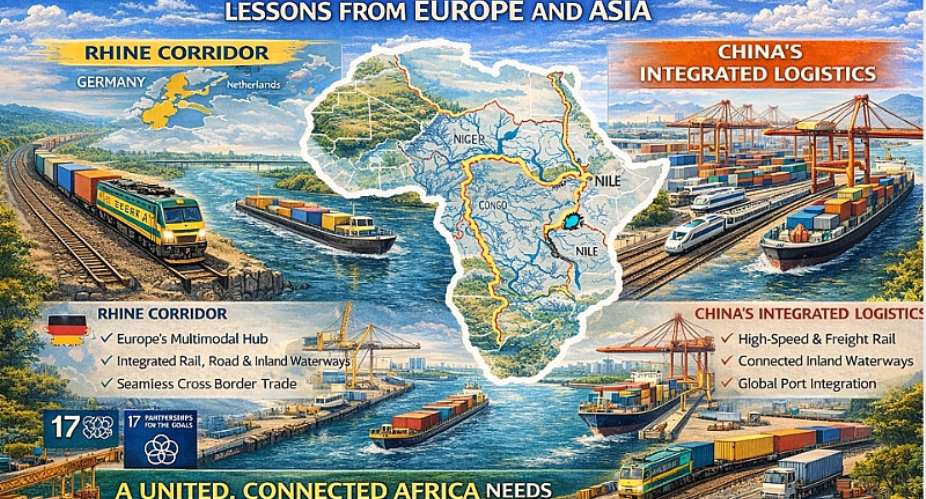
Africa’s development challenge is no longer just about building infrastructure, it is about connecting systems. Roads, railways, ports, and inland waterways exist across the continent, yet too often they function as isolated assets rather than as parts of a unified network. The result is a fragmented, inefficient, and costly transport landscape. As Africa advances under the African Continental Free Trade Area (AfCFTA), the urgency of overcoming this fragmentation has never been greater.
The solution lies in multimodal transport corridors, integrated systems that seamlessly connect different modes of transport to move goods and people efficiently across regions. This is not a new idea. It is a proven model that has transformed logistics and trade in other parts of the world. What Africa needs now is to adapt these lessons to its own context, scale, and ambitions.
At its core, a multimodal corridor is more than infrastructure. It is a coordinated ecosystem of railways, roads, inland waterways, ports, logistics hubs, digital systems, and institutions working together toward a common objective: efficient movement. The strength of a corridor lies not in its individual components, but in how well those components are integrated.
Europe offers one of the most compelling examples through the Rhine corridor https://shorturl.at/DMLHH. Stretching from Switzerland through Germany to the Netherlands, the Rhine is one of the busiest inland waterways in the world. But its success is not due solely to the river. It is the result of deep integration between inland water transport, rail networks, and ports such as Rotterdam. Goods can move seamlessly from barge to rail to truck, supported by advanced logistics systems and strong institutional coordination across countries. The corridor functions as a single, efficient system despite spanning multiple national boundaries. https://www.corridor-rhine-alpine.eu/home.html
The key lesson from the Rhine is not just about infrastructure quality, but also about institutional cooperation. Countries along the corridor have aligned regulations, coordinated investments, and built shared governance frameworks. This reflects the essence of SDG 17 (Partnerships for the Goals), recognizing that complex development challenges require collaboration across borders, sectors, and institutions.
Asia provides another powerful example, particularly through China’s logistics transformation. Over the past two decades, China has invested heavily in integrated transport corridors that combine high-speed rail, freight rail, inland waterways, and modern ports. The Yangtze River Economic Belt (https://shorturl.at/tK0LI), for instance, connects inland industrial hubs to coastal export zones through a highly coordinated multimodal system. Rail lines feed into river ports, which in turn connect to global shipping routes. This integration has dramatically reduced logistics costs, accelerated industrialization, and strengthened regional connectivity (https://shorturl.at/7QawH).
What distinguishes China’s approach is its strategic planning and long-term vision. Corridors are not developed as isolated projects but as part of national development strategies, supported by strong state coordination and significant investment in both physical and digital infrastructure. The result is a logistics system that is not only efficient but also scalable and resilient.
For Africa, these examples highlight both the opportunity and the gap.
The continent has the foundational elements needed for multimodal corridors: expanding rail networks, major river systems, growing port infrastructure, and a continental trade agreement in AfCFTA. Yet these elements remain largely disconnected. Rail projects are often developed without clear links to ports or inland waterways. River transport systems operate with limited integration into national logistics chains. Cross-border coordination is weak, with differing regulations and institutional frameworks slowing movement across countries.
This is where the concept of multimodal corridors becomes transformative.
Imagine a West African corridor where goods from inland agricultural zones are transported by rail to river ports along the Niger, then shipped via barges to coastal terminals for export. Or an East African system where rail lines connect directly to Lake Victoria ports, enabling seamless movement of goods across Kenya, Uganda, and Tanzania. In Central Africa, the Congo River system could serve as the backbone of a corridor linking multiple countries through integrated rail–water networks. These are not theoretical possibilities, they are practical pathways to reducing logistics costs, enhancing trade competitiveness, and promoting inclusive development. However, realizing this vision requires more than infrastructure investment. It demands partnerships at multiple levels.
First, regional cooperation is essential. Many of Africa’s most important transport corridors are transboundary by nature. Rivers cross borders, rail lines connect countries, and trade flows span regions. Effective corridors therefore require harmonized policies, shared standards, and coordinated investments among neighboring countries.
Second, public–private partnerships can play a critical role. Developing and managing multimodal corridors is capital-intensive and complex. Engaging private sector expertise in logistics, port operations, and digital systems can enhance efficiency and innovation, while public institutions provide the regulatory and strategic framework.
Third, international partnerships, including development banks and global institutions, are key to financing and technical support. Aligning these partnerships with Africa’s own priorities ensures that corridor development is both sustainable and locally relevant.
Finally, institutional integration within countries is just as important as cross-border coordination. Ministries of transport, rail authorities, port agencies, and waterway regulators must move beyond siloed operations toward a shared vision of system-wide efficiency.
The alignment with SDG 17 is clear. Multimodal corridors are, by their very nature, partnership-driven. They require collaboration across governments, sectors, and regions. They embody the principle that development is not achieved in isolation, but through coordinated effort.
Africa stands at a pivotal moment. The infrastructure investments of the past decade have laid important foundations, but without integration, their full value will remain unrealized. Multimodal corridors offer a way to unlock this value, transforming fragmented systems into connected networks that drive trade, growth, and sustainability.
The lesson from Europe and Asia is not that Africa should replicate their models exactly, but that integration is the multiplier of infrastructure. It is what turns assets into systems, and systems into engines of development.
If Africa is to fully realize the promise of AfCFTA and position itself in the global economy, it must move beyond building infrastructure to building connections. Multimodal corridors are not just an option, they are the pathway to a more integrated, competitive, and sustainable future.
Author: Joseph Fuseini ([email protected])


 'Stop excessive financial demands before sharing information with us' — Interior...
 EC will serve national interest, not partisan politics – Deputy Chair Dr Kwaku A...
 I expect no preferential treatment from EC for myself as President, my party or ...
 Afenyo-Markin meets management, proposes reforms to turnaround struggling ECG
 ECG management commends Afenyo-Markin for reforms during short stay as Board Cha...
 Mahama tasks new EC deputy chairpersons to uphold impartiality
 Attorney-General urges court to reject Adu-Boahene’s no-case submission
 Nyaho Medical Centre ordered to report to CID over expired data protection certi...
 Mahama swears in new Electoral Commission deputy commissioners
 PTAAM-Africa calls for government probe into alleged World Cup visa fraud


