




Media narratives are constructions of the social, political, and economic realities of a space and place, which subsequently influence the perceived image and identity of a country. Countries’ narrative content across traditional, online, and social media platforms continues to serve as a perception filter through which a country’s image and identity are viewed.
National images are not mechanical constructions but organic dispositions backed by multilayered activities associated with national initiatives, government policies, international diplomacy, global event hosting, and economic and social campaign efforts toward the upliftment of citizens and development. The role of media narratives in shaping and influencing a country’s global image cannot be underestimated, as they constitute a summary of a country’s beliefs, aspirations, and national trajectory.
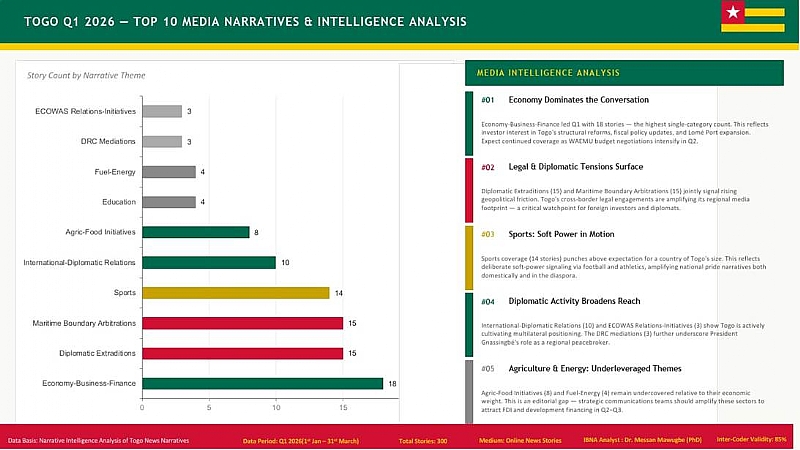
Against this backdrop, 300 online news narratives associated with Togo from January 1 to March 31, 2026 (Q1 2026), were analyzed to ascertain the degree of image sentiment associated with Togo’s national identity, as well as the topics driving this image. A vertical media narrative intelligence topical analysis methodology was employed, with an intercoder reliability test of 85%, as shown in the chart below. The chart depicts the top 10 topical narratives, out of the 300, considered most salient in media agenda-setting dissemination.
Togo’s Narrative Agenda
Togo’s national media narratives reveal a concerted effort by the country to sustain positive development for its citizenry, strengthen international diplomatic relations, and act as a global peace arbiter in international crises. Media narrative agendas are not set in a vacuum but act as extensions of deliberate national policies geared toward overall development across all facets of society.
News narratives such as “Togo unveils 2030 plan to eliminate key neglected tropical diseases,” “Togo allocates 1.8 billion CFA francs to support vulnerable groups,” “Community-driven care cuts risk of child death in Togo by nearly a third,” “Togo launches digital platform to combat food fraud,” and “Togo’s quiet rise as a startup contender in Lomé—a credible tech hub in Francophone West Africa driven by reform, infrastructure, and standout ventures,” are among the stories shaping Togo’s new image and positive perception.
In terms of narrative topics impacting Togo’s image, economic, business, and financial themes ranked highest, followed by diplomatic maritime arbitrations, extradition and international relations, sports, and others.
Key data interpretation takeaways include:
Economic and business coverage dominated Q1 2026 narratives, reflecting a strong focus on Togo’s commercial landscape.
Legal and diplomatic themes were heavily covered, particularly in relation to extraditions and maritime boundary arbitrations, highlighting Togo’s geopolitical partnerships and mediation roles within the ECOWAS subregion and across Africa.
Togo’s strong engagement in sports is also prominently projected, as reflected in the data chart below
Country Image & Strategic Communication
Media narratives emanating from Togo are not incidental but may reflect intentional national policy directions. Developments in industrialization, financial inclusion, digital transformation, gender initiatives, sports, cultural promotion, and international diplomacy are hallmarks of country image-building.
This raises an important question: does strategic communication enhance a country’s image? It certainly does—especially within a modern communication ecosystem where media narratives are coordinated strategic expressions of government policy aimed at fostering positive perceptions both locally and internationally.
Strategic communication should first be understood as a narrative intelligence tool. Secondly, it must be integrated across government policies to enable targeted messaging, narrative segmentation, media profiling, sentiment and reach analysis, and influencer mapping.
Furthermore, effective country image communication planning should be grounded in consistent and measurable narrative instruments, supported by tracking intelligence protocols for identifying threats, crises, and narrative impact. This is essential for sustaining a positively crafted national image.
Togo’s narrative trajectory is clearly aligned with enhancing the country’s image. However, national policy communication must consistently operate within a strategic media narrative ecosystem. Ministerial leaders and policy actors should align their media visibility with policy communication across platforms, as leadership identity is intrinsically linked to institutional and national image.
Another critical consideration for sustaining Togo’s positive image is the need for government communication systems to systematically track and evaluate misinformation, disinformation, and emerging narrative threats. Early warning systems and data-driven monitoring can support timely communication responses and informed decision-making.
In summary, the Togolese government, policymakers, commercial institutions, NGOs, and cultural agencies are encouraged to adopt strategic country image communication frameworks—such as a “Togo Narrative Intelligence Scorecard Report.” This framework would provide tailored insights on leadership perception, national media intelligence, political sentiment, media tone, social media volatility, institutional credibility, and public trust, thereby sustaining Togo’s organically evolving positive image within its broader development agenda.
About the Author: Messan Mawugbe (PhD)
A Narrative Intelligence Authority in Governance, Security & Public Institutions – A West African Narrative Intelligence shaping how institutions understand risk, perception, and Influence
Email: [email protected]


 We are going to provide emergency airstrip in regions without airports — Mahama
 Nana Konadu maiden memorial mass set for October 23
 'Double standards are not helpful, wrong yesterday is wrong today' – Ablakwa on ...
 'I am disappointed in govt for suspending ban on bus preaching' — Apostle Asempa...
 NPP has resolve internal wrangling — Bawumia
 Ghana, US Virgin Islands agree on recruitment of Ghanaian teachers, nurses
 Never Again: Mahama Pushes for Local Vaccine Manufacturing After COVID‑19
 “Soldiers Will Stay There”—Mahama Declares Permanent Military Presence in Forest...
 ‘No Borrowing Involved’ — Mahama Rolls Out US$10bn New Economy Policy
 “Ask Jean Mensa to resign first”—Tanko-Computer fires back


