




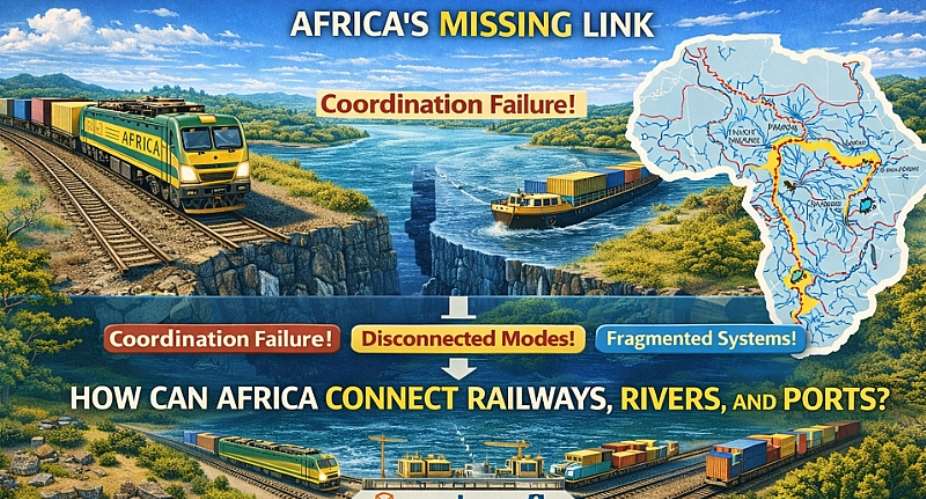
Across the continent, railways stretch across vast landscapes, some newly built, others aging but still functional. At the same time, powerful rivers like the Congo, Nile, Volta, and Niger flow through multiple countries, carrying immense but underutilized transport potential. Yet these two systems, rail and inland waterways, exist largely in isolation. Railways often end where rivers begin. Rivers flow without structured links to rail networks. Ports stand disconnected from inland logistics systems. The result is a fragmented transport architecture that undermines efficiency, increases costs, and limits Africa’s development potential. This is Africa’s missing link: coordination.
Transport systems across much of Africa have been planned, financed, and managed in silos. Rail authorities operate independently of port authorities. Waterway agencies rarely coordinate with railway corporations. Ministries design projects within narrow mandates, often driven by political cycles rather than long-term system integration. Each mode is developed as an endpoint rather than as part of a broader network.
This fragmentation has real economic consequences. A railway that does not connect to a river port loses its potential as a high-capacity feeder system. A navigable river without rail access remains underutilized, unable to efficiently channel bulk goods from inland production zones. Instead, both systems default to roads, overburdening highways, increasing logistics costs, and accelerating infrastructure degradation. In effect, Africa has built pieces of a system, but not the system itself. To understand what is missing, we must shift from thinking in terms of infrastructure to thinking in terms of transport corridors.
A transport corridor is not just a road, railway, or river. It is an integrated network of infrastructure, logistics services, policies, and institutions designed to move goods and people efficiently from origin to destination. Corridors connect production zones to markets, inland regions to ports, and countries to each other. They are the arteries of modern economies.
Globally, successful economies have embraced corridor-based thinking. In Europe, the Rhine corridor integrates inland waterways with rail and road networks, creating one of the most efficient logistics systems in the world. In Asia, China has developed multimodal corridors that seamlessly link railways, rivers, and ports, drastically reducing transport time and cost. These systems work not because they have more infrastructure, but because their infrastructure is connected, coordinated, and strategically aligned. Africa, by contrast, remains largely mode-centric rather than system-centric.
The consequences are evident in trade performance. Despite significant investments in transport infrastructure over the past two decades, logistics costs in Africa remain among the highest globally. Cross-border trade is slow and expensive. Inland regions remain disconnected from global markets. Industrialization is constrained not just by production capacity, but by the inability to move goods efficiently.
The African Continental Free Trade Area (AfCFTA) presents a historic opportunity to change this trajectory. But trade agreements alone cannot deliver integration without physical and operational connectivity. For AfCFTA to succeed, Africa must move beyond fragmented infrastructure toward integrated transport corridors that combine rail, inland waterways, ports, and roads into a unified system. This requires a fundamental shift in how transport is planned and governed.
First, planning must become corridor-driven, not project-driven. Instead of building isolated rail lines or rehabilitating individual ports, governments should design entire logistics chains, from inland production zones to final export points. Every investment should answer a simple question: how does this connect to the broader system?
Second, institutions must coordinate across modes. This may require new governance structures, corridor authorities or regional coordination bodies, that bring together rail, water, and port agencies under a shared strategic framework. Without institutional integration, physical integration will remain incomplete.
Third, financing models must evolve. Integrated corridors require long-term, large-scale investment, often across multiple countries. Development finance institutions, regional banks, and public-private partnerships must align around corridor-based projects rather than isolated infrastructure components.
Fourth, data and digital systems must support integration. Efficient corridors rely on real-time information, cargo tracking, port operations, customs processes. Digital platforms can bridge gaps between modes, reducing delays and improving reliability.
Finally, Africa must embrace a new mindset: infrastructure is not about visibility, but functionality. A road that is busy is not necessarily successful if it reflects the failure of rail and water systems. A river that flows unused is not a natural limitation, but a policy failure.
The vision is clear. Imagine a system where agricultural products from inland regions are transported by rail to river ports, loaded onto barges, and shipped efficiently to coastal terminals. Imagine mining outputs moving seamlessly across borders through coordinated rail–water networks. Imagine cities relieved of heavy truck traffic as bulk goods shift to more efficient modes. This is not a distant ideal, it is a practical, achievable model that has worked elsewhere and can work in Africa.
Africa must move from railways without rivers and rivers without rail to a future where both are part of a single, integrated system. The challenge is not to build more infrastructure, but to connect what already exists and plan what comes next with integration at its core.
In the end, development is not just about movement, it is about flow. And until Africa’s transport systems begin to flow together, the continent will continue to fall short of its full economic potential.
Author: Joseph Fuseini ([email protected])


 'Stop excessive financial demands before sharing information with us' — Interior...
 EC will serve national interest, not partisan politics – Deputy Chair Dr Kwaku A...
 I expect no preferential treatment from EC for myself as President, my party or ...
 Afenyo-Markin meets management, proposes reforms to turnaround struggling ECG
 ECG management commends Afenyo-Markin for reforms during short stay as Board Cha...
 Mahama tasks new EC deputy chairpersons to uphold impartiality
 Attorney-General urges court to reject Adu-Boahene’s no-case submission
 Nyaho Medical Centre ordered to report to CID over expired data protection certi...
 Mahama swears in new Electoral Commission deputy commissioners
 PTAAM-Africa calls for government probe into alleged World Cup visa fraud


