




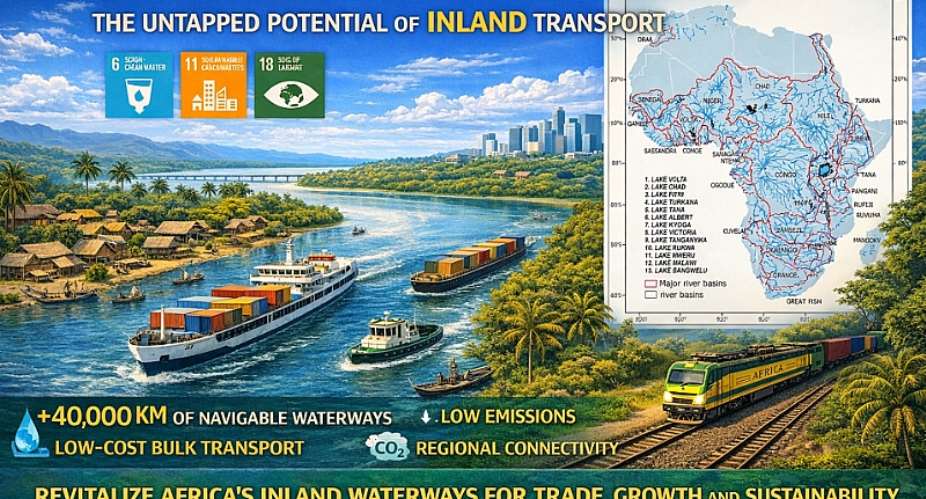
Across Africa, some of the continent’s most powerful transport assets flow quietly, often unnoticed, underutilized, and disconnected from national development strategies. From the vast Congo River basin to the historic trade routes of the Nile and the expansive Niger River system, Africa’s inland waterways have long served as natural corridors of movement, commerce, and cultural exchange. Yet in today’s policy landscape, they remain largely overshadowed by roads and, to a lesser extent, railways. This neglect represents not just a missed opportunity, but a structural inefficiency in how Africa moves its goods and connects its economies.
The paradox is striking. Africa is endowed with over 40,000 kilometers of navigable inland waterways, yet only a fraction of this network is actively used for modern transport. In many regions, rivers that could carry bulk cargo at low cost are either minimally developed or entirely absent from national transport plans. Instead, heavy goods are transported by road, often over long distances, at high cost, and with significant environmental impact. This imbalance has contributed to some of the highest logistics costs in the world, undermining trade competitiveness and slowing economic transformation.
Historically, inland waterways played a central role in pre-colonial African economies. Rivers were not barriers but connectors, linking inland communities to regional markets. However, colonial infrastructure planning shifted this logic. Railways and roads were developed primarily to extract resources from the interior to coastal ports, sidelining river-based transport systems that did not align with export-oriented priorities. Over time, this bias became institutionalized, leaving inland waterways underdeveloped and underappreciated.
Today, as Africa seeks to industrialize and deepen regional integration under the African Continental Free Trade Area (AfCFTA), the strategic importance of inland water transport is re-emerging. Unlike roads, which are prone to congestion and rapid deterioration under heavy loads, inland waterways offer a cost-effective and energy-efficient alternative for moving bulk commodities such as agricultural produce, minerals, and construction materials. A single barge can carry the equivalent of dozens of trucks, significantly reducing fuel consumption and easing pressure on road infrastructure.
The environmental case is equally compelling. Inland water transport produces far lower greenhouse gas emissions per ton-kilometer compared to road transport. In a continent increasingly vulnerable to climate change, this makes waterways a critical component of sustainable transport systems. Their revival aligns directly with global sustainability priorities, particularly those focused on climate action, sustainable urban development, and efficient resource use.
Yet the potential of Africa’s waterways extends beyond efficiency and sustainability, it is also about inclusion. Many rural and remote communities are located along rivers and lakes, often with limited access to reliable road networks. Developing inland water transport can improve connectivity for these communities, facilitating access to markets, healthcare, and education. In this sense, waterways are not just economic assets; they are social lifelines that can help bridge development gaps across regions.
Despite these advantages, several challenges continue to hinder the development of inland water transport in Africa. Infrastructure deficits are a major constraint. Many rivers lack basic navigational aids, dredging, and port facilities needed for efficient operations. Seasonal variability, such as fluctuating water levels due to rainfall patterns, also affects reliability, particularly in the context of climate change. Institutional fragmentation further complicates matters, as responsibility for waterways is often divided among multiple agencies with overlapping mandates and limited coordination.
There is also a persistent perception issue. Inland water transport is often viewed as outdated or informal, rather than as a modern, strategic component of national logistics systems. This perception has limited investment and innovation in the sector, creating a cycle of neglect that reinforces its marginalization.
Breaking this cycle requires a deliberate policy shift. Governments must begin to recognize inland waterways as integral to national and regional transport strategies, not as secondary or optional modes. This means investing in critical infrastructure such as river ports, dredging operations, and navigation systems. It also requires strengthening institutional frameworks to ensure coordinated planning and management across sectors.
Importantly, inland water transport should not be developed in isolation. Its true value emerges when integrated with other modes, particularly rail. Railways can serve as high-capacity feeders to river ports, enabling seamless movement of goods across long distances. Together, rail and water can form the backbone of efficient, low-carbon transport corridors that connect inland production zones to regional and global markets.
There are already promising examples across the continent. Efforts to revitalize transport on Lake Victoria in East Africa, as well as renewed interest in the Congo River system, signal a growing recognition of the role waterways can play in economic development. However, these initiatives remain fragmented and require scaling up through coordinated regional strategies.
Ultimately, the question is not whether Africa has the resources to develop its inland waterways, it clearly does. The real question is whether it has the vision and commitment to do so. In an era defined by the need for sustainable, inclusive, and efficient transport systems, Africa’s rivers offer a natural advantage that few regions in the world possess.
To ignore them is to overlook one of the continent’s greatest assets. To develop them is to unlock new pathways for trade, growth, and resilience. Africa’s waterways have always flowed. The challenge now is to ensure they carry the future of the continent along with them.
Author: Joseph Fuseini ([email protected])


 Trump signs order to rename Lake Ontario to 'Lake America' as Carney pushes back
 Police restrict concrete mixer trucks on Accra, Tema roads from August 28
 Supreme Court nominee Anthony Forson Jnr. opposes proposal to cap number of just...
 Justice Bernasko Essah explains why Supreme Court may depart from its previous d...
 Two NDC MPs whose ‘secret’ marriages have shocked Ghanaians
 All you need to know about Hon. Millicent Yeboah-Amankwa, wife of Hon. Mahama Ay...
 ‘A true trailblazer and cultural icon’ – Bawumia mourns Grace Nortey
 Vetting: 'Suspects should sue police if detained beyond 48 hours' - Supreme Cour...
 Speaker Bagbin outdoors uniforms for new parliamentary security guards
 Minority NPP boycotts vetting of three Supreme Court nominees over rushed timeta...

