




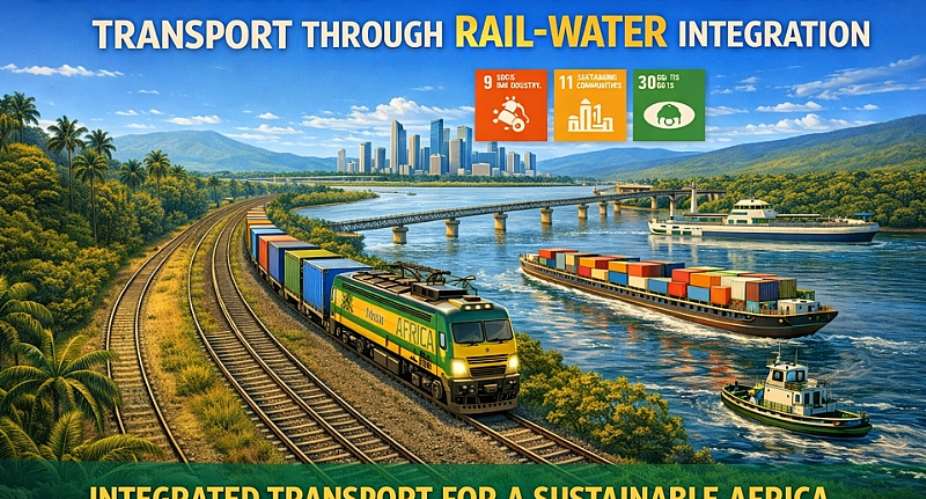
Africa’s transport story has, for decades, been written on asphalt. Roads dominate policy attention, public investment, and political rhetoric. From highways connecting capital cities to feeder roads linking rural communities, the continent has largely pursued a road-first model of mobility. While this has delivered short-term accessibility, it has also created long-term structural inefficiencies, congestion, high logistics costs, environmental degradation, and fragile supply chains. As Africa positions itself for deeper industrialization and continental trade under the African Continental Free Trade Area (AfCFTA), a critical question emerges. Can a road-dominated transport system sustain Africa’s future?
The answer increasingly appears to be “NO”. What Africa needs is not more roads alone, but a fundamental shift toward integrated, multimodal transport systems, where railways and inland waterways play central, complementary roles. This is not merely an infrastructure argument, it is a development imperative closely aligned with sustainable development goals, particularly those focused on industrialization, sustainable cities, and climate action.
At the heart of the issue lies efficiency. Roads are inherently flexible but inefficient for bulk, long-distance freight. Heavy reliance on trucking increases fuel consumption, accelerates road deterioration, and raises the cost of moving goods across borders. In contrast, rail transport offers high-capacity, energy-efficient movement over land, while inland waterways provide the lowest-cost option for moving bulky goods where navigable rivers and lakes exist. Yet across much of Africa, these modes operate in isolation or worse, remain underdeveloped, creating a fragmented transport landscape.
This fragmentation is not accidental. It is rooted in history. Much like the colonial rail systems that were designed to extract raw materials from the hinterland to coastal ports, transport infrastructure in many African countries evolved without integration in mind. Rail lines often terminate at ports without connecting to inland water systems. Rivers that could serve as natural logistics corridors remain disconnected from rail networks. The result is a system where each mode exists in silos, limiting the overall efficiency of the network.
Integration changes this logic entirely. A well-designed rail–water transport system allows goods to move seamlessly across modes: from inland production zones via rail, onto barges along major rivers, and onward to ports for export. This reduces transport costs, eases pressure on roads, and enhances trade competitiveness. More importantly, it creates transport corridors, economic lifelines that connect regions, stimulate industrial clusters, and promote balanced territorial development.
The implications for sustainable development are profound. Under SDG 9 (Industry, Innovation, and Infrastructure), integrated transport systems are essential for building resilient infrastructure and supporting industrialization. Efficient logistics reduce the cost of doing business, making African industries more competitive both regionally and globally. At the same time, SDG 11 (Sustainable Cities and Communities) calls for reducing urban congestion and pollution, outcomes that are difficult to achieve without shifting freight away from roads to rail and water.
Perhaps the most compelling argument for integration lies in climate sustainability. Transport is a growing source of greenhouse gas emissions in Africa, driven largely by road vehicles. Rail and inland water transport, by contrast, have significantly lower emissions per ton-kilometre. Shifting even a portion of freight from road to these modes could dramatically reduce the continent’s carbon footprint, aligning with SDG 13 (Climate Action). In an era of rising temperatures and increasing climate vulnerability, this is not optional, it is essential.
Yet, despite these advantages, progress toward integration has been slow. Institutional fragmentation remains a major barrier. Railways, ports, and inland waterways are often managed by separate agencies with limited coordination. Investment decisions are made in isolation, leading to mismatched infrastructure, modern ports without rail links, or rehabilitated rail lines that do not connect to key economic zones. Financing is another challenge, as large-scale integrated projects require long-term capital and strong governance frameworks.
There is also a perception problem. Roads are visible, politically attractive, and deliver immediate results. Rail and water projects, by contrast, are capital-intensive and take longer to materialise. However, this short-term bias has long-term costs. Without strategic investment in integrated systems, Africa risks locking itself into a high-cost, high-emission transport model that undermines its development ambitions.
The way forward requires a shift in mindset, from mode-specific planning to system-wide thinking. Governments must begin to design transport policies around corridors rather than individual projects. This means aligning rail development with inland water potential, ensuring that ports serve as multimodal hubs, and fostering regional cooperation to manage transboundary waterways and cross-border rail networks. It also requires investing in the “soft infrastructure” of integration: regulatory frameworks, data systems, and institutional coordination.
Encouragingly, there are early signs of this shift. Across the continent, discussions around logistics corridors, regional integration, and sustainable transport are gaining momentum. The AfCFTA provides a unique opportunity to rethink how goods move across Africa, not just faster, but smarter and more sustainably.
Ultimately, the question is not whether Africa can afford to invest in rail–water integration, but whether it can afford not to. The continent stands at a critical juncture. Continuing along the current path will deepen inefficiencies and environmental risks. Embracing integration, on the other hand, offers a pathway to a more connected, competitive, and sustainable future.
Africa’s transport future cannot be built on roads alone. It must flow, across rails, along rivers, and through systems designed not for the past, but for the possibilities of tomorrow.
Author: Joseph Fuseini ([email protected])


 Trump signs order to rename Lake Ontario to 'Lake America' as Carney pushes back
 Police restrict concrete mixer trucks on Accra, Tema roads from August 28
 Supreme Court nominee Anthony Forson Jnr. opposes proposal to cap number of just...
 Justice Bernasko Essah explains why Supreme Court may depart from its previous d...
 Two NDC MPs whose ‘secret’ marriages have shocked Ghanaians
 All you need to know about Hon. Millicent Yeboah-Amankwa, wife of Hon. Mahama Ay...
 ‘A true trailblazer and cultural icon’ – Bawumia mourns Grace Nortey
 Vetting: 'Suspects should sue police if detained beyond 48 hours' - Supreme Cour...
 Speaker Bagbin outdoors uniforms for new parliamentary security guards
 Minority NPP boycotts vetting of three Supreme Court nominees over rushed timeta...

