




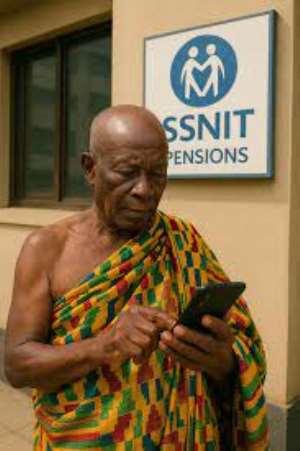
In recent months, a troubling pattern has emerged across Ghana’s pension landscape. One that raises serious questions about accountability, transparency, and the welfare of retirees. Numerous complaints from pensioners, particularly those who retired in 2025, point to persistent non-payment of Tier-2 pension benefits. These are not isolated grievances; they reflect a systemic issue that demands urgent national scrutiny. At the center of these concerns are two key institutions: Social Security and National Insurance Trust (SSNIT) and the National Pensions Regulatory Authority (NPRA). Both bodies are mandated to safeguard the integrity of Ghana’s pension system and ensure that retirees receive their due benefits promptly. Yet, mounting evidence suggests that many pensioners are being left behind, caught in a web of bureaucratic delays and institutional finger-pointing.
A Pensioner’s Ordeal
Consider the case of a retiree who exited active service in 2025. Like many others, he expected to receive his full pension benefits, including Tier-2 contributions. Instead, he has been met with repeated explanations that funds covering the period from August to December 2024 were never remitted by the Controller and Accountant-General's Department. This explanation raises more questions than answers. Why would remittances suddenly cease for a defined period, only to resume in 2025? What mechanisms exist to detect and correct such lapses in real time? And more importantly, why should pensioners bear the consequences of administrative failures beyond their control? Despite numerous follow-ups, affected individuals report receiving the same response: the funds have not been received, and therefore payments cannot be processed. For retirees who depend on these benefits for survival, such responses are not just inadequate, they are deeply distressing.
The Human Cost of Delay
Pensions are not a privilege; they are a right earned through decades of service and contributions. For many retirees, Tier-2 benefits represent a crucial component of their post-retirement financial security. Delays in payment can mean the difference between dignity and hardship. In Ghana, where social safety nets remain limited, pensioners often rely almost entirely on their retirement benefits to meet basic needs such as food, healthcare, housing, and support for dependents. When these payments are delayed indefinitely, the impact is immediate and severe. Reports from affected pensioners reveal growing frustration and anxiety. Some have depleted their savings while waiting for payments that never arrive. Others have been forced to rely on family members or take on debt. These are individuals who spent their working lives contributing to a system that now appears to be failing them.
Institutional Accountability under Scrutiny
The situation also raises critical questions about the roles and responsibilities of SSNIT and NPRA. While SSNIT is responsible for managing pension funds and disbursing benefits, NPRA is tasked with regulating and overseeing the entire pension system. If indeed the Controller and Accountant-General’s Department failed to remit contributions for several months, why was this not addressed promptly? What oversight mechanisms did NPRA deploy to ensure compliance? And why are pensioners only learning of these issues after retirement, when it is too late to take corrective action? Equally concerning is the apparent lack of communication and transparency. Pensioners report receiving vague or repetitive explanations, with little effort made to provide clear timelines or solutions. This lack of accountability undermines public trust in the pension system and raises doubts about its long-term sustainability.
A Disconnect Between Messaging and Reality
At a time when SSNIT and NPRA officials are actively promoting their achievements and reforms, the experiences of affected pensioners tell a different story. Public relations campaigns highlighting improvements in pension administration ring hollow when retirees are struggling to access their basic entitlements. This disconnect between official messaging and lived reality is not just a communications problem, it is a governance issue. It suggests a failure to align institutional priorities with the needs of those the system is meant to serve.
The Need for Immediate Action
Addressing this crisis requires more than rhetoric; it demands concrete and coordinated action from all stakeholders.
- SSNIT must provide a clear and comprehensive account of all outstanding Tier-2 payments, including the specific periods affected and the reasons for the delays. This information should be made publicly available to ensure transparency and build trust.
- The Controller and Accountant-General’s Department must urgently clarify the status of remittances for the disputed period. If funds were indeed not transferred, immediate steps must be taken to rectify the situation and prevent future occurrences.
- NPRA must exercise its regulatory authority to investigate the matter thoroughly and hold any responsible parties accountable. This includes reviewing compliance mechanisms and strengthening oversight to ensure that such lapses do not recur.
- Finally, there must be a commitment to timely resolution. Pensioners cannot afford to wait indefinitely for benefits that are rightfully theirs. A clear timeline for the settlement of all outstanding payments must be established and communicated.
Stirring a National Conversation
Beyond the immediate crisis, this issue highlights the need for a broader national conversation about the state of Ghana’s pension system. Are existing structures robust enough to prevent administrative failures? Do regulatory frameworks provide sufficient protection for contributors? And are institutions adequately resourced and accountable? These are questions that policymakers, civil society, and the public must engage with urgently. The integrity of the pension system is not just a technical matter. It is a reflection of how a society values its workers and treats its elderly.
What Can Affected Pensioners Do?
For individuals currently facing non-payment of Tier-2 benefits, the path forward may seem uncertain. However, there are several steps that can be taken:
- Document all communications with SSNIT and relevant authorities, including dates, names, and responses received.
- Submit formal complaints to NPRA, which has a mandate to address grievances within the pension system.
- Engage pensioner associations or advocacy groups to amplify concerns and push for collective action.
- Utilize media platforms to bring attention to the issue and encourage public accountability.
While these steps may not yield immediate results, they can help build pressure for systemic change and ensure that the issue remains in the public eye.
My Thoughts: A Call to Conscience
Ultimately, this is not just a bureaucratic problem. It is a moral one. Pensioners have fulfilled their obligations to the state, contributing diligently throughout their working lives. They deserve to retire with dignity, not uncertainty. Institutions like SSNIT and NPRA must remember that their legitimacy depends on their ability to serve the very people who built the system. Failure to address this crisis promptly and effectively will not only harm pensioners but also erode confidence in Ghana’s social security framework. The time for action is now. Pensioners cannot wait.
FUSEINI ABDULAI BRAIMAH
+233550558008 / +233208282575
[email protected]


 WASSCE: School officials helped students cheat for years, but we now see the tru...
 Probe alleged military killing of lecturer in Bawku – Kusaug Youth demands
 ‘If we all pay GH¢1,000 each, we should be able to construct National Cathedral’...
 Mahama inspects proposed site for Upper West Regional Airport
 Mahama reiterates government's commitment to end double-track SHS system
 Police interdict officer over death of 23-year-old Ivan Baidoo on Tema Motorway
 NDC gov't ‘scored own goals’ with new SHS placement policy — Dr. Bempah Tandoh
 Five-year presidency will give governments more time to deliver — Kofi Bentil
 Improved invigilation is exposing true performance of Ghanaian students — Mahama...
 There's no policy to introduce Arabic, Chinese in all public schools — Mahama


