




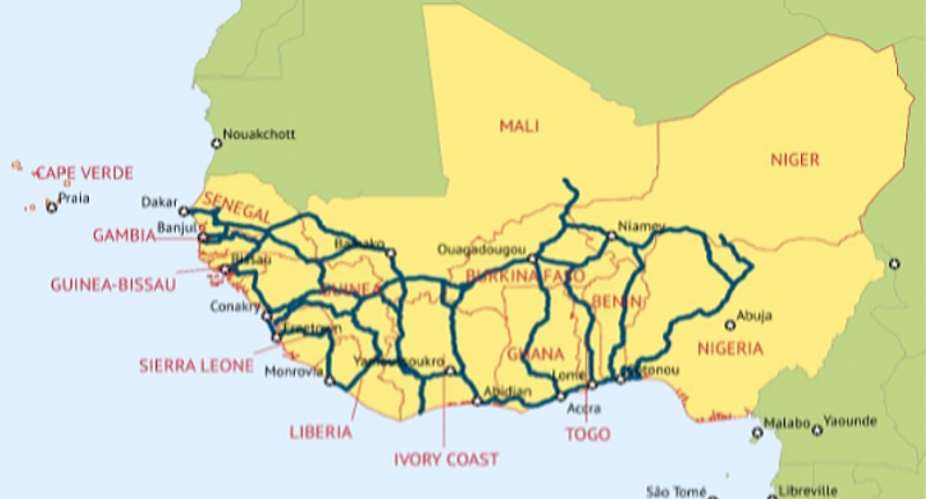
If Ghana is serious about building a transport system that supports long-term economic transformation, then it must begin to think beyond short-term projects and electoral cycles. A 25-year transport strategy is not simply a planning exercise. It is a statement about the country’s future position within West Africa. At the heart of such a strategy must be one central idea: regional connectivity. Without this, Ghana risks developing infrastructure that serves only domestic needs while missing the far greater opportunity of becoming a logistics gateway for the entire sub-region.
The vision of regional integration is not new. The Economic Community of West African States (ECOWAS) has long emphasized the importance of cross-border transport corridors linking coastal economies with landlocked countries such as Togo, Benin, and Nigeria connecting landlocked countries like Burkina Faso, Mali, and Niger. Ghana’s geographic position gives it a natural advantage in this framework. With access to the Atlantic Ocean through the Ports of Tema and Takoradi, the country is strategically positioned to serve as a regional trade hub. Yet this potential remains largely underutilized because transport systems are still designed primarily within national boundaries rather than regional networks.
A 25-year transport strategy must therefore redefine how Ghana conceives infrastructure, not as isolated national assets, but as components of a regional logistics system. Railways, roads, and inland water transport must be planned with cross-border connectivity in mind. The long-discussed rail link from southern Ghana to Burkina Faso, for example, should not be treated as a standalone project but as part of a broader corridor connecting ports to the Sahel. Similarly, inland water transport on Lake Volta could be integrated into regional trade routes, reducing pressure on roads while improving access to northern Ghana and neighboring countries.
The economic logic for regional connectivity is compelling. Landlocked countries depend heavily on coastal ports for imports and exports. Efficient transport corridors reduce transit time, lower logistics costs, and improve trade competitiveness. For Ghana, this translates into increased port throughput, expanded logistics services, and greater economic activity along transport corridors. In essence, regional connectivity transforms Ghana from a national market into a regional trade platform.
However, achieving this vision requires more than infrastructure investment. It demands policy coordination across multiple levels, national, regional, and institutional. Transport regulations, customs procedures, axle load limits, and safety standards must be harmonized within the ECOWAS framework. Without such alignment, even the most advanced infrastructure will fail to deliver seamless cross-border movement. Delays at borders, inconsistent regulations, and administrative bottlenecks can undermine the efficiency gains of physical connectivity.
Another critical element is the integration of transport modes. A 25-year strategy must ensure that rail, road, and maritime systems are not developed in isolation. Ports must be directly connected to rail corridors capable of moving bulk cargo inland. Road networks should complement rail by handling last-mile distribution rather than long-distance freight. Inland water transport should be revitalized as a cost-effective option for moving goods within the country and across borders. This multimodal approach is essential for building a resilient and efficient transport system.
Financing such an ambitious strategy will undoubtedly be challenging. Large-scale infrastructure projects require significant capital, often beyond the capacity of public budgets alone. This is where innovative financing mechanisms, such as public-private partnerships and regional investment frameworks, become essential. ECOWAS itself can play a role in mobilizing resources and coordinating cross-border projects that benefit multiple countries.
Yet perhaps the most important requirement for success is consistency. A 25-year transport strategy must be insulated from political cycles and policy reversals. Too often, infrastructure projects in Ghana have suffered from discontinuity, with new administrations revising or delaying initiatives launched by their predecessors. Regional connectivity cannot be built in fragments; it requires sustained commitment over decades.
There is also a deeper strategic question at play. In an increasingly interconnected global economy, countries that control efficient transport corridors gain significant economic advantages. They become hubs for trade, investment, and industrial activity. Ghana has the opportunity to position itself as such a hub within West Africa, but this will only happen if transport policy is aligned with regional realities. The challenge, therefore, is not a lack of vision. The concepts of regional corridors, ECOWAS integration, and multimodal transport systems are already well understood. The real challenge lies in execution, translating long-term strategy into coordinated, sustained action.
A 25-year transport strategy anchored in regional connectivity would represent a decisive shift in Ghana’s development trajectory. It would move the country from a fragmented infrastructure approach to a coherent system designed to serve both national and regional economies. More importantly, it would signal that Ghana is ready to move beyond building infrastructure for itself alone, and instead build systems that connect it meaningfully to the wider West African region.
In the end, the success of Ghana’s transport future will not be measured solely by the number of roads paved or tracks laid, but by how effectively those networks connect the country to its neighbors. Regional connectivity is not just an option, it is the foundation upon which a truly transformative transport strategy must be built.
Author: Joseph Fuseini ([email protected])


 Miracles Aboagye arrest: 'You looted and your reaction is that the tables will t...
 Police arrest two with 73 parcels of suspected cannabis, reject GH¢300,000 bribe
 NACOC traces 73 assets linked to suspected drug traffickers
 Government seeks financial clearance to recruit 400 scientists – Armah Kofi-Buah
 Ya‑Naa Abubakari II laid to rest at Gbewaa Palace
 NPP will reinstate workers unlawfully sacked by NDC government - Chairman COKA
 'Neglecting grassroots dangerous' – GFL warns NDC, NPP
 'No money, no vote' — Bongo NPP delegates tell contestants in constituency execu...
 NAM1 files witness statements in Menzgold trial, seeks to rely on seven defence ...
 Miracles Aboagye’s wife raises health concerns over husband's detention by EOCO

