




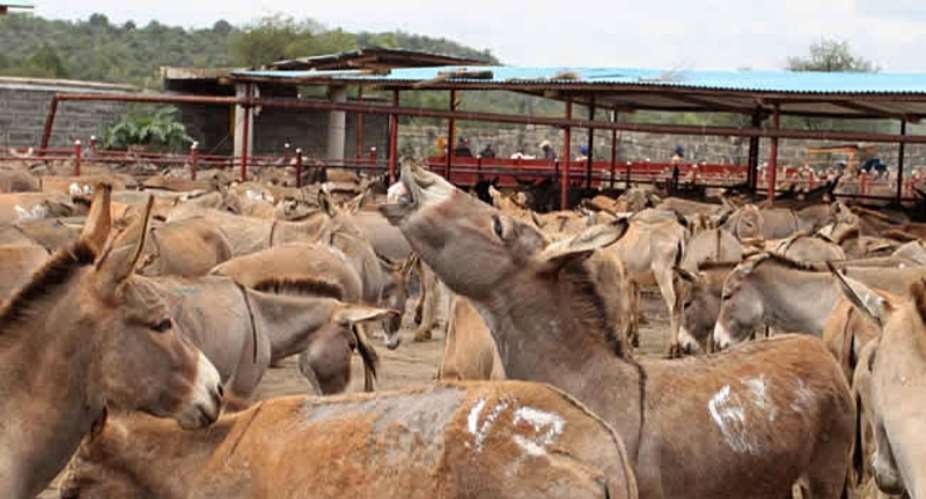
A growing shortage of donkeys in parts of the Upper East Region is driving up prices and raising concerns among farmers, traders, and dealers who depend on the animals for their daily economic activities.
A visit by a Modern Ghana correspondent to key communities revealed a sharp decline in donkey availability, particularly in areas once known for high daily slaughter rates. Many of these centres, which previously bustled with activity, are now nearly empty, leaving several workers without jobs.
The shortage has been linked to a significant drop in the number of donkeys transported from neighbouring Burkina Faso into the region. For years, cross-border trade has been the main source of supply, sustaining both local demand and the regional donkey population. However, recent disruptions appear to have weakened this supply chain.
Donkeys remain a vital asset across the Upper East Region, serving as a primary means of transport, farming support, and trade logistics. Farmers rely on them for ploughing and carrying produce, while traders use them to access markets, especially in remote areas. The current shortage is already affecting agricultural productivity and slowing down market activities.
Industry observers point to several possible causes behind the decline, including tighter border security, trade restrictions, logistical difficulties, and potential political tensions between neighbouring countries. Additionally, animal health concerns, shifting demand, and changes in trade routes may also be contributing to the reduced movement of donkeys across borders.
The impact is being felt across the value chain. Dealers are struggling to source animals, facing intense competition for the limited supply. This has led to a sharp rise in prices, making it increasingly difficult for consumers to afford the animals. Profit margins are shrinking, and demand continues to outstrip supply.
Beyond their economic value, donkeys also serve as a source of food in some communities within the region and across West Africa. Donkey meat, though not widely consumed everywhere, remains an important protein source for certain households, further intensifying demand.
As the shortage deepens, stakeholders are calling for urgent measures to address the supply gap and stabilise prices. Without intervention, the situation could worsen, placing additional strain on livelihoods and the local economy.


 Trump says Russia, Ukraine agree to energy ceasefire – 'news for me', Zelensky s...
 Ethiopia intel chief visits flashpoint Tigray region
 Djibouti boat wreck leaves 139 migrants dead, 84 missing: UN
 Brazil's Lula accuses social media giant Meta of election interference amid tigh...
 Upper Dixcove: Dumsor is killing our business – Chief Fisherman
 South Africa protests: Ghanaians warned to limit travel in Johannesburg and Durb...
 UN cautions against forced tenant evictions without prior consultation
 UN advises Ghana to strengthen Rent Control Department with requisite logistics
 ECG announces three-day power outages in parts of Accra from Monday
 Ghana’s banking assets rise to GH¢500.2billion


