




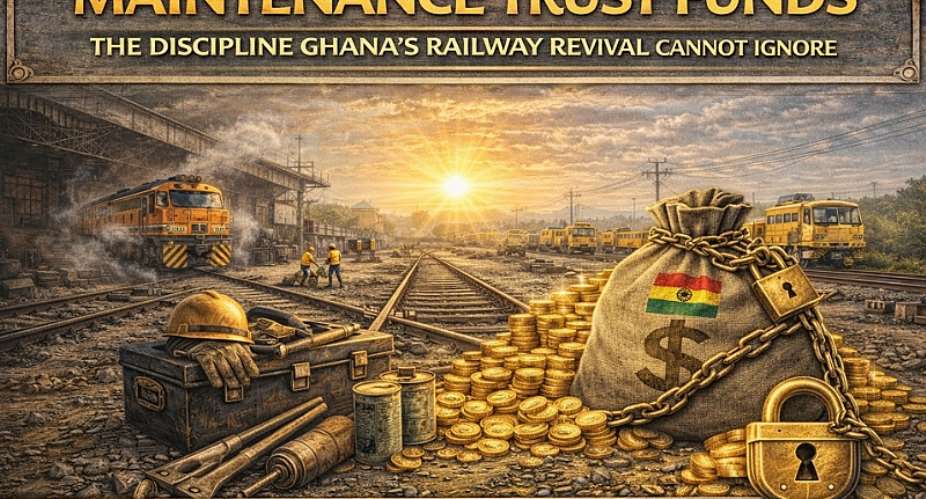
If Ghana’s railway story has taught us anything, it is this: we do not have a construction problem, we have a maintenance problem. Tracks are laid, locomotives are procured, corridors are launched with national pride. Yet a decade later, the same systems struggle, slower, weaker, and sometimes abandoned. The missing link is not ambition. It is maintenance discipline backed by predictable financing.
This is where the concept of maintenance trust funds becomes critical. If Ghana is serious about reviving its rail sector, then it must move beyond project financing and confront the harder question: how will we sustain what we build?
The Reality: Build, Neglect, Rebuild
Ghana’s transport history follows a familiar cycle:
- Infrastructure is built with significant capital investment
- Maintenance is underfunded or delayed
- System performance declines
- Rehabilitation becomes more expensive than routine maintenance
This cycle has played out across roads, railways, and even inland water transport systems. In the railway sector, the consequences have been particularly severe. Lines that once supported freight and passenger movement gradually deteriorated, not because they were poorly designed, but because they were not consistently maintained.
The uncomfortable truth is that maintenance is rarely politically attractive. New projects win headlines. Maintenance budgets do not. Yet without maintenance, every new railway line is simply a future rehabilitation project in waiting.
What Is a Maintenance Trust Fund?
A maintenance trust fund is a dedicated, ring-fenced financing mechanism designed to ensure continuous funding for infrastructure upkeep. Unlike traditional budget allocations, which fluctuate with political priorities, a trust fund:
- Guarantees predictable, long-term financing
- Is protected from diversion into unrelated expenditures
- Is often funded through user-based revenues (e.g., freight charges, port fees, fuel levies)
- Supports routine, preventive, and emergency maintenance
In simple terms, it answers one critical question. Who pays to keep the railway running after it is built?
Why Ghana Needs It Urgently
Ghana’s railway revival is entering a new phase. Standard gauge lines are being constructed, old corridors are being rehabilitated, and connections to ports and inland areas are being reimagined. But without a structured maintenance financing system, the country risks repeating past mistakes, building infrastructure that cannot sustain itself.
Institutions such as the Ghana Railway Development Authority are tasked with overseeing railway development. However, institutional oversight alone cannot guarantee maintenance. Funding certainty is the real foundation of sustainability.
Currently, maintenance funding in Ghana often depends on:
- Annual government budgets
- External financing
- Ad hoc allocations
These sources are inherently unstable. When fiscal pressures rise, maintenance is usually one of the first areas to be cut. Over time, this leads to system degradation.
Lessons from Other Sectors and Countries
Ghana does not need to look far for a working model. The country’s own road sector offers a powerful example through the Ghana Road Fund. The Road Fund, financed largely through fuel levies and road user charges, has provided a relatively stable mechanism for maintaining road infrastructure. While not perfect, it demonstrates that dedicated maintenance financing can work in the Ghanaian context.
Globally, similar approaches have been used in the railway sector:
South Africa: Rail operators maintain structured asset management systems where maintenance budgets are tied directly to operational revenue streams, ensuring continuous upkeep of rail infrastructure.
India: Railway maintenance is embedded within the financial structure of the national railway system, with dedicated allocations for track renewal, rolling stock servicing, and signaling upgrades.
Brazil: Freight rail concessions require private operators to maintain infrastructure as part of contractual obligations, effectively creating performance-based maintenance systems.
The lesson across these cases is consistent. railways that survive are railways that plan for maintenance before construction is completed.
What a Ghana Railway Maintenance Fund Should Look Like
If Ghana is to adopt this model, the design of the maintenance trust fund must be deliberate and transparent.
1. Ring-Fenced Revenue Streams
Funding sources could include:
- Rail freight charges
- Port handling fees linked to rail cargo
- A dedicated logistics levy on bulk commodities (e.g., minerals, cement, fuel)
These revenues should be legally protected and used exclusively for railway maintenance.
2. Independent Governance Structure
The fund should be managed independently, with representation from:
- Government
- Railway operators
- Private sector stakeholders
- Technical experts
This reduces political interference and ensures accountability.
3. Performance-Based Allocation
Maintenance funding should be tied to measurable indicators:
- Track condition
- Rolling stock availability
- Safety performance
- Network uptime
This ensures that funds are not only spent, but spent effectively.
4. Integration with Asset Management Systems
Modern railways rely on data-driven maintenance. The trust fund should support:
- Digital inspection systems
- Predictive maintenance tools
- Lifecycle asset management planning
Maintenance must move from reactive repairs to preventive and predictive systems.
The Political Economy of Maintenance
The biggest challenge is not technical, it is political. Maintenance requires discipline. It requires governments to commit funds today for benefits that may not be immediately visible. It requires resisting the temptation to prioritize new projects over existing systems. But the cost of ignoring maintenance is far greater.
Every kilometer of railway that deteriorates represents:
- Lost economic efficiency
- Increased transport costs
- Reduced investor confidence
- Higher future rehabilitation expenses
In this sense, maintenance is not a cost, it is an investment in system longevity.
Conclusion: Build Once, Maintain Always
Ghana stands at a critical moment in its railway revival. The country has the plans, the institutions, and the ambition. What it needs now is discipline. A maintenance trust fund is not just a financial tool, it is a signal of seriousness. It tells citizens, investors, and engineers that Ghana is no longer content with building infrastructure that fades over time. It represents a shift from a culture of construction to a culture of stewardship. Because in the end, the success of Ghana’s railway system will not be judged by how many lines are launched, but by how many remain operational decades later.
Author: Joseph Fuseini ([email protected])


 Miracles Aboagye arrest: 'You looted and your reaction is that the tables will t...
 Police arrest two with 73 parcels of suspected cannabis, reject GH¢300,000 bribe
 NACOC traces 73 assets linked to suspected drug traffickers
 Government seeks financial clearance to recruit 400 scientists – Armah Kofi-Buah
 Ya‑Naa Abubakari II laid to rest at Gbewaa Palace
 NPP will reinstate workers unlawfully sacked by NDC government - Chairman COKA
 'Neglecting grassroots dangerous' – GFL warns NDC, NPP
 'No money, no vote' — Bongo NPP delegates tell contestants in constituency execu...
 NAM1 files witness statements in Menzgold trial, seeks to rely on seven defence ...
 Miracles Aboagye’s wife raises health concerns over husband's detention by EOCO

