




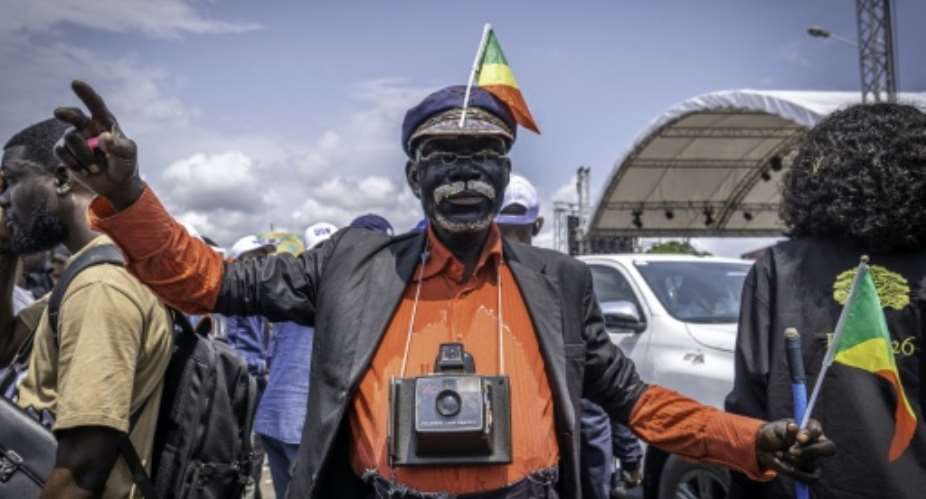
Congo-Brazzaville goes to the polls this weekend and 82-year-old President Denis Sassou Nguesso looks set to extend his decades-long rule.
From oil to rainforest, here are five things to know about the central African nation:
Hydrocarbon economy
The third-largest oil producer in sub-Saharan Africa, Congo-Brazzaville began producing liquefied natural gas (LNG) in 2024, largely for export.
At the start of 2025, the government set a target of boosting output to 500,000 barrels of oil per day within three years.
The oil sector accounts for half of GDP and 80 percent of exports, according to the World Bank.
Yet around half the country's roughly six million people live below the poverty line.
Russia ties
Since its independence from France in 1960, Congo-Brazzaville has suffered a succession of coups, attempted putsches and insurrections.
A coup in 1969 ushered in the People's Republic of the Congo -- a Marxist-Leninist one-party state aligned with the Soviet bloc under the Congolese Labour Party -- which remained in place until 1992.
After the fall of the USSR, the country introduced multi-party politics and returned to its official name, the Republic of Congo.
It continues to maintain close ties with Russia.
Traditionally centred on military and educational cooperation, the relationship has expanded in recent years into new sectors like energy, including plans for an oil pipeline linking the Atlantic coast to northern Congo.
Although France's economic footprint has shrunk in recent years, it remains one of Congo's main foreign investors alongside China.
Population density
Congo-Brazzaville is one of Africa's least densely populated countries. More than half of its people live in the two main cities: Brazzaville and Pointe-Noire.
The population is very young and nearly half are under 18.
About 67 percent of people in urban areas have access to electricity, compared to just over 12 percent in rural areas, according to the World Bank.
Budding agriculture
Congo-Brazzaville has around 10 million hectares of arable land but only a very small share is cultivated, mostly for low-yield subsistence farming.
Sugar is one of the few products for which the country is self-sufficient.
As a result, Congo imports much of its food, leaving households vulnerable to swings in global prices, transport costs and exchange rates.
Authorities aim to boost the production of cassava, maize, sorghum and soy, along with developing fisheries and poultry, to diversify the economy and reduce dependence on oil revenues.
Vast tropical forest
The Congo Basin -- spanning parts of Congo-Brazzaville and five neighbouring countries -- is home to the world's second-largest tropical rainforest after the Amazon.
It plays a key role in regulating the global climate.
But it is under threat, experts warn.
Forest loss in the basin nearly doubled between 2010 and 2020 compared to the previous decade, driven largely by agricultural expansion and infrastructure development.
The region is among the world's richest in biodiversity.
The Nouabale-Ndoki National Park is a UNESCO world heritage site and home to rich flora and fauna, including important populations of forest elephants and endangered lowland gorillas and chimpanzees.

 Fire Service rescues trapped victim after STC Bus, Taxi collision at Konongo
 Private SHSs in Free SHS pilot programme demand payment of outstanding governmen...
 Police foil planned robbery, recover weapons at Kukuom
 A 53-year-old mechanic remanded for allegedly stabbing another over car battery ...
 Asiedu Nketiah urges IGP to speed up justice for victims of election 2024 killin...
 Each family receives GH¢15,000 support after Accra Police Barracks Fire
 Mussa Dankwah urges ministers to focus on performance amid MoFA–finance minister...
 Selling single cigarette sticks illegal – FDA
 Hungry, unhealthy workforce cannot protect nation’s health – GRNMA
 Health Minister orders suspension of KATH CEO over Emergency admissions directiv...


