




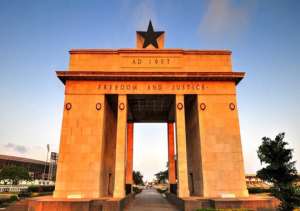
"Ghana holds a unique place in the collective consciousness of Africa. As the first sub-Saharan country to gain independence from colonial rule, it was celebrated not just for breaking the shackles of imperialism but for symbolizing the promise of self-determination across the continent."
The jubilant cries of “Freedom!” reverberated far beyond the Gold Coast, inspiring liberation movements throughout West Africa and beyond (Austin, 1970). Over the decades, Ghana has often been portrayed as a political and cultural lighthouse - a model of democracy, stability, and development in a region historically marked by political turbulence (Boafo-Arthur, 2008). Nevertheless, as Ghana approaches its close to seventh decade of independence in 2026, a pressing question emerges: does this reputation reflect contemporary realities, or has it become an ideological façade, rooted more in nostalgia than in current achievements? Evaluating Ghana’s position requires a careful examination of its political, economic, social, and cultural trajectory, alongside a comparative assessment with other West African nations.
Political Leadership: The Beacon of Stability?
Politically, Ghana has long been hailed as a model of democratic governance in West Africa. Since the establishment of the Fourth Republic in 1992, the peaceful transition of power has stood out in a region often plagued by coups and autocratic regimes (Amutabi & Nasong’o, 2015). International observers frequently cite Ghana’s relatively free press, active civil society, and competitive elections as hallmarks of its exemplary democratic ethos (Framo, 2024).
"Political stability alone does not equate to leadership."
While Ghana’s democracy is resilient, it faces persistent challenges: electoral tensions, regional inequalities, and governance lapses highlight cracks in its political façade. Countries such as Nigeria and Côte d’Ivoire, despite their own challenges, have demonstrated more complex governance innovations that rival Ghana’s influence. Thus, while Ghana’s stability is commendable, it may not guarantee its place as the uncontested political pinnacle of West Africa (Boafo-Arthur, 2008).
Economic Trajectory: Growth or Stagnation?
Economically, Ghana’s post-independence journey has been a study in contrasts. The early years under Kwame Nkrumah were marked by ambitious industrialization, infrastructure projects, and pan-African initiatives. However, mismanagement, debt crisis, and political instability in later decades slowed progress. Since the early 2000s, Ghana has witnessed renewed growth, buoyed by gold, cocoa, oil, and an expanding services sector. Global economic rankings have improved, and the nation has occasionally been hailed as a “rising star” in Africa (White, 2003).
"Yet, poverty reduction has been uneven, unemployment remains significant, and infrastructural gaps persist."
Moreover, Ghana's reputation as the economic leader of West Africa is increasingly challenged by regional competitors such as Nigeria, with its massive economy, and Côte d'Ivoire, with strong agricultural output and rapid industrial growth. This regional context highlights that Ghana's influence, while notable, may be overstated when compared to these dominant neighbors.
Social and Cultural Influence: Soft Power in Action
Beyond politics and economics, Ghana has wielded considerable soft power. Its contributions to education, culture, and social policy have historically set benchmarks. Institutions such as the University of Cape Coast, the University of Ghana, and the Kwame Nkrumah University of Science and Technology have nurtured intellectual elites across the continent. Ghanaian music, film, literature, and festivals consistently project the nation’s identity globally, contributing to a cultural prestige that few West African countries rival (Klutse, 2018).
"In this sense, Ghana’s historical cultural impact may now overshadow its current regional dominance, suggesting a shift from being a beacon to being a symbolic reference point."
However, cultural influence is nuanced. Contemporary media, social networks, and entertainment industries in Nigeria (Afrobeats, Nollywood) and Senegal (film and music) increasingly challenge Ghana's traditional soft power leadership (Faidi, 2024).
Regional Comparisons: The Broader West African Context
Assessing Ghana’s leadership requires looking at West Africa as a whole. The region is diverse: Nigeria’s demographic and economic weight make it a de facto regional powerhouse; Côte d’Ivoire’s post-conflict recovery and economic dynamism position it as a formidable competitor; Senegal impresses with governance, human development, and cultural production (Boafo-Arthur, 2008).
"Influence is shared, and leadership in West Africa is increasingly diffuse."
Against this backdrop, Ghana’s perceived primacy is nuanced. It remains a respected voice in ECOWAS deliberations and regional diplomacy, yet it is no longer the uncontested “pinnacle” it once symbolized.
Perception vs. Reality: Legacy of Ideology
Much of Ghana’s image derives from its historical narrative. Independence-era rhetoric, Nkrumah’s pan-African vision, and decades of political stability created a lasting ideological symbol. Ghana came to represent what West Africa and Africa more broadly might aspire to: democracy, self-reliance, and moral leadership (Onwumere, 2008).
"This symbolic capital is powerful, influencing perceptions in academic literature, media, and popular consciousness."
Nevertheless, reality is more complex. Economic challenges, governance gaps, and regional competition suggest that Ghana's role as West Africa's "beacon" is not absolute. Its current reputation may be a mixture of genuine achievements and the enduring power of historical ideology a dual identity in which past glory shapes contemporary perception.
Looking Ahead: Ghana in 2026 and Beyond
As Ghana approaches 2026, a critical evaluation of its regional leadership is timely. The country continues to demonstrate strengths: stable democracy, vibrant culture, regional diplomatic engagements, and pockets of economic innovation. Yet persistent challenges such as structural economic issues, social inequality, and intensified regional competition must be addressed to maintain or enhance influence.
"Moving from symbolic leadership to substantive, measurable leadership requires conscious policy choices, investment in human capital, and strategic engagement with the West African region."
Without strategic policy choices, investment, and regional engagement, Ghana risks resting on its historical laurels, with its legacy more celebrated in memory than reflected in its current regional influence. A critical reflection on its past and present is essential for shaping its future leadership.
Conclusion
Ghana’s journey from 1957 to 2026 is a narrative rich with promise, achievement, and enduring symbolism. The country’s pioneering independence, decades of relative political stability, and contributions to culture, education, and regional diplomacy have cemented its reputation as a model for democracy and a source of inspiration across West Africa. Yet the perception of Ghana as the region's uncontested pinnacle is increasingly complicated. Economic pressures, deepening social inequalities, and the rise of regional competitors underscore that influence alone does not guarantee supremacy.
"Ultimately, Ghana remains influential, but influence is not synonymous with supremacy."
Ghana’s leadership today is a complex interplay between tangible accomplishments and the lasting resonance of historical ideology. Its symbolic status, rooted in independence-era optimism and Nkrumah’s pan-African vision, remains powerful but symbolic capital must now translate into substantive results. The nation’s future relevance in West Africa will depend on its ability to address persistent economic and social challenges, invest decisively in human capital, strengthen governance, and assert innovative regional strategies.
In essence, Ghana stands at a crossroads: it can continue to rely on the prestige of its past, celebrated as a legacy of triumph, or it can transform that legacy into forward-looking leadership that shapes the political, economic, and cultural trajectory of West Africa in the 21st century. To secure its position as a true regional leader, Ghana must ensure that history informs action and that its enduring ideals are matched by measurable, contemporary achievements, turning symbolic influence into lasting impact.
References
Amutabi, M. N., & Nasong’o, S. W. (2015). Regime change and succession politics in Africa. Routledge.
Austin, D. (1970). Progress in Ghana. International Journal, 25(3), 594–602.
Awanyo, L., & Attua, E. M. (2018). A paradox of three decades of neoliberal economic reforms in Ghana: A tale of economic growth and uneven regional development. African Geographical Review, 37(3), 173–191.
Boafo-Arthur, K. (2008). Democracy and stability in West Africa: The Ghanaian experience. Nordiska Afrikainstitutet; Department of Peace and Conflict Research, Uppsala University.
Boone, C. (2007). Africa's new territorial politics: Regionalism and the open economy in Côte d'Ivoire. African Studies Review, 50(1), 59–81.
Faidi, Z. (2024). Cultural flows: The development and global influence of Nigeria's creative industries. Policy Center for the New South.
Framo, M. (2024). Explaining variation in democracy in West Africa: A case study of Ghana and Nigeria.
Klutse, C. A. (2018). Cultural exchanges and their implications for regional integration in West Africa: A case study of Ghana and Nigeria (Doctoral dissertation, University of Ghana).
Onwumere, O. (2008). Pan-Africanism: The impact of the Nkrumah years, 1945–1966. In Trans-Atlantic migration: The paradoxes of exile (pp. 229–241).
White, E. (2003). Kwame Nkrumah: Cold War modernity, pan-African ideology and the geopolitics of development. Geopolitics, 8(2), 99–124.


 Third Drug Mule in 3 Weeks: R2m Heroin Found in SA Man’s Luggage at OR Tambo
 NACOC Debunks MP’s Claim as France’s €225m Cocaine Case Deepens
 Zimbabwe Suspends Journalist for One Year Over ‘Unethical’ Reporting on Chinese ...
 Trump to meet Macron in New York before UN General Assembly
 Five takeaways from Germany's regional elections after far-right gains
 Putin party retains majority in first vote since 2022 invasion of Ukraine
 Third-country removals: Trump’s deportation policy by the numbers
 US, China discuss AI safety ahead of Trump-Xi summit
 Mysterious illness leaves children struggling to walk, hear in Mafi Kope
 ‘We’ve come back to make sure our father's ideas never die’ – Nkrumah family



Comments
Excellent write-up on Ghana's historic achievements and the challenges we face as a nation today. We have a lot of work to do in the areas discussed in the article if we want to be competitive in the region. Our past glory is not enough. Ghana is regarded as a soccer powerhouse in Africa but the last time we won African championship title was in 1982!!! Not good enough. Congratulations to Ghana on her 69th anniversary. A lot has been achieved but we can do more. We should all come together ...