




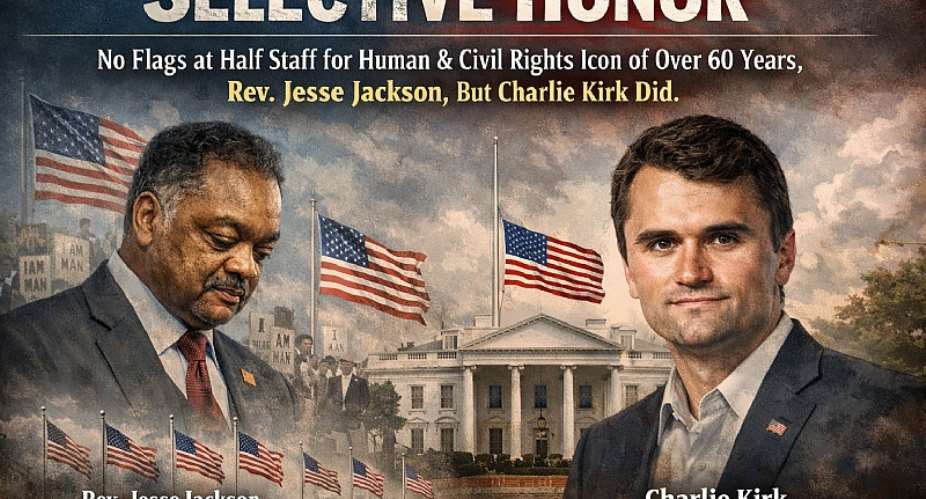
America, I have a problem here. A serious one. And it speaks not only to one president, but to a pattern—one shaped by politics, amplified by media, and sanctified by selective memory.
On September 10, 2025, right-wing activist Charlie Kirk was killed. He was not assassinated. Ten days later, the sitting President of the United States ordered American flags flown at half-staff at the White House, military installations, federal buildings, embassies, and public facilities across the nation. It was framed as a mark of respect for a “prominent political voice.”
Kirk was not an elected official. He was not a statesman. He was known largely for debating college students and promoting a brand of nationalist conservatism that frequently included rhetoric dismissive of Dr. Martin Luther King Jr. and critical of Black advancement. Yet the highest symbolic honor available through executive gesture was granted.
Fast forward to February 17, 2026. Reverend Jesse Jackson, a global ambassador of hope for over 60 years, passed away. A man who walked with Dr. King, a man who Kirk disrepected. A man who ran for president twice, expanding the American political imagination.
A man who negotiated hostage releases abroad, advocated for farmers, workers, immigrants, the poor, and the forgotten—across race, creed, and nation. Rev. Jackson helped to usher into the American lexicon of words/terms, African American in the 1980s. Jackson made it possible for Barack Obama to be president. Jesse gave us hope first, and Barack rebranded it.
To date, no national order to lower the flag. Can you see the difference, America? This is not merely about two men. It is about two mirrors reflecting two moral imaginations. One represents grievance politics sharpened in debate halls. The other represents six decades of bridge-building across the globe.
Scripture tells us in Matthew 7:16, “By their fruits you shall know them.” What are the fruits of a life? Are they viral clips and applause from partisan rallies? Or are they policies expanded, doors opened, prisoners freed, children inspired, and nations reconciled? Reverend Jackson’s ministry was never confined to civil rights alone. It was human rights. It was South Africa during apartheid. It was Haiti. It was Syria. It was farm workers in the Midwest. It was poor whites in Appalachia. It was Latinos, Native Americans, labor unions, and small Black businesses. It was always about expanding the circle.
Kirk’s influence lived primarily within partisan mobilization. Jackson’s influence crossed oceans. And yet, the flag bends for one and stands tall for the other. The American flag at half-staff is not just cloth lowered on a pole. It is a national confession. It signals: We recognize significance here. We mourn publicly. We pause collectively. But when honor is distributed unevenly, it exposes our hierarchy of memory.
Proverbs 31:8–9 commands us: “Speak up for those who cannot speak for themselves… defend the rights of the poor and needy.” Reverend Jackson spent over 60 years doing exactly that. Not for popularity. Not for applause. Often at great personal cost.
He endured criticism from the left and the right. He faced controversy and imperfection. But history will record that he stood in the gap when it mattered most. America must ask itself: What do we reward? What do we revere? What do we ritualize? When a political activist receives full ceremonial honors, yet a civil rights titan receives silence, it reveals not only presidential preference but cultural conditioning. The media, too, plays its role—amplifying one narrative while reducing another to obituary columns and archival footage. Let us be honest. Lowering the flag for Reverend Jesse Jackson would not be a partisan act. It would be an American act, a godly thing to do.
Micah 6:8 says, “What does the Lord require of you? To act justly, love mercy, and walk humbly with your God.” Justice is not selective. Mercy is not partisan. Humility is not ideological.
Reverend Jackson was not perfect. No ambassador of truth is. But he was consistent. He carried forward the moral vocabulary of the Civil Rights Movement into global human rights advocacy. He helped normalize Black presidential viability before it was fashionable. He preached hope when despair was profitable.
The question before us is not whether one agrees with every position he ever took. The question is whether a 60-plus-year commitment to human dignity deserves at least equal symbolic recognition as a partisan activist.
Mr. President, lower the flags.
Not because Reverend Jackson was Black. Not because he was Democratic. Not because he was a preacher. Lower them because he was an American ambassador of truth. Lower them because history watches how nations honor their moral architects. Lower them because when we fail to distinguish between transient political noise and sustained moral leadership, we distort our children’s understanding of greatness. America, this is bigger than one order. It is about what kind of nation we are becoming.
Are we a country that honors debate performance more than sacrificial service?
Are we a people who reward ideological alignment over lifelong advocacy for the marginalized? Are we measuring influence by applause or by impact? This is not bitterness. It is civic accountability. When the flags were lowered for Charlie Kirk, a message was sent. When they remain raised for Jesse Jackson, another message is sent.
History will interpret both. And so I ask plainly: Can you see the difference, America? The flag is a symbol. But symbols teach. And what we teach through public ritual becomes the moral curriculum of the next generation. Reverend Jesse Jackson carried hope like a torch through six decades of American turbulence. That deserves more than silence. Mr. President, do the right thing.
Lower the flag.
ABOUT THE AUTHOR:
Edmond W. Davis is an American social historian, international speaker, and Amazon #1 bestselling author. He is a global authority on the Tuskegee Airmen and serves as the founder of the National HBCU Black Wall Street Career Fest. A native of Philadelphia, PA, and current resident of Little Rock, AR, Davis is committed to cultural empowerment and educational equity through storytelling and civic engagement. Davis is a Grand Marshal at the 38th Annual African American History Month Celebration Parade.

 Trump says Russia, Ukraine agree to energy ceasefire – 'news for me', Zelensky s...
 Ethiopia intel chief visits flashpoint Tigray region
 Djibouti boat wreck leaves 139 migrants dead, 84 missing: UN
 Brazil's Lula accuses social media giant Meta of election interference amid tigh...
 Upper Dixcove: Dumsor is killing our business – Chief Fisherman
 South Africa protests: Ghanaians warned to limit travel in Johannesburg and Durb...
 UN cautions against forced tenant evictions without prior consultation
 UN advises Ghana to strengthen Rent Control Department with requisite logistics
 ECG announces three-day power outages in parts of Accra from Monday
 Ghana’s banking assets rise to GH¢500.2billion


