




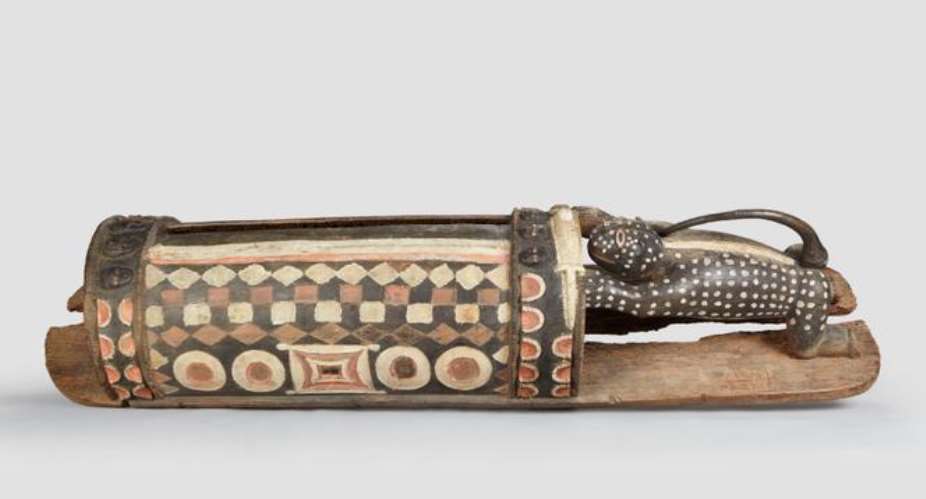
In a powerful act of cultural restitution and historical reckoning, France has officially returned the sacred talking drum known as Djidji Ayôkwé to Côte d’Ivoire after more than a century in European museums. The ceremony, held on 20 February 2026 in Paris, marked the end of 110 years of enforced separation from one of the most symbolic artifacts of Ivorian traditions.
The drum more than three meters (about 10 feet) long and weighing roughly 430 kilograms was originally taken by French colonial soldiers from the Ebrié people of what is now Abidjan in 1916. It functioned historically as a communication tool, used to transmit messages over long distances across villages and regions through coded rhythms an ancient form of sonic messaging and social coordination.
A Symbol Stolen, A Legacy Interrupted
For the communities of the Ebrié and other Ivorian ethnic groups, Djidji Ayôkwé was much more than a musical instrument. It was central to social cohesion, ritual life, and community memory its rhythms called people together for ceremonies, relayed news, and maintained connections across distant settlements. After its seizure during the colonial era, the drum remained in French national collections, predominantly at the Musée du Quai Branly–Jacques Chirac in Paris.
The loss of the drum resonated deeply in Ivoirians’ collective memory, representing both cultural erasure and the broader injustices of colonial plunder. It was among 148 artifacts formally requested for return by Côte d’Ivoire as far back as 2018.
Path to Repatriation: Politics, Persistence, and Law
The legal and diplomatic journey toward the drum’s return was long and complex. French law traditionally prevents the removal of objects from national collections a principle known as inaliénabilité. To overcome this, France’s National Assembly passed special legislation on 7 July 2025, unanimously authorizing the Djidji Ayôkwé’s restitution to Côte d’Ivoire. This vote came after years of negotiation and parliamentary debate, reflecting both shifting French attitudes towards colonial-era collections and increased pressure from African nations seeking cultural justice.
French President Emmanuel Macron had previously committed to returning the drum alongside other looted objects as part of a broader “new relationship” with African states.
The Ceremony and What It Means
The formal handover took place in Paris on 20 February 2026, attended by France’s Culture Minister Rachida Dati and Côte d’Ivoire’s Minister of Culture and Francophonie, Françoise Remarck. At the ceremony, Remarck spoke of the emotional significance of the drum’s return, noting that the object’s homecoming represented “a symbol finally coming back to its homeland.” Plans are underway for the drum to be displayed permanently in a new museum in Abidjan, offering Ivoirians and global visitors alike the opportunity to reconnect with a vital part of the country’s heritage.
Beyond its physical homecoming, the event underscores growing global calls for the restitution of African cultural heritage taken during colonial rule. France’s move is part of a gradual shift in European museum practices, as more former colonies seek the return of objects that represent centuries of history, identity, and artistic mastery.
A Resonance Beyond Sound
The return of Djidji Ayôkwé is not merely about repatriating an artifact. For many Ivoirians, it is a restoration of dignity, memory, and cultural continuity. As heritage specialists note, talking drums like this one were instruments of social communication long before modern technologies, and their rhythms once carried voices, warnings, celebrations, and ancestral messages across landscapes.
Now back in its rightful context, Djidji Ayôkwé will once again serve as a beacon of Ivorian cultural resilience a reminder that history can be reclaimed, and that the echoes of the past still have much to teach future generations.
Mustapha Bature Sallama.
Medical/ Science Communicator,
Private Investigator, Criminal investigation and Intelligence Analysis.
International Conflict Management and Peace Building.USIP
[email protected]
+233-555-275-880


 Macron promises tough punishments for rioters during nationwide day of action
 Trump endorses embattled Israeli PM Netanyahu ahead of October 27 election
 We are going to provide emergency airstrip in regions without airports — Mahama
 Nana Konadu maiden memorial mass set for October 23
 'Double standards are not helpful, wrong yesterday is wrong today' – Ablakwa on ...
 NPP has resolve internal wrangling — Bawumia
 Ghana, US Virgin Islands agree on recruitment of Ghanaian teachers, nurses
 “Soldiers Will Stay There”—Mahama Declares Permanent Military Presence in Forest...
 ‘No Borrowing Involved’ — Mahama Rolls Out US$10bn New Economy Policy
 “Ask Jean Mensa to resign first”—Tanko-Computer fires back


