




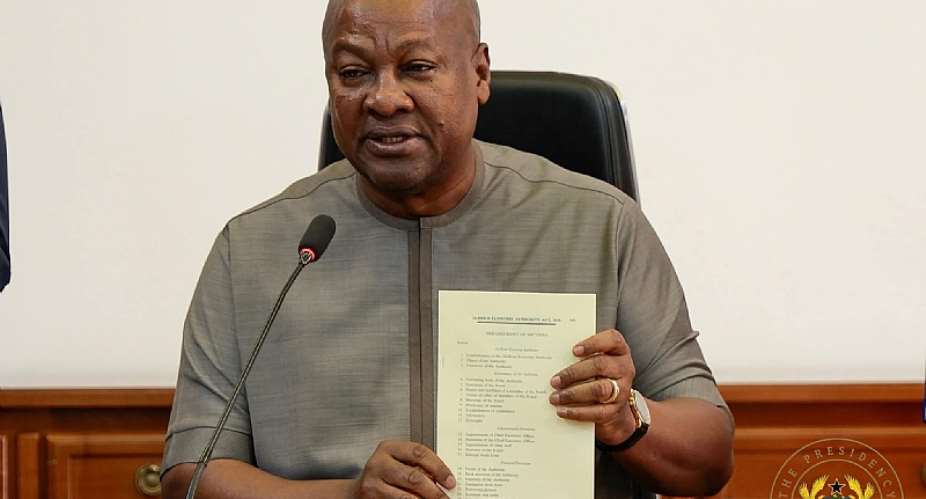
President Mahama has assented to the 24-Hour Economy Authority Bill, 2025, formally establishing a legal framework for continuous economic activity in Ghana. The law creates the 24-Hour Economy Authority, a statutory body responsible for coordinating policies, incentives, and regulations that enable businesses and public institutions to operate around the clock. This initiative is part of the government’s broader agenda to boost productivity, create employment, attract investment, and strengthen Ghana’s position in global trade.
By extending economic activity beyond traditional working hours, industries, services, and infrastructure can be used more efficiently. Manufacturing plants can operate night shifts to increase production, while ports at Tema and Takoradi can process more cargo, reduce congestion, and accelerate exports. Service sectors such as banking, ICT, and retail may serve clients for longer hours, and agricultural processing facilities can operate continuously, adding value to raw products and making them export-ready. The Authority is tasked with coordinating incentives, supporting public-private partnerships, and ensuring smooth implementation across sectors.
The potential impact on employment is significant, with shift-based work offering new opportunities, particularly for youth and graduates. Continuous operations make better use of existing infrastructure, increasing output and contributing to overall economic growth. Faster trade and export processing improve competitiveness, and the clarity provided by the law can encourage both domestic and foreign investment. More processing and value addition within the country means that wealth stays in Ghana rather than being exported as raw materials.
Challenges remain, including higher operational costs for electricity, wages, security, and maintenance. High industrial electricity tariffs and limited off-peak pricing could discourage night-time operations, while the net effect on job creation may not meet expectations without complementary policies. Strong coordination between the central government, local authorities, and the private sector will be critical, and the creation of the Authority adds fiscal demands at a time when government resources are already stretched.
For citizens, a 24-hour economy could provide longer access to goods and services, while businesses gain opportunities to increase revenue and expand operations. Success depends on reliable infrastructure, consistent government support, and effective oversight. If these conditions are met, Ghana could become a hub of continuous industrial and service activity in West Africa, boosting productivity, trade, investment, and employment. The assent of the bill lays the foundation for a more dynamic, competitive economy and a new era of round-the-clock economic activity.
By Charles Cardinal Quao -Pokuase.

 Mahama Begins Four‑Day State Visit to Belarus to Deepen Ghana–Belarus Cooperatio...
 Adubinsu Tanker Explosion: Fire Service Slams Residents for Attacking Firefighte...
 80 Suspects Grabbed as Police Storm Upper East in Massive Anti‑Crime Sweep
 Abuakwa South MP Pushes for National Disaster Fund to Support Flood Victims
 “Don’t Be Fooled!” — Foh-Amoaning Tells African MPs LGBTQ+ Rights Not Backed by ...
 BoG Mops Up GHS 11.28bn in Fresh Liquidity Sweep as 14‑Day Bill Auction Records ...
 Foreign Digital Content Eroding African Values — Sam George Warns Parents
 Anthropic calls for global AI slowdown, says systems may outpace human control
 Bono Region: Police investigate murder of retired veterinary officer
 VIDEO: Fuel tanker driver burnt to death in fiery crash at Adubinso, seven shops...


