




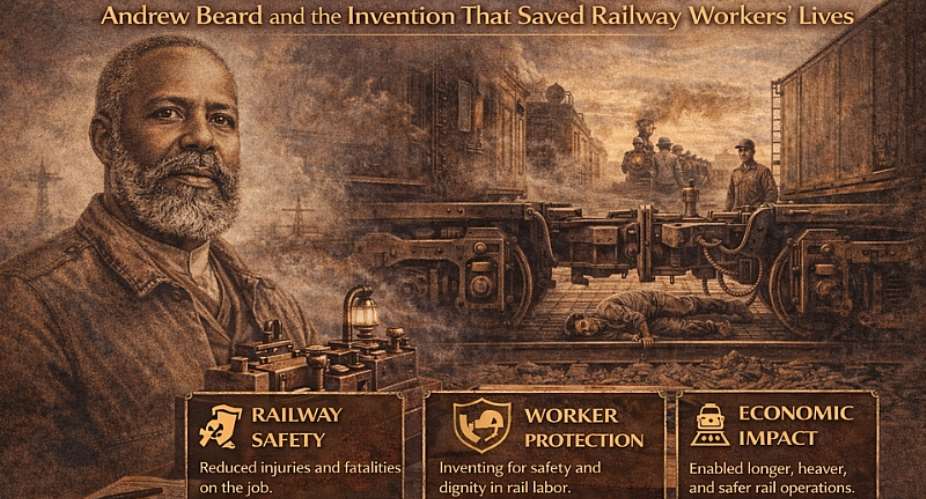
Railway history is often told through grand infrastructure projects, miles of track laid, locomotives built, and empires connected. But some of the most important railway innovations were not about speed or expansion. They were about survival. Andrew Beard, a formerly enslaved Black inventor, changed railways forever with a device that most passengers never see, the automatic railway coupler. His invention did not make headlines. It made railroads safer.
In the early days of rail transport, coupling railcars was one of the most dangerous jobs in America. Workers had to stand between moving railcars and manually link them together using a pin-and-link system. Timing had to be perfect. A single miscalculation meant crushed limbs or death. Thousands of railway workers were injured or killed in coupling accidents each year.
Beard understood this reality not as an outsider, but as someone who had worked around rail systems and heavy machinery. In 1897, he patented an automatic coupler that allowed railcars to connect upon impact without a worker standing between them. The system used a locking mechanism that engaged automatically when cars came together.
It was a deceptively simple idea. But its consequences were revolutionary.
Railway coupling injuries declined dramatically after the widespread adoption of automatic couplers. The U.S. Safety Appliance Act of 1893 had already mandated safer equipment on railroads, but inventors like Beard made compliance practical. His device aligned engineering with human dignity, technology serving labor, not sacrificing it.
Beard eventually sold the rights to his invention for a significant sum, a rare financial success story for a Black inventor in the 19th century. Yet, like many others, his name seldom appears in mainstream railway histories. The coupler became standard equipment. The inventor became a footnote.
Why does this matter today?
Because Beard’s story reframes how we think about railway modernization. Safety is not secondary to expansion. It is foundational. A railway network that grows without protecting its workers is not advanced it is fragile.
For countries seeking to rebuild or expand rail systems, including across Africa, Beard’s legacy offers a critical lesson, innovation must prioritize human protection alongside operational efficiency. Infrastructure policy must ask not only how fast trains can move, but how safely systems operate for those who build and maintain them.
His story also challenges a deeper narrative. Black contributions to industrial engineering were not peripheral. They were central to making railways viable at scale. Automatic coupling enabled longer trains, heavier freight, and more efficient operations. In other words, Beard’s invention was not merely a safety upgrade, it was an economic enabler.
The broader lesson is about recognition and confidence. When we understand that Black inventors solved some of the most pressing technical problems of industrialization, it shifts how we think about technological capacity today. It dismantles the myth that innovation belongs to a particular geography or race.
Andrew Beard did not build locomotives. He built the mechanism that allowed them to function safely at scale. And in doing so, he saved lives quietly, permanently, and decisively.
Sometimes the most transformative railway innovations are not those that make trains faster, but those that ensure workers return home safely.
Author: Joseph Fuseini ([email protected])


 Miracles Aboagye arrest: 'You looted and your reaction is that the tables will t...
 Police arrest two with 73 parcels of suspected cannabis, reject GH¢300,000 bribe
 NACOC traces 73 assets linked to suspected drug traffickers
 Government seeks financial clearance to recruit 400 scientists – Armah Kofi-Buah
 Ya‑Naa Abubakari II laid to rest at Gbewaa Palace
 NPP will reinstate workers unlawfully sacked by NDC government - Chairman COKA
 'Neglecting grassroots dangerous' – GFL warns NDC, NPP
 'No money, no vote' — Bongo NPP delegates tell contestants in constituency execu...
 NAM1 files witness statements in Menzgold trial, seeks to rely on seven defence ...
 Miracles Aboagye’s wife raises health concerns over husband's detention by EOCO

