




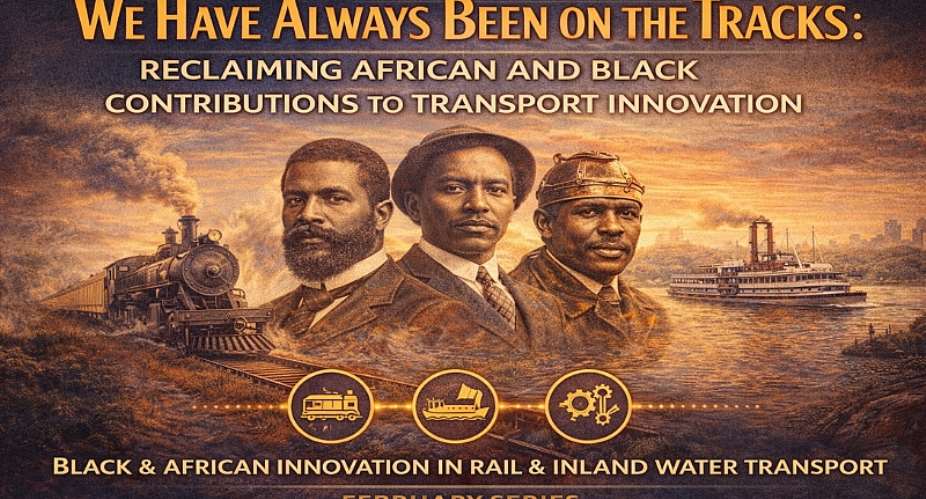
When the history of railways, shipping, and inland water transport is told, it often follows a familiar script. European engineers, American industrialists, and large corporations dominate the narrative, while Black and African contributors appear, at best, as footnotes. This absence has shaped how innovation is understood, and who is seen as capable of producing it. Yet the truth is not that Black and African inventors were absent from transport innovation, but that their contributions were systematically overlooked, undervalued, or erased.
One reason for this omission lies in how history itself was recorded. Transport technologies emerged during periods of slavery, colonialism, and racial segregation, systems that denied Black people access to recognition, capital, and authorship. Innovations created by Black inventors were often patented under restrictive conditions, ignored by mainstream institutions, or absorbed into industrial systems without proper attribution. In many cases, inventions were adopted because they worked, not because their creators were celebrated.
Rail transport offers a clear example. Black inventors developed critical technologies that improved safety, efficiency, and reliability, yet their names rarely appear in textbooks. Innovations in lubrication systems, signaling, braking, and couplers became industry standards, while the inventors themselves were sidelined by racial barriers that limited visibility and professional advancement. The technology moved forward; the credit did not.
Inland water transport and maritime systems tell a similar story. African societies had long mastered river navigation, boat building, and water-based trade networks before colonial contact. These systems were efficient, adapted to local environments, and deeply technical. However, colonial narratives dismissed indigenous engineering knowledge as primitive, replacing it with imported models while quietly relying on local expertise to make them function. Over time, the original knowledge was excluded from formal histories and engineering curricula.
Another factor is access to institutions. Innovation is not only about ideas; it is about who gets to document, publish, teach, and archive them. Black and African inventors were often excluded from universities, professional associations, and technical journals, the very spaces where “official” history is written. Without institutional backing, many contributions remained informal, uncredited, or lost altogether.
There is also a modern dimension to this erasure. Contemporary transport discussions in Africa frequently frame innovation as something to be imported rather than inherited. This mindset unintentionally reinforces the idea that Africans are new entrants to technological progress, rather than long-standing contributors. When history is not taught, confidence erodes, and policy choices follow.
Reclaiming these stories is not about rewriting history to flatter ourselves. It is about completing it. Recognizing Black and African inventors restores balance to the narrative and challenges the assumption that technological leadership belongs elsewhere. It also matters for the present. A society that understands its own innovative past is better positioned to invest in engineering, research, and long-term transport systems with confidence.
The absence of Black and African inventors from mainstream transport history is not accidental. It is the result of power, access, and selective memory. Correcting it is not merely an academic exercise, it is a necessary step toward building transport systems that reflect both our history and our potential.
Author: Joseph Fuseini ([email protected])


 'Stop excessive financial demands before sharing information with us' — Interior...
 EC will serve national interest, not partisan politics – Deputy Chair Dr Kwaku A...
 I expect no preferential treatment from EC for myself as President, my party or ...
 Afenyo-Markin meets management, proposes reforms to turnaround struggling ECG
 ECG management commends Afenyo-Markin for reforms during short stay as Board Cha...
 Mahama tasks new EC deputy chairpersons to uphold impartiality
 Attorney-General urges court to reject Adu-Boahene’s no-case submission
 Nyaho Medical Centre ordered to report to CID over expired data protection certi...
 Mahama swears in new Electoral Commission deputy commissioners
 PTAAM-Africa calls for government probe into alleged World Cup visa fraud



Comments
Great piece Joseph!! My son will read this article. God bless you.