




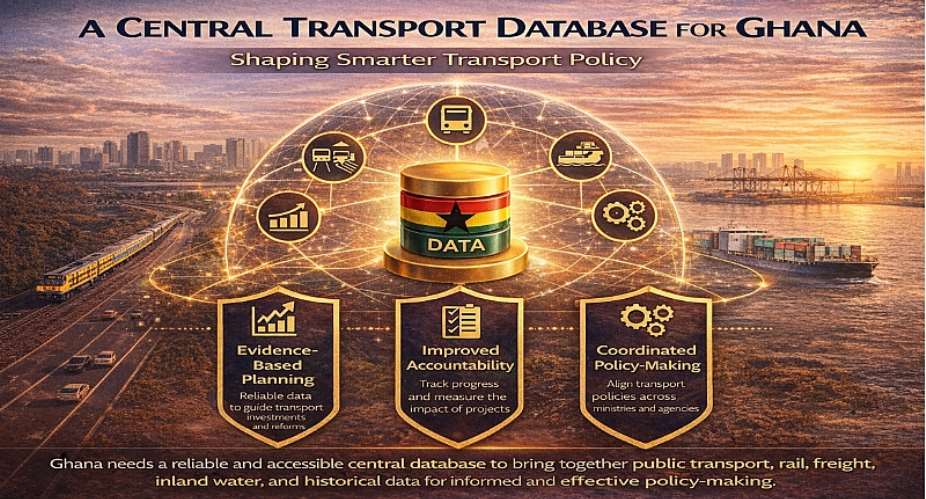
For many years, Ghana’s transport challenges have been discussed in terms of roads, buses, railways, and ports. Yet beneath these visible systems lies a less visible but equally critical issue: the absence of a central, reliable transport database to guide policy and investment decisions. Without this foundation, even well intended reforms struggle to deliver lasting results.
Transport policy works best when it is informed by clear evidence. Governments need to know how many passengers move daily, which corridors carry the highest demand, how assets are performing, and where bottlenecks are emerging. In Ghana, such information exists only in fragments. Different agencies collect data for their own purposes, using varying standards and timeframes. As a result, national-level planning often relies on estimates, outdated figures, or project-specific studies rather than a comprehensive picture of the system.
This gap affects every mode of transport. In urban public transport, the lack of reliable ridership and fleet-availability data makes it difficult to plan services or evaluate the true impact of new bus procurements. In rail transport, incomplete information on freight volumes, passenger demand, and asset condition weakens the case for sustained operations and long-term investment. Inland water transport, despite its potential, remains under-documented, limiting its integration into national logistics and mobility strategies.
A central transport database would help address these challenges by bringing together key information across all modes into a single, standardized system. Such a database would not need to be overly complex at the outset. A core set of indicators, passenger volumes, freight flows, network coverage, asset condition, and operational performance, updated regularly and consistently, would already represent a major improvement over the current situation.
Beyond planning, a central database would strengthen accountability. When data is transparent and accessible, it becomes easier to track whether projects are delivering their intended outcomes. Policymakers can assess what works, what does not, and why. This, in turn, supports better use of public resources and reduces the risk of repeating costly mistakes.
There is also an institutional benefit. Treating transport data as a shared national asset encourages coordination among ministries, agencies, and operators. Instead of working in silos, stakeholders can align their efforts around a common evidence base. Over time, this improves coherence between policy objectives, budget allocations, and implementation on the ground.
Importantly, Ghana does not need to start from scratch. International experience shows that successful transport systems are built incrementally, with data systems evolving alongside infrastructure and operations. By learning from these examples and adapting them to local realities, Ghana can build a transport intelligence framework that grows stronger over time.
Ultimately, a central transport database is not an end in itself. It is a means to better decisions, more resilient systems, and policies that respond to real needs rather than assumptions. As Ghana looks to modernize its transport sector, investing in data may be one of the most practical and impactful steps it can take.
Author: Joseph Fuseini ([email protected])


 Miracles Aboagye arrest: 'You looted and your reaction is that the tables will t...
 Police arrest two with 73 parcels of suspected cannabis, reject GH¢300,000 bribe
 NACOC traces 73 assets linked to suspected drug traffickers
 Government seeks financial clearance to recruit 400 scientists – Armah Kofi-Buah
 Ya‑Naa Abubakari II laid to rest at Gbewaa Palace
 NPP will reinstate workers unlawfully sacked by NDC government - Chairman COKA
 'Neglecting grassroots dangerous' – GFL warns NDC, NPP
 'No money, no vote' — Bongo NPP delegates tell contestants in constituency execu...
 NAM1 files witness statements in Menzgold trial, seeks to rely on seven defence ...
 Miracles Aboagye’s wife raises health concerns over husband's detention by EOCO

