




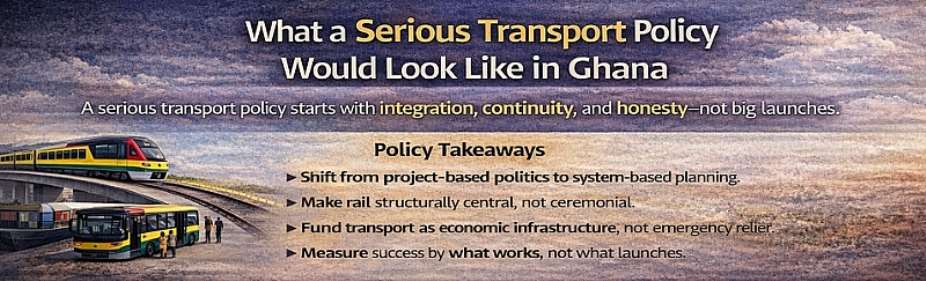
The evidence of Ghana’s transport policies should not be found in press releases, sod-cutting ceremonies, or procurement announcements. It must be visible in how projects connect, how institutions endure, and how policies survive political change.
First, transport must be planned as a single system. Roads, buses, rail, ports, and logistics hubs cannot be developed independently. Urban growth, housing density, and employment corridors must guide transport investment. Without this integration, infrastructure fights itself.
Second, rail must be structurally central, not rhetorically important. Accra cannot be moved by road-based systems alone. Rail should handle high-volume commuter corridors and freight evacuation, freeing roads for local movement. This is not ideology, it is physics.
Third, seriousness demands institutional stability. Transport agencies must operate beyond electoral cycles, with protected funding, technical leadership, and clear performance benchmarks. Projects should not restart because governments change. They should progress because national needs persist.
Fourth, funding must be predictable and long-term. Transport policy cannot depend on grants, emergency loans, or political goodwill. Sustainable financing, land value capture, user fees, and structured private participation, must be embedded into policy design.
Finally, seriousness requires truthful leadership. Not every project can be completed in four years. Not every problem has a quick fix. But citizens can endure long timelines if they see consistency, transparency, and progress.
Ghana does not need another transport vision. It needs the discipline to execute the visions it already has.
Policy Takeaways For Decision-Makers
- Shift from project-based politics to system-based planning
- Make rail the backbone of urban and freight transport
- Protect transport institutions from political resets
- Fund transport as economic infrastructure, not emergency relief
- Measure success by what works, not what launches.
Author: Joseph Fuseini ([email protected])


 Miracles Aboagye arrest: 'You looted and your reaction is that the tables will t...
 Police arrest two with 73 parcels of suspected cannabis, reject GH¢300,000 bribe
 NACOC traces 73 assets linked to suspected drug traffickers
 Government seeks financial clearance to recruit 400 scientists – Armah Kofi-Buah
 Ya‑Naa Abubakari II laid to rest at Gbewaa Palace
 NPP will reinstate workers unlawfully sacked by NDC government - Chairman COKA
 'Neglecting grassroots dangerous' – GFL warns NDC, NPP
 'No money, no vote' — Bongo NPP delegates tell contestants in constituency execu...
 NAM1 files witness statements in Menzgold trial, seeks to rely on seven defence ...
 Miracles Aboagye’s wife raises health concerns over husband's detention by EOCO

