




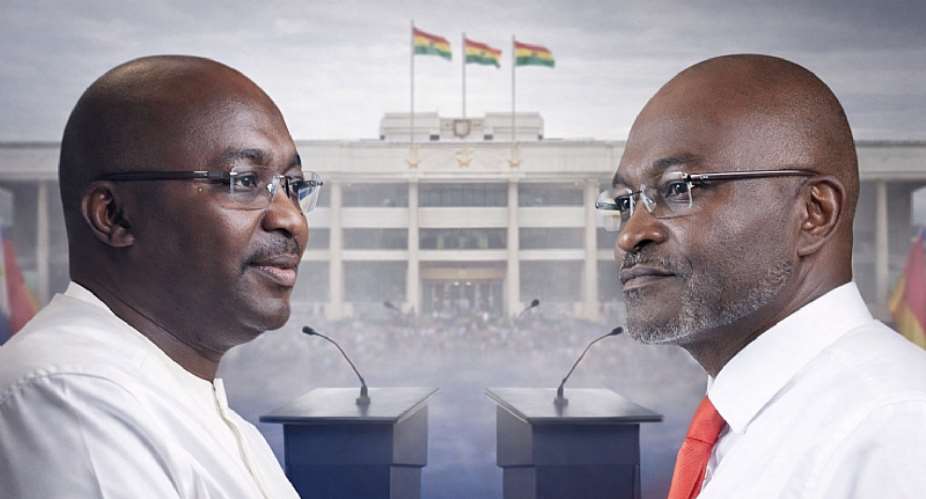
As the New Patriotic Party (NPP) marches toward its 31 January 2026 flagbearership election, the contest has hardened into a decisive two-horse race between Dr. Mahamudu Bawumia and Kennedy Agyapong. This is no routine internal exercise, it is the opening act in the party’s bid to reclaim political power from the NDC in 2028, following a bruising period of economic strain, institutional controversy, and deep moral fatigue that defined the NPP’s final years in government. What confronts delegates is not simply a choice of personalities, but a collision of governing philosophies and political temperaments-technocratic restraint versus populist reinvention. Both men present themselves as vessels of renewal, yet beneath their rhetoric lie unresolved contradictions that demand unflinching scrutiny. This duel, therefore, is not only about who leads the NPP, but about whether the party can credibly reintroduce itself to a sceptical nation.
Dr. Bawumia: The Virtue of Silence—or the Failure to Intervene?
Dr. Bawumia arrives as the NPP’s most polished technocrat, a man whose calm demeanour and macroeconomic vocabulary have long reassured markets and party elites alike. Admirers cast him as a disciplined statesman, one who “does not wash dirty linen in public.” Yet this very attribute, praised as maturity, now raises a deeper concern. When the economy faltered and institutions buckled, what exactly did silence achieve?
During the years when inflation surged, the cedi depreciated sharply, and households absorbed the shock of unpopular fiscal instruments such as the E‑Levy, COVID‑19 bond structures, and betting taxes—Bawumia, as Head of the Economic Management Team, seldom emerged as a public corrective force within government. The defence is that unity required discretion. The counter‑argument is more unsettling. Leadership is tested not by composure in calm seasons, but by intervention in moments of drift. Silence, when the fundamentals are weak, is not neutrality, it is abdication.
The irony is historical. Bawumia once popularised the aphorism that “if the fundamentals are weak, the exchange rate will expose you.” That line became prophetic during the later years of NDC stewardship and then returned to indict the NPP when the cedi buckled under its own contradictions. Today, after a period of relative exchange‑rate stability and the scrapping or reduction of several unpopular levies under the current NDC government, the economy has steadied. But this raises a central campaign dilemma for Bawumia, is he the architect of recovery, or merely its quiet custodian?
Read through a literary lens, this posture of Dr Bawumia recalls the tragic archetype explored in ‘’Freedom in Chains’’ by Dr Daniel Appiagyei —the enlightened insider who understands the language of freedom and recognises decay within the system, yet remains bound by loyalty, discipline, and procedural restraint. In the play, Appiagyei indicts not only the loud tyrant, but the educated custodian who knows the chains exist and still believes patience and decorum will redeem a collapsing order. This disposition also mirrors a deeper institutional temperament within the NPP tradition itself, one historically rooted in the UGCC’s preference for constitutionalism, elite negotiation, and procedural caution over rupture. It is this moral hesitation, this preference for silence over rupture that turns knowledge into complicity. Seen this way, Bawumia’s celebrated restraint risks resembling the very flaw the play warns against that when institutions are failing, discipline without courage does not preserve stability, it merely postpones reckoning, until public anger arrives not as dialogue, but as judgment.
Kennedy Agyapong: The Firebrand in Rebrand
If Bawumia is restraint personified, Kennedy Agyapong is combustion re-engineered. A maverick businessman-turned-politician. He has fashioned himself as an anti-establishment insider, one who claims persecution by his own party hierarchy through denied contracts, economic strangulation, and internal sabotage. His political capital was forged in confrontation with judges, journalists, outspoken women celebrities, and rivals felt the heat of his rhetoric.
Yet this campaign presents a quieter Kennedy, measured, apologetic, and intent on legacy to enter the ‘’Great Interest Church’’. His public apology to Mahama, once his favourite target, was emblematic, humility on the surface, strategic recalibration beneath. Supporters read maturity, critics see camouflage.
Agyapong now champions agriculture and agribusiness as engines of development and job creation, despite earlier dismissals of agriculture as a serious pathway to national transformation. He speaks of cassava, coconut oil, chipboards of “the basics.” But Ghana has never ignored the basics. Every Fourth Republic government has tried some version of agrarian or industrial re-founding. The lesson of initiatives such as the Ayensu Starch Factory is sobering. When Ghana began exporting cassava‑derived starch, external tariff barriers collapsed the market and the project failed. The unresolved question, therefore, is strategic depth. When the basics falter under global pressure, what next? On that horizon, Agyapong’s policy architecture remains conspicuously thin.
Here, the Akan proverb applies with force, when the drumbeat changes, the dancer must also change his steps. Adaptation is not the problem, credibility is.
For many observers, Agyapong resembles Kenta in ‘’The Tears of Lucifer’’ by Dr Daniel Appiagyei—the figure whose visible horns are sheared and whose voice softens, yet whose character remains concealed beneath the performance of reform. In the play, Appiagyei warns that transformation without accountability is merely adaptation, not redemption. This palpable duality makes him an unpredictable contender in a race where stability and vision must be clearly signalled. His “PhD” of governance—Patriotism, Honesty, Discipline resonates emotionally and may even position him for the long game beyond 2026. But emotional resonance is not a substitute for institutional discipline.
Economics, Messaging, and the Test of Courage
With the exchange rate stabilised and prices easing after a difficult period, the electorate is understandably impatient with slogans and increasingly hungry for substance. Dr. Bawumia’s internal party messaging appears largely targeted at constituency delegates, emphasising job equity, continuity, and managerial competence. His case is built around consolidation rather than rupture, preserving macroeconomic stability, deepening digitisation, restoring investor confidence, and projecting himself as the safest pair of hands after turbulence.
Kennedy Agyapong’s message, by contrast, is outward-facing and national in tone, pitched less to party delegates alone and more to a frustrated public. His campaign language centres on disruption rather than consolidation— breaking elite capture, unleashing enterprise, fixing unemployment, and returning the economy to what he calls productive basics. In that sense, Bawumia’s message is best understood as a subset of Agyapong’s broader populist narrative, competence within the system versus confrontation with the system.
Yet Ghana’s moment demands more than either frame offers on its own. What the country requires is courage with clarity, the willingness to confront corruption even when it implicates allies, to reform institutions even when it costs political capital, and to speak precisely when silence is most convenient. Without this moral backbone, continuity becomes complacency and disruption degenerates into performance.
The National Cathedral and the SML Scandal: The Moral Test of Electability
Beyond personalities and campaign choreography lies a more damning vacuum, the absence of a credible anti-corruption doctrine in this contest. On the National Cathedral, a project that drifted from sacred ambition into a symbol of opacity, and on the SML scandal, now widely cited as emblematic of elite impunity, neither Bawumia nor Agyapong has drawn a clear moral line. For the NPP, this episode serves as both a cautionary tale and a campaign subtext. It reminds Ghanaians that leadership cannot be divorced from competent execution and ethical stewardship of public resources. Delegates evaluating flagbearer candidates are by extension choosing a guardian of national credibility and fiscal discipline, not merely catchy slogans.
Manasseh Azure alongside policy analyst, Bright Simons, have repeatedly framed the SML contract as a case study in captured governance. The KPMG audit dismantled claims of massive revenue savings, exposing inflated figures, duplication, and the absence of value-for-money analysis or regulatory input.
This is not an NPP embarrassment or an NDC vendetta. It is a republic’s reckoning with truth. If this disgrace is not talked about in intra party politics and left unpunished, such conduct normalises corruption under the veil of technocratic reform. And yet, from the two leading aspirants to lead the party, and potentially the nation, there is no ringing commitment to confront this rot. Silence here is not neutrality, it is complicity.
The Delegate’s Dilemma
The choice before the NPP is not merely electoral, it is moral and institutional.
- Bawumia represents quiet competence—but must prove that silence was strategy, not abdication.
- Agyapong represents disruptive energy—but must prove that transformation is conviction, not camouflage.
Until either candidate confronts corruption decisively, the party risks mistaking theatre for leadership.
By: Kennedy Opoku
By: Kennedy Opoku


 Israel votes in first election since October 7 attack as Netanyahu faces crucial...
 US-EU trade truce at risk over $3.4 billion Airbus loan, Trump official warns
 Flavio Bolsonaro vows to lead opposition after Brazil court imposes travel ban
 Mecca pact nations hold talks with Iran to prevent renewed Middle East war
 New DStv sports package will save subscribers over Ghc500 monthly – Sam George
 Your past prescriptions never helped developing countries - TOR MD tells IMF
 Crude Distillation Unit turnaround was funded from TOR's internally generated fu...
 Trump offers $1 million for tipoffs leading to vote fraud conviction as midterms...
 UN cites 'ethnic cleansing' concerns around Israel's Palestinian displacement op...
 'Irresponsible media coverage is hurting Obuasi SHTS abuse probe' – Gender Minis...


